This article is an abbreviated version of the original, published in 2005 on the website of the Wellington Place Neighbourhood Association.
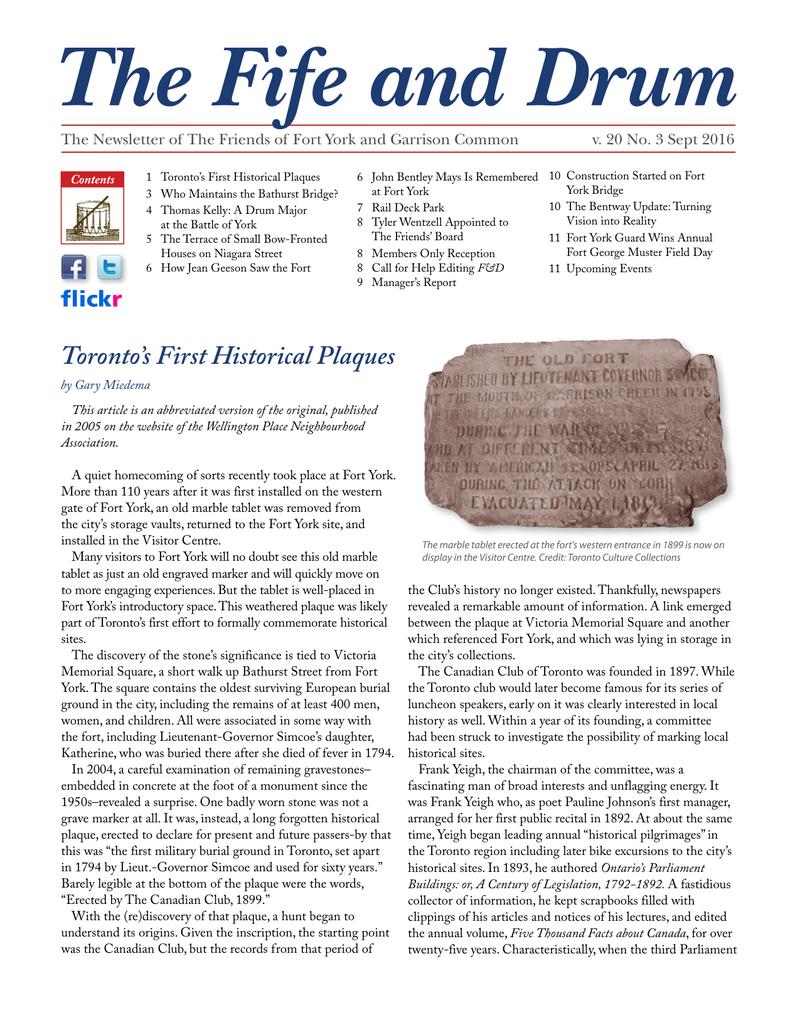
A quiet homecoming of sorts recently took place at Fort York. More than 110 years after it was first installed on the western gate of Fort York, an old marble tablet was removed from the city’s storage vaults, returned to the Fort York site, and installed in the Visitor Centre.
Many visitors to Fort York will no doubt see this old marble tablet as just an old engraved marker and will quickly move on to more engaging experiences. But the tablet is well-placed in Fort York’s introductory space. This weathered plaque was likely part of Toronto’s first effort to formally commemorate historical sites.

The discovery of the stone’s significance is tied to Victoria Memorial Square, a short walk up Bathurst Street from Fort York. The square contains the oldest surviving European burial ground in the city, including the remains of at least 400 men, women, and children. All were associated in some way with the fort, including Lieutenant-Governor Simcoe’s daughter, Katherine, who was buried there after she died of fever in 1794.
In 2004, a careful examination of remaining gravestones—embedded in concrete at the foot of a monument since the 1950s—revealed a surprise. One badly worn stone was not a grave marker at all. It was, instead, a long forgotten historical plaque, erected to declare for present and future passers-by that this was “the first military burial ground in Toronto, set apart in 1794 by Lieut.-Governor Simcoe and used for sixty years.” Barely legible at the bottom of the plaque were the words, “Erected by The Canadian Club, 1899.”
With the (re)discovery of that plaque, a hunt began to understand its origins. Given the inscription, the starting point was the Canadian Club, but the records from that period of the Club’s history no longer existed. Thankfully, newspapers revealed a remarkable amount of information. A link emerged between the plaque at Victoria Memorial Square and another which referenced Fort York, and which was lying in storage in the city’s collections.
The Canadian Club of Toronto was founded in 1897. While the Toronto club would later become famous for its series of luncheon speakers, early on it was clearly interested in local history as well. Within a year of its founding, a committee had been struck to investigate the possibility of marking local historical sites.
Frank Yeigh, the chairman of the committee, was a fascinating man of broad interests and unflagging energy. It was Frank Yeigh who, as poet Pauline Johnson’s first manager, arranged for her first public recital in 1892. At about the same time, Yeigh began leading annual “historical pilgrimages” in the Toronto region including later bike excursions to the city’s historical sites. In 1893, he authored Ontario’s Parliament Buildings: or, A Century of Legislation, 1792-1892. A fastidious collector of information, he kept scrapbooks filled with clippings of his articles and notices of his lectures, and edited the annual volume, Five Thousand Facts about Canada, for over twenty-five years. Characteristically, when the third Parliament buildings on Front Street were slated for demolition, Yeigh arranged a last tour of the site. The tour ended in the legislative chambers where Yeigh himself recounted the illustrious history of the people and events who had marked that place.


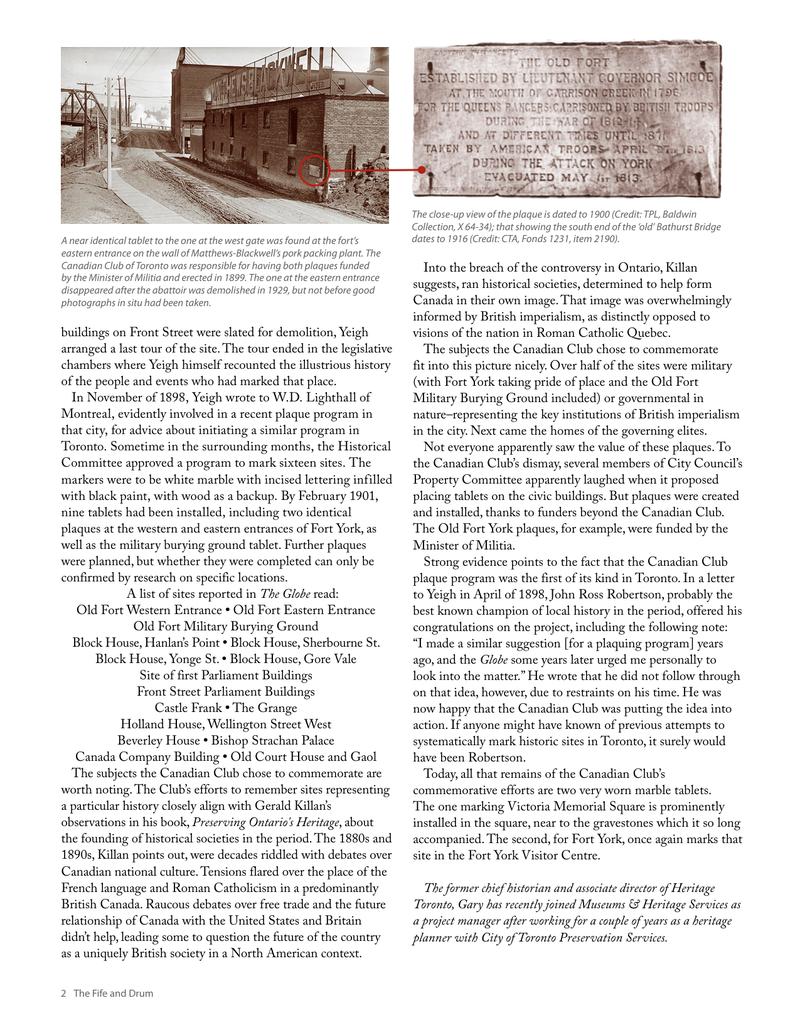
In November of 1898, Yeigh wrote to W.D. Lighthall of Montreal, evidently involved in a recent plaque program in that city, for advice about initiating a similar program in Toronto. Sometime in the surrounding months, the Historical Committee approved a program to mark sixteen sites. The markers were to be white marble with incised lettering infilled with black paint, with wood as a backup. By February 1901, nine tablets had been installed, including two identical plaques at the western and eastern entrances of Fort York, as well as the military burying ground tablet. Further plaques were planned, but whether they were completed can only be confirmed by research on specific locations.
A list of sites reported in The Globe read:
Old Fort Western Entrance • Old Fort Eastern Entrance
Old Fort Military Burying Ground
Block House, Hanlan’s Point • Block House, Sherbourne St.
Block House, Yonge St. • Block House, Gore Vale
Site of first Parliament Buildings
Front Street Parliament Buildings
Castle Frank • The Grange
Holland House, Wellington Street West
Beverley House • Bishop Strachan Palace
Canada Company Building • Old Court House and Gaol
The subjects the Canadian Club chose to commemorate are worth noting. The Club’s efforts to remember sites representing a particular history closely align with Gerald Killan’s observations in his book, Preserving Ontario’s Heritage, about the founding of historical societies in the period. The 1880s and 1890s, Killan points out, were decades riddled with debates over Canadian national culture. Tensions flared over the place of the French language and Roman Catholicism in a predominantly British Canada. Raucous debates over free trade and the future relationship of Canada with the United States and Britain didn’t help, leading some to question the future of the country as a uniquely British society in a North American context.
Into the breach of the controversy in Ontario, Killan suggests, ran historical societies, determined to help form Canada in their own image. That image was overwhelmingly informed by British imperialism, as distinctly opposed to visions of the nation in Roman Catholic Quebec.
The subjects the Canadian Club chose to commemorate fit into this picture nicely. Over half of the sites were military (with Fort York taking pride of place and the Old Fort Military Burying Ground included) or governmental in nature—representing the key institutions of British imperialism in the city. Next came the homes of the governing elites.
Not everyone apparently saw the value of these plaques. To the Canadian Club’s dismay, several members of City Council’s Property Committee apparently laughed when it proposed placing tablets on the civic buildings. But plaques were created and installed, thanks to funders beyond the Canadian Club. The Old Fort York plaques, for example, were funded by the Minister of Militia.
Strong evidence points to the fact that the Canadian Club plaque program was the first of its kind in Toronto. In a letter to Yeigh in April of 1898, John Ross Robertson, probably the best known champion of local history in the period, offered his congratulations on the project, including the following note: “I made a similar suggestion [for a plaquing program] years ago, and the Globe some years later urged me personally to look into the matter.” He wrote that he did not follow through on that idea, however, due to restraints on his time. He was now happy that the Canadian Club was putting the idea into action. If anyone might have known of previous attempts to systematically mark historic sites in Toronto, it surely would have been Robertson.
Today, all that remains of the Canadian Club’s commemorative efforts are two very worn marble tablets. The one marking Victoria Memorial Square is prominently installed in the square, near to the gravestones which it so long accompanied. The second, for Fort York, once again marks that site in the Fort York Visitor Centre.
Original printed pages