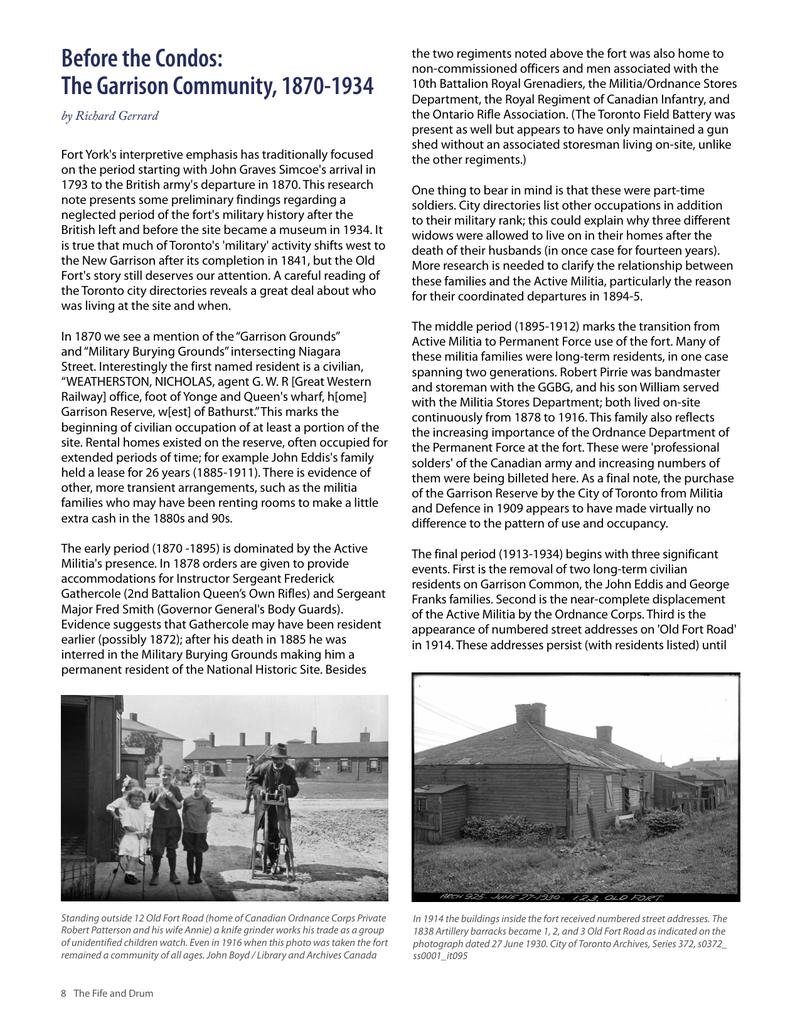
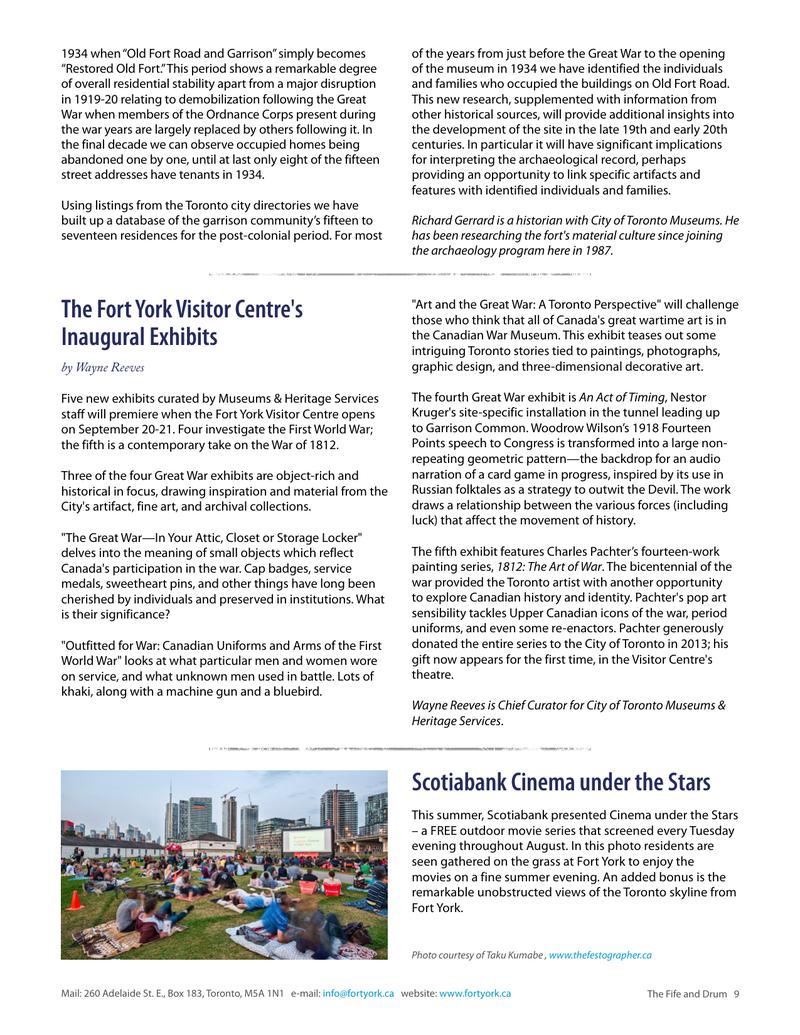
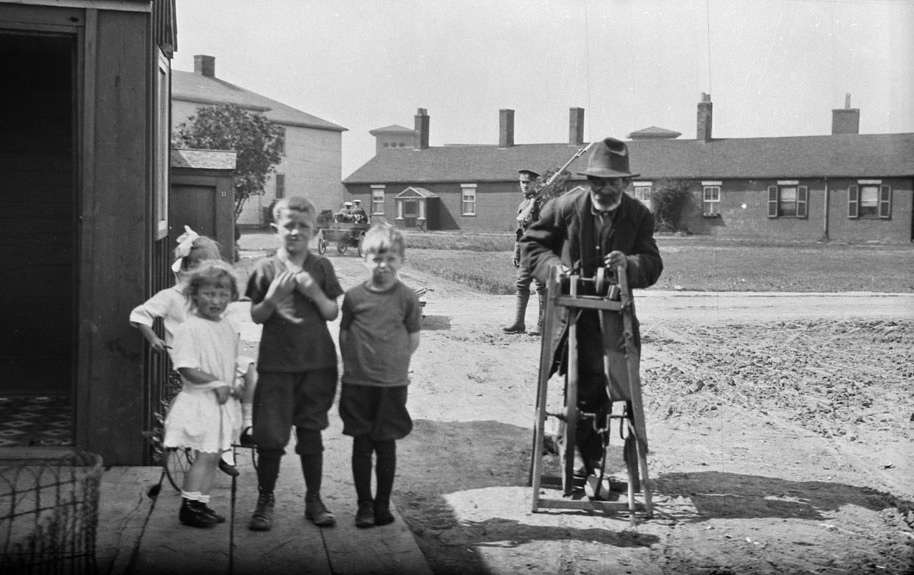
Fort York’s interpretive emphasis has traditionally focused on the period starting with John Graves Simcoe’s arrival in 1793 to the British army’s departure in 1870. This research note presents some preliminary findings regarding a neglected period of the fort’s military history after the British left and before the site became a museum in 1934. It is true that much of Toronto’s ‘military’ activity shifts west to the New Garrison after its completion in 1841, but the Old Fort’s story still deserves our attention. A careful reading of the Toronto city directories reveals a great deal about who was living at the site and when.
In 1870 we see a mention of the “Garrison Grounds” and “Military Burying Grounds” intersecting Niagara Street. Interestingly the first named resident is a civilian, “WEATHERSTON, NICHOLAS, agent G. W. R [Great Western Railway] office, foot of Yonge and Queen’s wharf, h[ome] Garrison Reserve, w[est] of Bathurst.” This marks the beginning of civilian occupation of at least a portion of the site. Rental homes existed on the reserve, often occupied for extended periods of time; for example John Eddis’s family held a lease for 26 years (1885-1911). There is evidence of other, more transient arrangements, such as the militia families who may have been renting rooms to make a little extra cash in the 1880s and 90s.
The early period (1870-1895) is dominated by the Active Militia’s presence. In 1878 orders are given to provide accommodations for Instructor Sergeant Frederick Gathercole (2nd Battalion Queen’s Own Rifles) and Sergeant Major Fred Smith (Governor General’s Body Guards). Evidence suggests that Gathercole may have been resident earlier (possibly 1872); after his death in 1885 he was interred in the Military Burying Grounds making him a permanent resident of the National Historic Site. Besides
the two regiments noted above the fort was also home to non-commissioned officers and men associated with the 10th Battalion Royal Grenadiers, the Militia/Ordnance Stores Department, the Royal Regiment of Canadian Infantry, and the Ontario Rifle Association. (The Toronto Field Battery was present as well but appears to have only maintained a gun shed without an associated storesman living on-site, unlike the other regiments.)
One thing to bear in mind is that these were part-time soldiers. City directories list other occupations in addition to their military rank; this could explain why three different widows were allowed to live on in their homes after the death of their husbands (in once case for fourteen years). More research is needed to clarify the relationship between these families and the Active Militia, particularly the reason for their coordinated departures in 1894-5.
The middle period (1895-1912) marks the transition from Active Militia to Permanent Force use of the fort. Many of these militia families were long-term residents, in one case spanning two generations. Robert Pirrie was bandmaster and storeman with the GGBG, and his son William served with the Militia Stores Department; both lived on-site continuously from 1878 to 1916. This family also reflects the increasing importance of the Ordnance Department of the Permanent Force at the fort. These were ‘professional solders’ of the Canadian army and increasing numbers of them were being billeted here. As a final note, the purchase of the Garrison Reserve by the City of Toronto from Militia and Defence in 1909 appears to have made virtually no difference to the pattern of use and occupancy.
The final period (1913-1934) begins with three significant events. First is the removal of two long-term civilian residents on Garrison Common, the John Eddis and George Franks families. Second is the near-complete displacement of the Active Militia by the Ordnance Corps. Third is the appearance of numbered street addresses on ‘Old Fort Road’ in 1914. These addresses persist (with residents listed) until

1934 when “Old Fort Road and Garrison” simply becomes “Restored Old Fort.” This period shows a remarkable degree of overall residential stability apart from a major disruption in 1919-20 relating to demobilization following the Great War when members of the Ordnance Corps present during the war years are largely replaced by others following it. In the final decade we can observe occupied homes being abandoned one by one, until at last only eight of the fifteen street addresses have tenants in 1934.
Using listings from the Toronto city directories we have built up a database of the garrison community’s fifteen to seventeen residences for the post-colonial period. For most of the years from just before the Great War to the opening of the museum in 1934 we have identified the individuals and families who occupied the buildings on Old Fort Road. This new research, supplemented with information from other historical sources, will provide additional insights into the development of the site in the late 19th and early 20th centuries. In particular it will have significant implications for interpreting the archaeological record, perhaps providing an opportunity to link specific artifacts and features with identified individuals and families.
Original printed pages