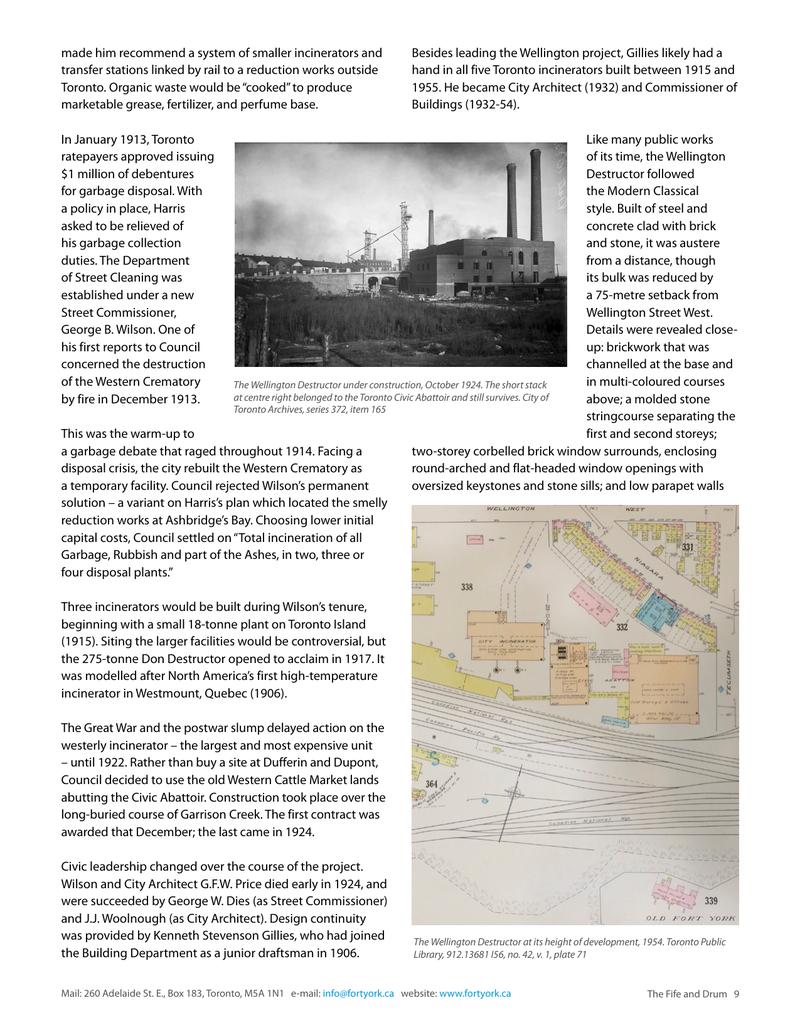
“A giant causeway, edged with huge square blocks and an immense railing leads up to a massive building with two high towers. In the midst of a great park in an old world setting it would be taken for a castle. But in Toronto… it is only the new ‘destructor’ that will burn up the city’s garbage.”
So wrote the Toronto Daily Star in January 1925, days before the city’s second high-temperature incinerator opened at Wellington and Niagara streets. The Wellington Destructor represented the most dramatic – and last – use of Toronto’s Military Reserve as a solution to the city’s solid waste woes and as a catalyst for thinking about how to deal with garbage disposal in Toronto.
Until the 1870s, waste disposal in the Reserve (bounded by Peter, Queen, and Dufferin streets and the lake) and the rest of Toronto was largely a private matter. Garbage was burned in fireplaces and furnaces, dumped in privy pits and nearby gullies, or fed to hogs. But as volumes increased, the municipal government organized refuse collection and disposal more systematically. Low-lying areas became targets for disposal. Some cinders went into road potholes, but most refuse was hauled to Garrison Creek. As the largest watercourse between the Don and Humber rivers, the Garrison was ideally located as a dumping ground. Filling went hand-in-hand with the lower creek’s burial in a combined sewer in 1884-86. Ash-rich dumps would continue to operate around Fort York until the 1950s.
Ash was a by-product of incineration, which the city first experimented with in 1890 by the Don River. A second low-temperature facility, the Western Crematory, opened in 1893 east of Strachan Avenue in the centre of what is now called the Ordnance Triangle Lands and what was then part of the city’s Cattle Market Annex. Expected to burn 92 cubic metres of garbage a day, the Western Crematory was, like its eastern counterpart, a failure. Despite operating fitfully and intermittently, its performance highlighted Toronto’s reliance on dumping and pushed the civic government toward new waste disposal technologies.
Crucial to this story of sanitary reform is the Canadian National Exhibition of 1910 and the construction of a new seawall at Exhibition Park. The seawall, running from Bathurst Street to the Humber, had been proposed by Mayor William McMurrich in 1882, detailed by the City Engineer in 1901, and formed part of civic improvement schemes from 1906 onward.
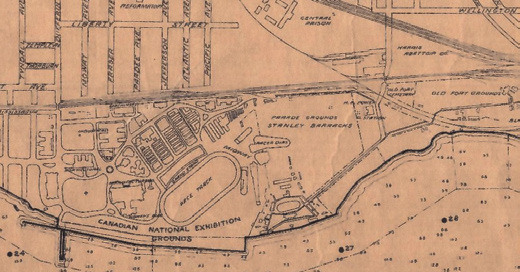
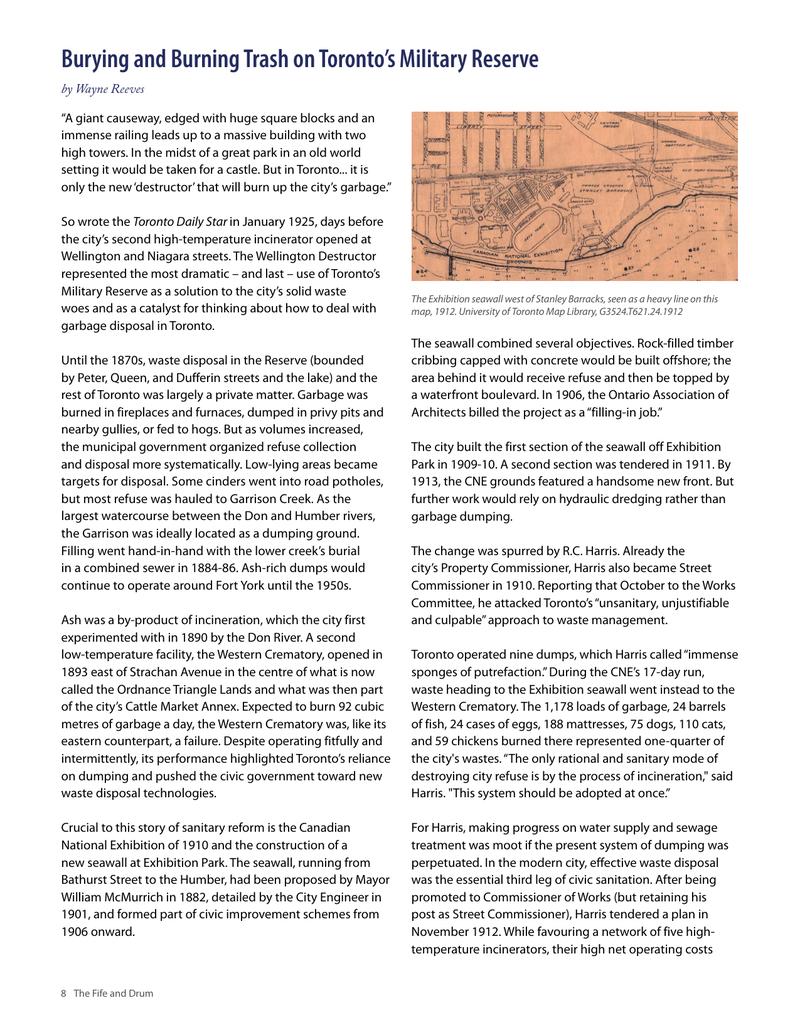
The seawall combined several objectives. Rock-filled timber cribbing capped with concrete would be built offshore; the area behind it would receive refuse and then be topped by a waterfront boulevard. In 1906, the Ontario Association of Architects billed the project as a “filling-in job.”
The city built the first section of the seawall off Exhibition Park in 1909-10. A second section was tendered in 1911. By 1913, the CNE grounds featured a handsome new front. But further work would rely on hydraulic dredging rather than garbage dumping.
The change was spurred by R.C. Harris. Already the city’s Property Commissioner, Harris also became Street Commissioner in 1910. Reporting that October to the Works Committee, he attacked Toronto’s “unsanitary, unjustifiable and culpable” approach to waste management.
Toronto operated nine dumps, which Harris called “immense sponges of putrefaction.” During the CNE’s 17-day run, waste heading to the Exhibition seawall went instead to the Western Crematory. The 1,178 loads of garbage, 24 barrels of fish, 24 cases of eggs, 188 mattresses, 75 dogs, 110 cats, and 59 chickens burned there represented one-quarter of the city’s wastes. “The only rational and sanitary mode of destroying city refuse is by the process of incineration,” said Harris. “This system should be adopted at once.”
For Harris, making progress on water supply and sewage treatment was moot if the present system of dumping was perpetuated. In the modern city, effective waste disposal was the essential third leg of civic sanitation. After being promoted to Commissioner of Works (but retaining his post as Street Commissioner), Harris tendered a plan in November 1912. While favouring a network of five high-temperature incinerators, their high net operating costs made him recommend a system of smaller incinerators and transfer stations linked by rail to a reduction works outside Toronto. Organic waste would be “cooked” to produce marketable grease, fertilizer, and perfume base.

In January 1913, Toronto ratepayers approved issuing $1 million of debentures for garbage disposal. With a policy in place, Harris asked to be relieved of his garbage collection duties. The Department of Street Cleaning was established under a new Street Commissioner, George B. Wilson. One of his first reports to Council concerned the destruction of the Western Crematory by fire in December 1913.
This was the warm-up to a garbage debate that raged throughout 1914. Facing a disposal crisis, the city rebuilt the Western Crematory as a temporary facility. Council rejected Wilson’s permanent solution – a variant on Harris’s plan which located the smelly reduction works at Ashbridge’s Bay. Choosing lower initial capital costs, Council settled on “Total incineration of all Garbage, Rubbish and part of the Ashes, in two, three or four disposal plants.”
Three incinerators would be built during Wilson’s tenure, beginning with a small 18-tonne plant on Toronto Island (1915). Siting the larger facilities would be controversial, but the 275-tonne Don Destructor opened to acclaim in 1917. It was modelled after North America’s first high-temperature incinerator in Westmount, Quebec (1906).
The Great War and the postwar slump delayed action on the westerly incinerator – the largest and most expensive unit – until 1922. Rather than buy a site at Dufferin and Dupont, Council decided to use the old Western Cattle Market lands abutting the Civic Abattoir. Construction took place over the long-buried course of Garrison Creek. The first contract was awarded that December; the last came in 1924.
Civic leadership changed over the course of the project. Wilson and City Architect G.F.W. Price died early in 1924, and were succeeded by George W. Dies (as Street Commissioner) and J.J. Woolnough (as City Architect). Design continuity was provided by Kenneth Stevenson Gillies, who had joined the Building Department as a junior draftsman in 1906.
Besides leading the Wellington project, Gillies likely had a hand in all five Toronto incinerators built between 1915 and 1955. He became City Architect (1932) and Commissioner of Buildings (1932-54).
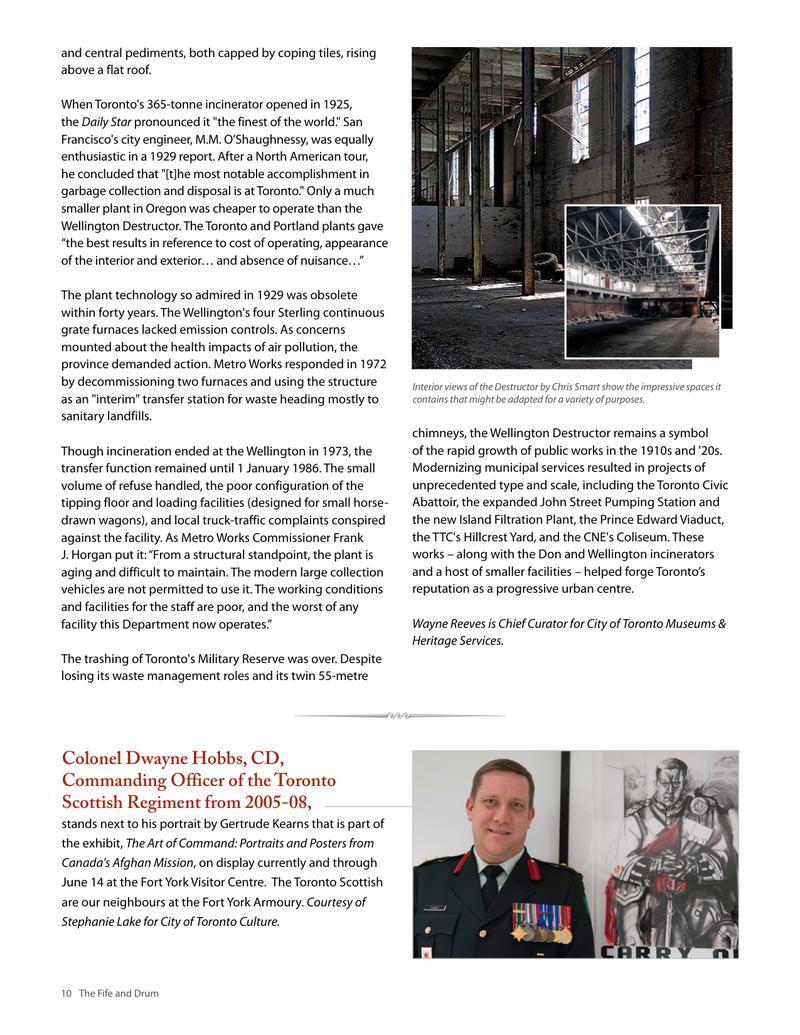
Like many public works of its time, the Wellington Destructor followed the Modern Classical style. Built of steel and concrete clad with brick and stone, it was austere from a distance, though its bulk was reduced by a 75-metre setback from Wellington Street West. Details were revealed close-up: brickwork that was channelled at the base and in multi-coloured courses above; a molded stone stringcourse separating the first and second storeys; two-storey corbelled brick window surrounds, enclosing round-arched and flat-headed window openings with oversized keystones and stone sills; and low parapet walls and central pediments, both capped by coping tiles, rising above a flat roof.

When Toronto’s 365-tonne incinerator opened in 1925, the Daily Star pronounced it “the finest of the world.” San Francisco’s city engineer, M.M. O’Shaughnessy, was equally enthusiastic in a 1929 report. After a North American tour, he concluded that “[t]he most notable accomplishment in garbage collection and disposal is at Toronto.” Only a much smaller plant in Oregon was cheaper to operate than the Wellington Destructor. The Toronto and Portland plants gave “the best results in reference to cost of operating, appearance of the interior and exterior… and absence of nuisance…”
The plant technology so admired in 1929 was obsolete within forty years. The Wellington’s four Sterling continuous grate furnaces lacked emission controls. As concerns mounted about the health impacts of air pollution, the province demanded action. Metro Works responded in 1972 by decommissioning two furnaces and building the structure as an “interim” transfer station for waste heading mostly to sanitary landfills.

Though incineration ended at the Wellington in 1973, the transfer function remained until 1 January 1986. The small volume of refuse handled, the poor configuration of the tipping floor and loading facilities (designed for small horse-drawn wagons), and local truck traffic complaints conspired against the facility. As Metro Works Commissioner Frank J. Horgan put it, “From a structural standpoint, the plant is aging and difficult to maintain. The modern large collection vehicles are not permitted to use it. The working conditions and facilities for the staff are poor, and the worst of any facility this Department now operates.”
The trashing of Toronto’s Military Reserve was over. Despite losing its waste management roles and its twin 55-metre chimneys, the Wellington Destructor remains a symbol of the rapid growth of public works in the 1910s and ’20s. Modernizing municipal services resulted in projects of unprecedented type and scale, including the Toronto Civic Abattoir, the expanded John Street Pumping Station and the new Island Filtration Plant, the Prince Edward Viaduct, the TTC’s Hillcrest Yard, and the CNE’s Coliseum. These works – along with the Don and Wellington incinerators and a host of smaller facilities – helped forge Toronto’s reputation as a progressive urban centre.
Original printed pages