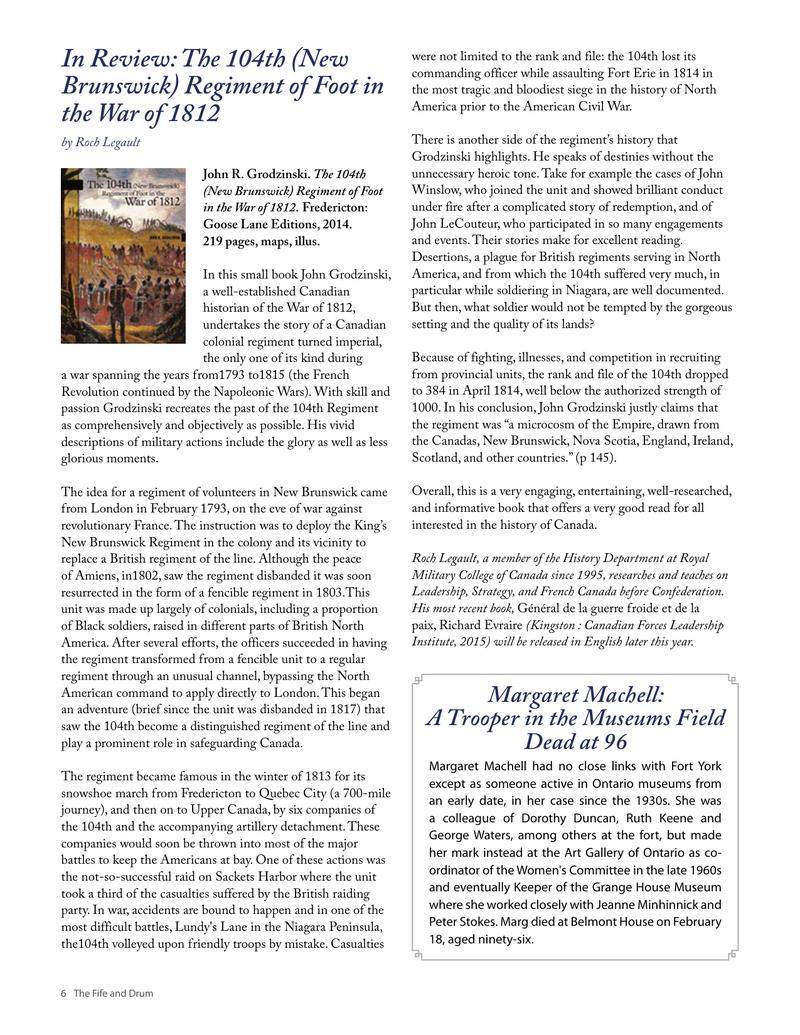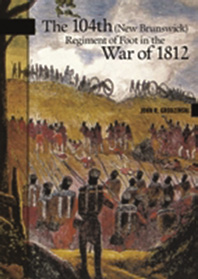
In this small book John Grodzinski, a well-established Canadian historian of the War of 1812, undertakes the story of a Canadian colonial regiment turned imperial, the only one of its kind during a war spanning the years from 1793 to 1815 (the French Revolution continued by the Napoleonic Wars). With skill and passion Grodzinski recreates the past of the 104th Regiment as comprehensively and objectively as possible. His vivid descriptions of military actions include the glory as well as less glorious moments.
The idea for a regiment of volunteers in New Brunswick came from London in February 1793, on the eve of war against revolutionary France. The instruction was to deploy the King’s New Brunswick Regiment in the colony and its vicinity to replace a British regiment of the line. Although the peace of Amiens, in 1802, saw the regiment disbanded it was soon resurrected in the form of a fencible regiment in 1803. This unit was made up largely of colonials, including a proportion of Black soldiers, raised in different parts of British North America. After several efforts, the officers succeeded in having the regiment transformed from a fencible unit to a regular regiment through an unusual channel, bypassing the North American command to apply directly to London. This began an adventure (brief since the unit was disbanded in 1817) that saw the 104th become a distinguished regiment of the line and play a prominent role in safeguarding Canada.
The regiment became famous in the winter of 1813 for its snowshoe march from Fredericton to Quebec City (a 700-mile journey), and then on to Upper Canada, by six companies of the 104th and the accompanying artillery detachment. These companies would soon be thrown into most of the major battles to keep the Americans at bay. One of these actions was the not-so-successful raid on Sackets Harbor where the unit took a third of the casualties suffered by the British raiding party. In war, accidents are bound to happen and in one of the most difficult battles, Lundy’s Lane in the Niagara Peninsula, the 104th volleyed upon friendly troops by mistake. Casualties were not limited to the rank and file: the 104th lost its commanding officer while assaulting Fort Erie in 1814 in the most tragic and bloodiest siege in the history of North America prior to the American Civil War.
There is another side of the regiment’s history that Grodzinski highlights. He speaks of destinies without the unnecessary heroic tone. Take for example the cases of John Winslow, who joined the unit and showed brilliant conduct under fire after a complicated story of redemption, and of John LeCouteur, who participated in so many engagements and events. Their stories make for excellent reading.
Desertions, a plague for British regiments serving in North America, and from which the 104th suffered very much, in particular while soldiering in Niagara, are well documented. But then, what soldier would not be tempted by the gorgeous setting and the quality of its lands?
Because of fighting, illnesses, and competition in recruiting from provincial units, the rank and file of the 104th dropped to 384 in April 1814, well below the authorized strength of 1000. In his conclusion, John Grodzinski justly claims that the regiment was “a microcosm of the Empire, drawn from the Canadas, New Brunswick, Nova Scotia, England, Ireland, Scotland, and other countries.” (p 145).
Overall, this is a very engaging, entertaining, well-researched, and informative book that offers a very good read for all interested in the history of Canada.
Original printed pages