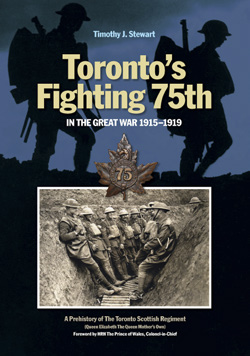
Even before one picks up this history it’s clear that this is a beautiful book and a labour of love. A true bibliophile will hold this book with reverential hands and promise to care for it accordingly. The quality of its manufacture, at least, demands no less.
This is the account of a Toronto-based infantry unit, now the Toronto Scottish Regiment, and how ordinary Canadians carried John McCrae’s torch into the blackest darkness and did not let go. Histories of the numbered battalions of the Canadian Expeditionary Force are common enough, but stories like those of the 75th are well worth retelling.
Ottawa’s decision to recombine our county and traditional regiments into numbered battalions in 1914 robbed some of the chance to add new lustre to well-burnished names. The confusion caused by Sir Sam Hughes’ purported genius at mobilization seems to have bred more desperate hacking melees than your average hockey tournament.
The story of the 75th Battalion of the CEF is tangled but Stewart walks us through it. The distant view of Canada’s pre-war Militia seems oddly familiar. Earnest officers, under-trained privates, desperate shortages of training space, equipment, uniforms, pay, and – strangely for an infantry regiment – shortages of horses. What became the Toronto Scottish was mostly drawn from the long-vanished 9th Light Mississauga Horse and it was more familiar at first with boots and saddles than kilts and bagpipes.
The second scramble occurs in England. The numbered battalions slotted into the first three Canadian divisions were largely assured of their continued existence. The rest had to politic, posture and plead for a chance at a future and deployment to the front; this battalion very nearly became little more than a footnote. Their founder, Lieutenant-Colonel Samuel Beckett, won some significant victories ere he reached France and died on Vimy Ridge.
The Toronto Scottish and other elements of the 4th Canadian Division have always been a little defensive about their performance at Vimy in April 1917. Stewart revisits the disastrous gas raid that cost Lt.-Col. Beckett his life as well as the controversy of the unshelled trench line in front of Hill 145. Note to Stewart: the rest of the Canadian Army doesn’t care! The 75th still did good work on the day and sterling work in the coming months.
The rest of the story in Flanders is well known. Hill 70, Passchendaele, Amiens and the Hundred Days come in their turn, and the men of the 75th settle into a groove as highly skilled and capable soldiers – like the rest of CEF. Some of the defensiveness Stewart exhibits about Vimy returns for Amiens (traffic snarls and other factors out of their control didn’t help) but again, the “Six Bits” acquitted themselves very well.
In some respects, the strength of the book is also its failing: like other historians of the period, Stewart can mostly turn to the unit’s war diaries, buttressed by the nominal roll, to produce a solid historical work. Yet, like many similar books, it doesn’t really convey a feeling of how those soldiers coped on the battlefield. What put fire in their bellies and kept them going?
For example, the 75th’s effort at Drury Ridge (part of the formidable Drocourt-Quéant Line) cost them 67 officers and men dead, and 246 wounded, in just one day. It also got their American doctor, Captain Bellenden Hutcheson, one of the CEF’s most spectacularly earned Victoria Crosses. But what kept those men working their way through 50-metre-thick belts of barbed wire, while being hosed by dozens of machine guns and blasted by shellfire? What kept them going on days like that?
It may be that the authors of the first wave of regimental histories were too close to the war to be candid about it, while those of this generation are too far away to comprehend it. We may never understand what made the 75th and the rest of the CEF so special; and that is a tragedy.
Some 23 per cent of the 4,000 soldiers who served in the battalion died as a result, and 57.5 per cent were wounded at least once. One

appendix also gives an eight-month snapshot (August 1916 to April 1917) of disciplinary statistics in the four battalions of its brigade. Almost three-quarters of their charges related to shortages of kit. (I would love to know more about the Canadian soldier charged with Writing the War Office Directly.)
A more illuminating statistic is also drawn from the same period: ten men went through courts martial. There were six convictions, and one deserter was sentenced to seven years of penal servitude. Seven were charged with wounding themselves; five were convicted, but the worst award was 90 days of Field Punishment. Yet this was from a new and inexperienced unit, with men only getting their first exposure to combat (on the Somme) at the beginning of that eight-month period. These single-digit figures suggest that Canada’s soldiers were strongly committed to the war.
We may never understand what made the 75th and the rest of the CEF so special; and that is a tragedy.
There are other nuggets that make Stewart’s book a treasure. The unit’s first wartime death, for example, came eight days after arriving in the United Kingdom in April 1916. A handful of soldiers had been granted leave after the voyage from Canada; Private Neville Fryday went to see his mother in Dublin for Easter and was shot by an Irish rebel. A Scottish battalion from Toronto, they went to war with two Sikhs in their ranks – and left one buried in France. The other was still with them for the 1939 Royal Visit.
Lt.-Col. Colin Harbottle, as instrumental to the 75th and the Toronto Scottish as Sam Beckett, drafted his final orders as the battalion came home in June 1919. He warned his boys about black-market hooch and labour agitators, and he asked them to stick together and look after each other. They did.
The tight cohesion of the returning veterans gave renewed life to the pre-war Militia organization that had hung on into 1919. The 75th Battalion CEF soon became the Toronto Scottish Regiment. There is also a poignancy to those veterans, and Stewart samples it. Some lingered long, like the hard-bitten scout sergeant with the Military Medal and a wound stripe who was still selling hats on King Street within living memory. Others, like Lt.-Col. Harbottle, were in their graves before the next war started.
Along with lavish illustration and 16 original maps, a substantial portion of the book is reference material. A history teacher, piper and long-term curator of the Toronto Scottish archives, Stewart has been collecting and sorting artifacts, photographs and documents for years. Among the 15 appendices are citations for medals, statistics of courts martial and a very long list of the Six-Bits’ fallen members.
Toronto’s Fighting 75th is a fine examination of one battalion of the CEF and the people behind it. Members of the Toronto Scottish will find the book a treasure, and they won’t be the only ones. The only flaw of the book is one that very few modern writers could rectify: that after 100 years, we still don’t really understand what drove these very ordinary Canadians forward and made them such formidable fighting men.
Original printed pages