Sites that are important to our history quickly become magnets for the royal family and their representatives. We steer them to these places since a royal visitor brings attention (especially from the media) to their role in the development of modern Canada. Fort York has enjoyed a strong relationship with the Crown and its representatives since Lieutenant-Governor Simcoe first erected his tents near its grounds on Garrison Creek in 1793.
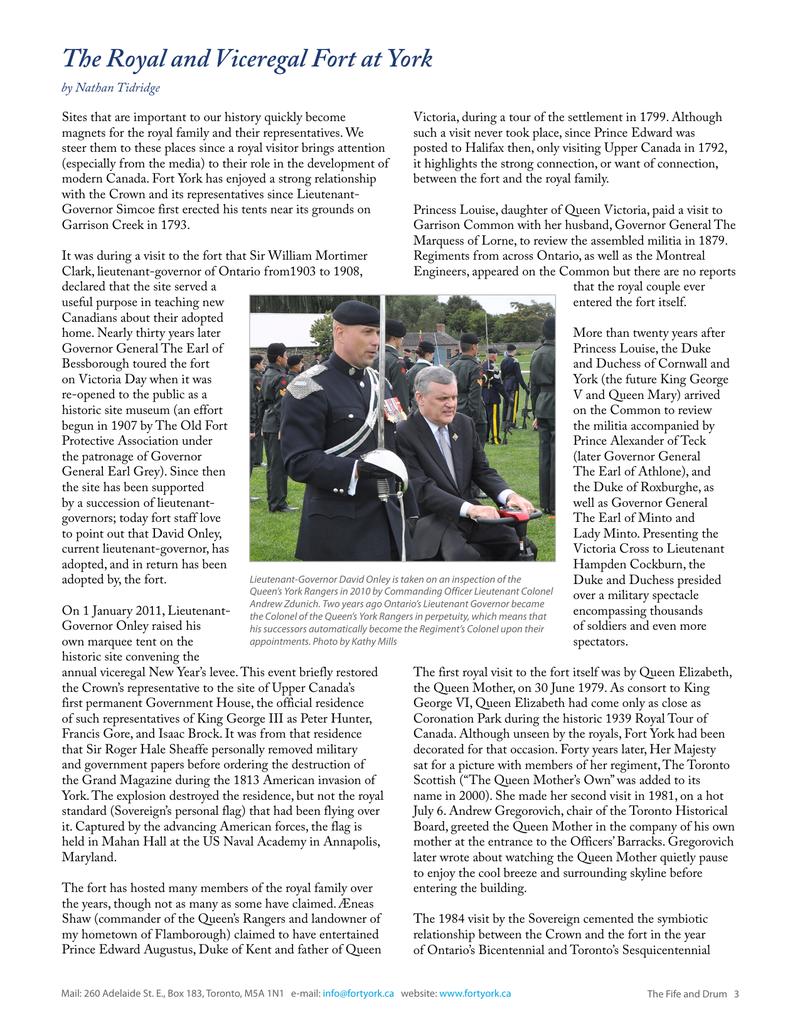
It was during a visit to the fort that Sir William Mortimer Clark, lieutenant-governor of Ontario from 1903 to 1908, declared that the site served a useful purpose in teaching new Canadians about their adopted home. Nearly thirty years later Governor General The Earl of Bessborough toured the fort on Victoria Day when it was re-opened to the public as a historic site museum (an effort begun in 1907 by The Old Fort Protective Association under the patronage of Governor General Earl Grey). Since then the site has been supported by a succession of lieutenant-governors; today fort staff love to point out that David Onley, current lieutenant-governor, has adopted, and in return has been adopted by, the fort.
On 1 January 2011, Lieutenant-Governor Onley raised his own marquee tent on the historic site convening the annual viceregal New Year’s levee. This event briefly restored the Crown’s representative to the site of Upper Canada’s first permanent Government House, the official residence of such representatives of King George III as Peter Hunter, Francis Gore, and Isaac Brock. It was from that residence that Sir Roger Hale Sheaffe personally removed military and government papers before ordering the destruction of the Grand Magazine during the 1813 American invasion of York. The explosion destroyed the residence, but not the royal standard (Sovereign’s personal flag) that had been flying over it. Captured by the advancing American forces, the flag is held in Mahan Hall at the US Naval Academy in Annapolis, Maryland.
The fort has hosted many members of the royal family over the years, though not as many as some have claimed. Æneas Shaw (commander of the Queen’s Rangers and landowner of my hometown of Flamborough) claimed to have entertained Prince Edward Augustus, Duke of Kent and father of Queen Victoria, during a tour of the settlement in 1799. Although such a visit never took place, since Prince Edward was posted to Halifax then, only visiting Upper Canada in 1792, it highlights the strong connection, or want of connection, between the fort and the royal family.
Princess Louise, daughter of Queen Victoria, paid a visit to Garrison Common with her husband, Governor General The Marquess of Lorne, to review the assembled militia in 1879. Regiments from across Ontario, as well as the Montreal Engineers, appeared on the Common but there are no reports that the royal couple ever entered the fort itself.
More than twenty years after Princess Louise, the Duke and Duchess of Cornwall and York (the future King George V and Queen Mary) arrived on the Common to review the militia accompanied by Prince Alexander of Teck (later Governor General The Earl of Athlone), and the Duke of Roxburghe, as well as Governor General The Earl of Minto and Lady Minto. Presenting the Victoria Cross to Lieutenant Hampden Cockburn, the Duke and Duchess presided over a military spectacle encompassing thousands of soldiers and even more spectators.
The first royal visit to the fort itself was by Queen Elizabeth, the Queen Mother, on 30 June 1979. As consort to King George VI, Queen Elizabeth had come only as close as Coronation Park during the historic 1939 Royal Tour of Canada. Although unseen by the royals, Fort York had been decorated for that occasion. Forty years later, Her Majesty sat for a picture with members of her regiment, The Toronto Scottish (“The Queen Mother’s Own” was added to its name in 2000). She made her second visit in 1981, on a hot July 6. Andrew Gregorovich, chair of the Toronto Historical Board, greeted the Queen Mother in the company of his own mother at the entrance to the Officers’ Barracks. Gregorovich later wrote about watching the Queen Mother quietly pause to enjoy the cool breeze and surrounding skyline before entering the building.
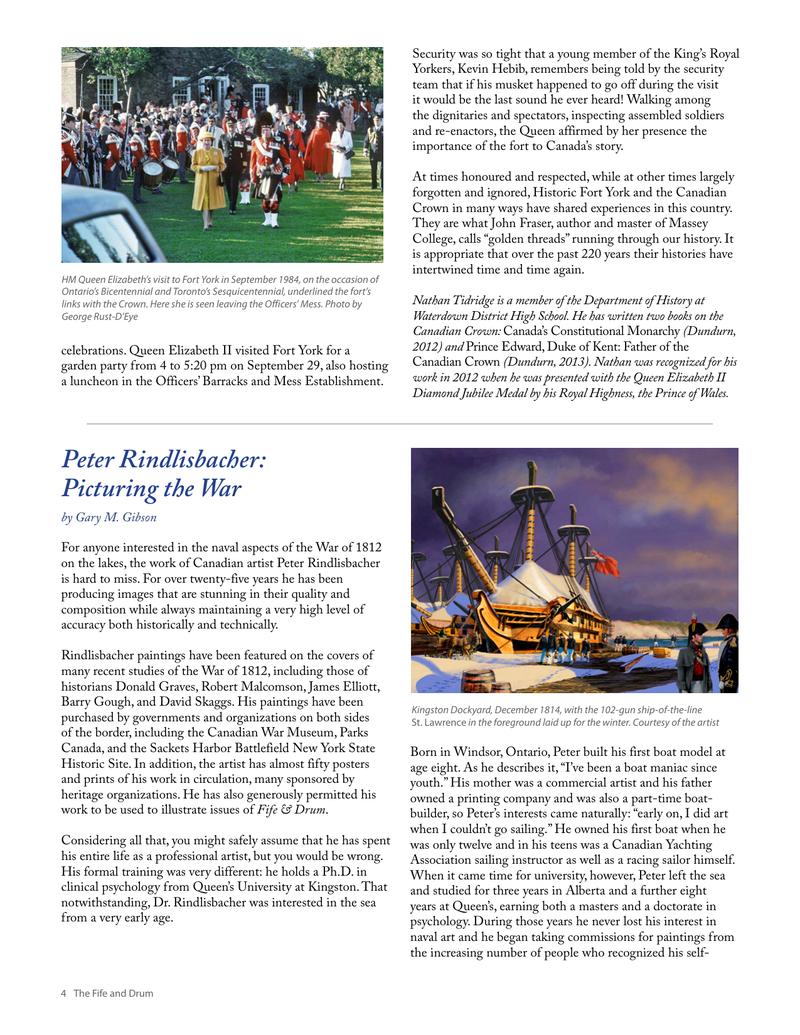
The 1984 visit by the Sovereign cemented the symbiotic relationship between the Crown and the fort in the year of Ontario’s Bicentennial and Toronto’s Sesquicentennial celebrations. Queen Elizabeth II visited Fort York for a garden party from 4 to 5:20 pm on September 29, also hosting a luncheon in the Officers’ Barracks and Mess Establishment.

Security was so tight that a young member of the King’s Royal Yorkers, Kevin Hebib, remembers being told by the security team that if his musket happened to go off during the visit it would be the last sound he ever heard! Walking among the dignitaries and spectators, inspecting assembled soldiers and re-enactors, the Queen affirmed by her presence the importance of the fort to Canada’s story.
At times honoured and respected, while at other times largely forgotten and ignored, Historic Fort York and the Canadian Crown in many ways have shared experiences in this country.
At times honoured and respected, while at other times largely forgotten and ignored, Historic Fort York and the Canadian Crown in many ways have shared experiences in this country. They are what John Fraser, author and master of Massey College, calls “golden threads” running through our history. It is appropriate that over the past 220 years their histories have intertwined time and time again.
Original printed pages