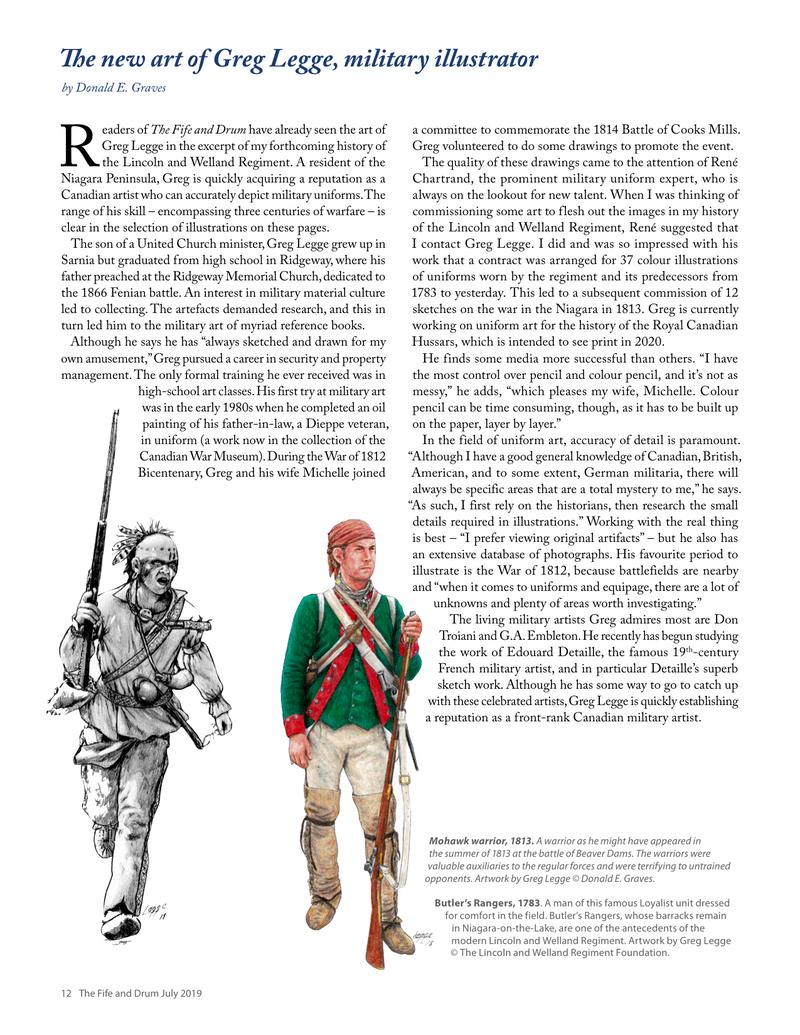
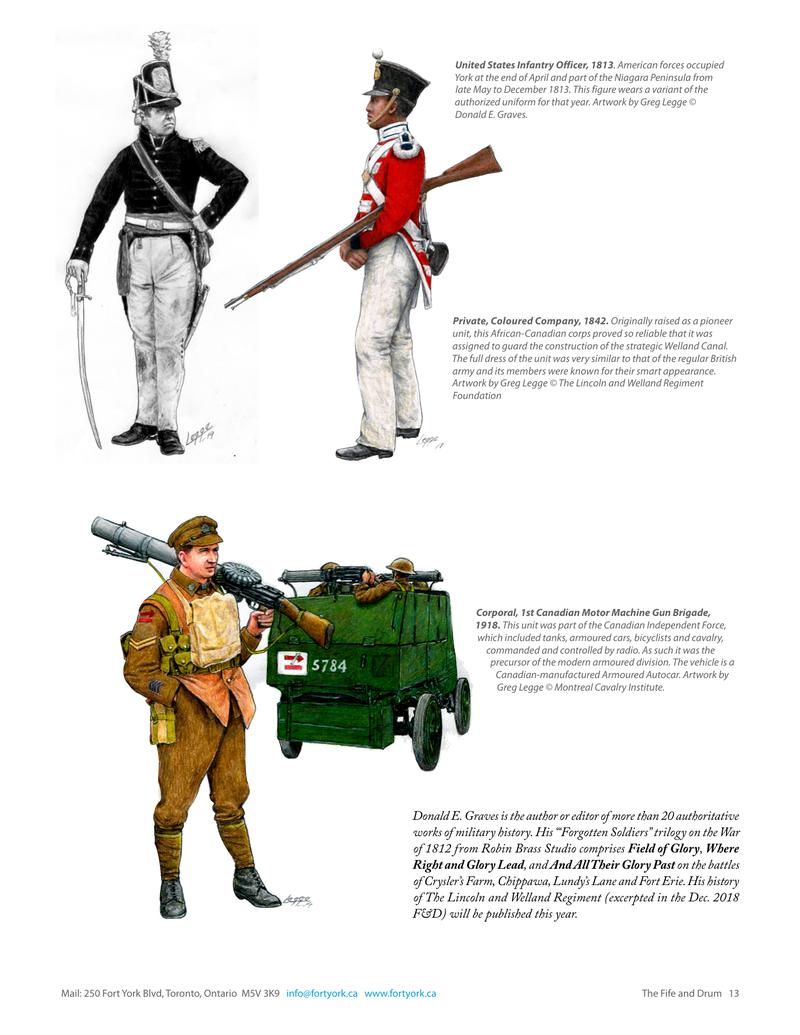
Readers of The Fife and Drum have already seen the art of Greg Legge in the excerpt of my forthcoming history of the Lincoln and Welland Regiment. A resident of the Niagara Peninsula, Greg is quickly acquiring a reputation as a Canadian artist who can accurately depict military uniforms. The range of his skill – encompassing three centuries of warfare – is clear in the selection of illustrations on these pages.
The son of a United Church minister, Greg Legge grew up in Sarnia but graduated from high school in Ridgeway, where his father preached at the Ridgeway Memorial Church, dedicated to the 1866 Fenian battle. An interest in military material culture led to collecting. The artefacts demanded research, and this in turn led him to the military art of myriad reference books.
Although he says he has “always sketched and drawn for my own amusement,” Greg pursued a career in security and property management. The only formal training he ever received was in high-school art classes. His first try at military art was in the early 1980s when he completed an oil painting of his father-in-law, a Dieppe veteran, in uniform (a work now in the collection of the Canadian War Museum). During the War of 1812 Bicentenary, Greg and his wife Michelle joined a committee to commemorate the 1814 Battle of Cooks Mills. Greg volunteered to do some drawings to promote the event.
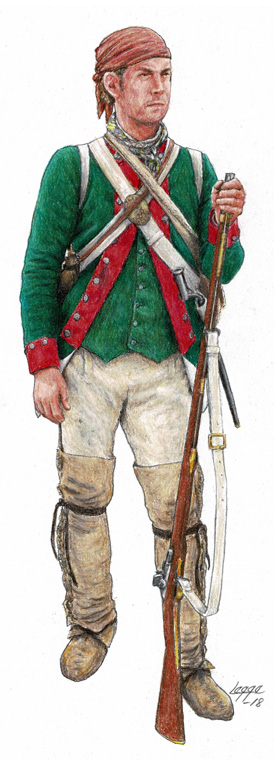

The quality of these drawings came to the attention of René Chartrand, the prominent military uniform expert, who is always on the lookout for new talent. When I was thinking of commissioning some art to flesh out the images in my history of the Lincoln and Welland Regiment, René suggested that I contact Greg Legge. I did and was so impressed with his work that a contract was arranged for 37 colour illustrations of uniforms worn by the regiment and its predecessors from 1783 to yesterday. This led to a subsequent commission of 12 sketches on the war in the Niagara in 1813. Greg is currently working on uniform art for the history of the Royal Canadian Hussars, which is intended to see print in 2020.
He finds some media more successful than others. “I have the most control over pencil and colour pencil, and it’s not as messy,” he adds, “which pleases my wife, Michelle. Colour pencil can be time consuming, though, as it has to be built up on the paper, layer by layer.”
In the field of uniform art, accuracy of detail is paramount. “Although I have a good general knowledge of Canadian, British, American, and to some extent, German militaria, there will always be specific areas that are a total mystery to me,” he says. “As such, I first rely on the historians, then research the small details required in illustrations.” Working with the real thing is best – “I prefer viewing original artifacts” – but he also has an extensive database of photographs. His favourite period to illustrate is the War of 1812, because battlefields are nearby and “when it comes to uniforms and equipage, there are a lot of unknowns and plenty of areas worth investigating.”


The living military artists Greg admires most are Don Troiani and G.A. Embleton. He recently has begun studying the work of Edouard Detaille, the famous 19th-century French military artist, and in particular Detaille’s superb sketch work. Although he has some way to go to catch up with these celebrated artists, Greg Legge is quickly establishing a reputation as a front-rank Canadian military artist.

Original printed pages