MacMillan continued from page 1
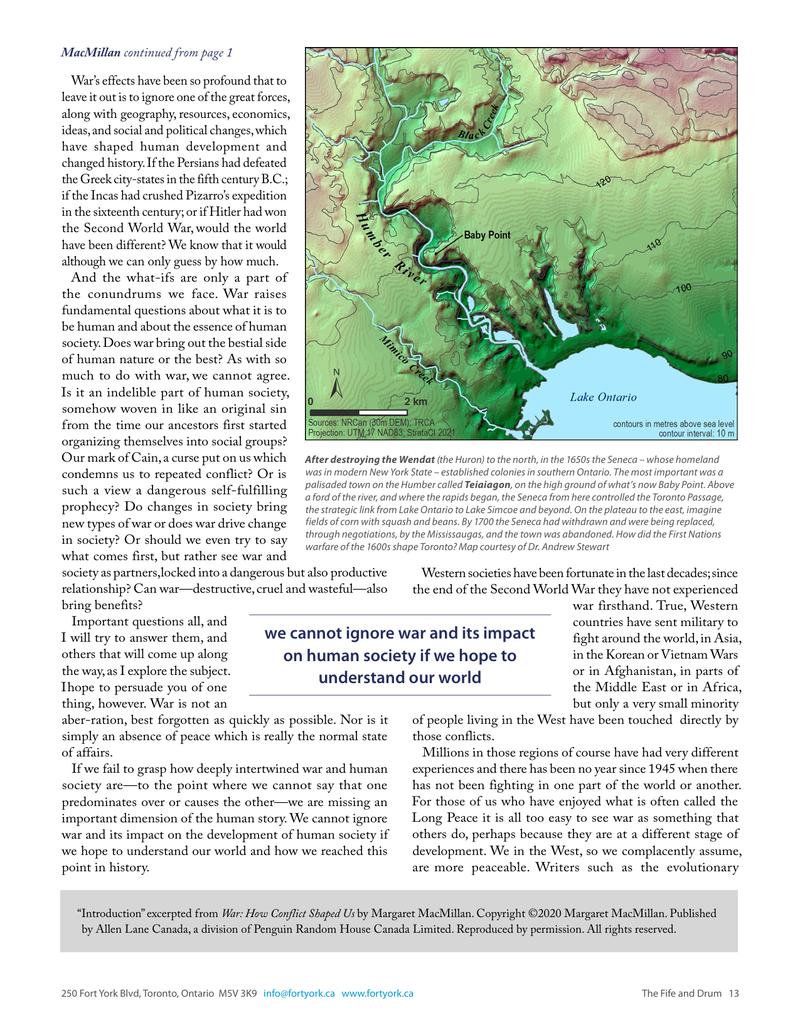
War’s effects have been so profound that to leave it out is to ignore one of the great forces, along with geography, resources, economics, ideas, and social and political changes, which have shaped human development and changed history. If the Persians had defeated the Greek city-states in the fifth century B.C.; if the Incas had crushed Pizarro’s expedition in the sixteenth century; or if Hitler had won the Second World War, would the world have been different? We know that it would although we can only guess by how much. And the what-ifs are only a part of the conundrums we face. War raises fundamental questions about what it is to be human and about the essence of human society. Does war bring out the bestial side of human nature or the best? As with so much to do with war, we cannot agree. Is it an indelible part of human society, somehow woven in like an original sin from the time our ancestors first started organizing themselves into social groups? After destroying the Wendat (the Huron) to the north, in the 1650s the Seneca – whose homeland Our mark of Cain, a curse put on us which was in modern New York State – established colonies in southern Ontario. The most important was a condemns us to repeated conflict? Or is palisaded town on the Humber called Teiaiagon, on the high ground of what’s now Baby Point. Above such a view a dangerous self-fulfilling a ford of the river, and where the rapids began, the Seneca from here controlled the Toronto Passage, the strategic link from Lake Ontario to Lake Simcoe and beyond. On the plateau to the east, imagine prophecy? Do changes in society bring fields of corn with squash and beans. By 1700 the Seneca had withdrawn and were being replaced, new types of war or does war drive change through negotiations, by the Mississaugas, and the town was abandoned. How did the First Nations in society? Or should we even try to say warfare of the 1600s shape Toronto? Map courtesy of Dr. Andrew Stewart what comes first, but rather see war and society as partners, locked into a dangerous but also productive Western societies have been fortunate in the last decades; since relationship? Can war—destructive, cruel and wasteful—also the end of the Second World War they have not experienced bring benefits? war firsthand. True, Western Important questions all, and countries have sent military to we cannot ignore war and its impact I will try to answer them, and fight around the world, in Asia, on human society if we hope to others that will come up along in the Korean or Vietnam Wars understand our world the way, as I explore the subject. or in Afghanistan, in parts of I hope to persuade you of one the Middle East or in Africa, thing, however. War is not an but only a very small minority aber-ration, best forgotten as quickly as possible. Nor is it of people living in the West have been touched directly by simply an absence of peace which is really the normal state those conflicts. of affairs. Millions in those regions of course have had very different If we fail to grasp how deeply intertwined war and human experiences and there has been no year since 1945 when there has not been fighting in one part of the world or another. society are—to the point where we cannot say that one For those of us who have enjoyed what is often called the predominates over or causes the other—we are missing an Long Peace it is all too easy to see war as something that important dimension of the human story. We cannot ignore others do, perhaps because they are at a different stage of war and its impact on the development of human society if development. We in the West, so we complacently assume, we hope to understand our world and how we reached this are more peaceable. Writers such as the evolutionary point in history.
War’s effects have been so profound that to leave it out is to ignore one of the great forces, along with geography, resources, economics, ideas, and social and political changes, which have shaped human development and changed history. If the Persians had defeated the Greek city-states in the fifth century B.C.; if the Incas had crushed Pizarro’s expedition in the sixteenth century; or if Hitler had won the Second World War, would the world have been different? We know that it would although we can only guess by how much. And the what-ifs are only a part of the conundrums we face. War raises fundamental questions about what it is to be human and about the essence of human society. Does war bring out the bestial side of human nature or the best? As with so much to do with war, we cannot agree. Is it an indelible part of human society, somehow woven in like an original sin from the time our ancestors first started organizing themselves into social groups? After destroying the Wendat (the Huron) to the north, in the 1650s the Seneca – whose homeland Our mark of Cain, a curse put on us which was in modern New York State – established colonies in southern Ontario. The most important was a condemns us to repeated conflict? Or is palisaded town on the Humber called Teiaiagon, on the high ground of what’s now Baby Point. Above such a view a dangerous self-fulfilling a ford of the river, and where the rapids began, the Seneca from here controlled the Toronto Passage, the strategic link from Lake Ontario to Lake Simcoe and beyond. On the plateau to the east, imagine prophecy? Do changes in society bring fields of corn with squash and beans. By 1700 the Seneca had withdrawn and were being replaced, new types of war or does war drive change through negotiations, by the Mississaugas, and the town was abandoned. How did the First Nations in society? Or should we even try to say warfare of the 1600s shape Toronto? Map courtesy of Dr. Andrew Stewart what comes first, but rather see war and society as partners, locked into a dangerous but also productive Western societies have been fortunate in the last decades; since relationship? Can war—destructive, cruel and wasteful—also the end of the Second World War they have not experienced bring benefits? war firsthand. True, Western Important questions all, and countries have sent military to we cannot ignore war and its impact I will try to answer them, and fight around the world, in Asia, on human society if we hope to others that will come up along in the Korean or Vietnam Wars understand our world the way, as I explore the subject. or in Afghanistan, in parts of I hope to persuade you of one the Middle East or in Africa, thing, however. War is not an but only a very small minority aber-ration, best forgotten as quickly as possible. Nor is it of people living in the West have been touched directly by simply an absence of peace which is really the normal state those conflicts. of affairs. Millions in those regions of course have had very different If we fail to grasp how deeply intertwined war and human experiences and there has been no year since 1945 when there has not been fighting in one part of the world or another. society are—to the point where we cannot say that one For those of us who have enjoyed what is often called the predominates over or causes the other—we are missing an Long Peace it is all too easy to see war as something that important dimension of the human story. We cannot ignore others do, perhaps because they are at a different stage of war and its impact on the development of human society if development. We in the West, so we complacently assume, we hope to understand our world and how we reached this are more peaceable. Writers such as the evolutionary point in history.
War’s effects have been so profound that to leave it out is to ignore one of the great forces, along with geography, resources, economics, ideas, and social and political changes, which have shaped human development and changed history. If the Persians had defeated the Greek city-states in the fifth century B.C.; if the Incas had crushed Pizarro’s expedition in the sixteenth century; or if Hitler had won the Second World War, would the world have been different? We know that it would although we can only guess by how much. And the what-ifs are only a part of the conundrums we face. War raises fundamental questions about what it is to be human and about the essence of human society. Does war bring out the bestial side of human nature or the best? As with so much to do with war, we cannot agree. Is it an indelible part of human society, somehow woven in like an original sin from the time our ancestors first started organizing themselves into social groups? After destroying the Wendat (the Huron) to the north, in the 1650s the Seneca – whose homeland Our mark of Cain, a curse put on us which was in modern New York State – established colonies in southern Ontario. The most important was a condemns us to repeated conflict? Or is palisaded town on the Humber called Teiaiagon, on the high ground of what’s now Baby Point. Above such a view a dangerous self-fulfilling a ford of the river, and where the rapids began, the Seneca from here controlled the Toronto Passage, the strategic link from Lake Ontario to Lake Simcoe and beyond. On the plateau to the east, imagine prophecy? Do changes in society bring fields of corn with squash and beans. By 1700 the Seneca had withdrawn and were being replaced, new types of war or does war drive change through negotiations, by the Mississaugas, and the town was abandoned. How did the First Nations in society? Or should we even try to say warfare of the 1600s shape Toronto? Map courtesy of Dr. Andrew Stewart what comes first, but rather see war and society as partners, locked into a dangerous but also productive Western societies have been fortunate in the last decades; since relationship? Can war—destructive, cruel and wasteful—also the end of the Second World War they have not experienced bring benefits? war firsthand. True, Western Important questions all, and countries have sent military to we cannot ignore war and its impact I will try to answer them, and fight around the world, in Asia, on human society if we hope to others that will come up along in the Korean or Vietnam Wars understand our world the way, as I explore the subject. or in Afghanistan, in parts of I hope to persuade you of one the Middle East or in Africa, thing, however. War is not an but only a very small minority aber-ration, best forgotten as quickly as possible. Nor is it of people living in the West have been touched directly by simply an absence of peace which is really the normal state those conflicts. of affairs. Millions in those regions of course have had very different If we fail to grasp how deeply intertwined war and human experiences and there has been no year since 1945 when there has not been fighting in one part of the world or another. society are—to the point where we cannot say that one For those of us who have enjoyed what is often called the predominates over or causes the other—we are missing an Long Peace it is all too easy to see war as something that important dimension of the human story. We cannot ignore others do, perhaps because they are at a different stage of war and its impact on the development of human society if development. We in the West, so we complacently assume, we hope to understand our world and how we reached this are more peaceable. Writers such as the evolutionary point in history.
Sources & Further Reading
“Introduction” excerpted from War: How Conflict Shaped Us by Margaret MacMillan. Copyright ©2020 Margaret MacMillan. Published by Allen Lane Canada, a division of Penguin Random House Canada Limited. Reproduced by permission. All rights reserved.
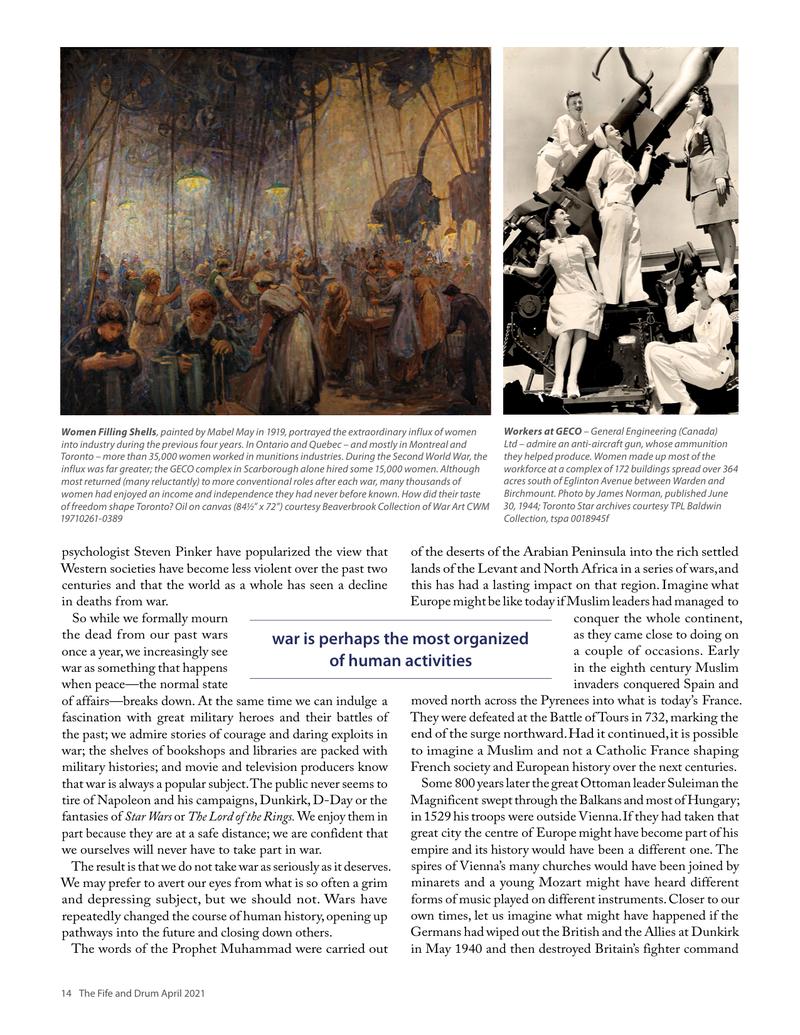
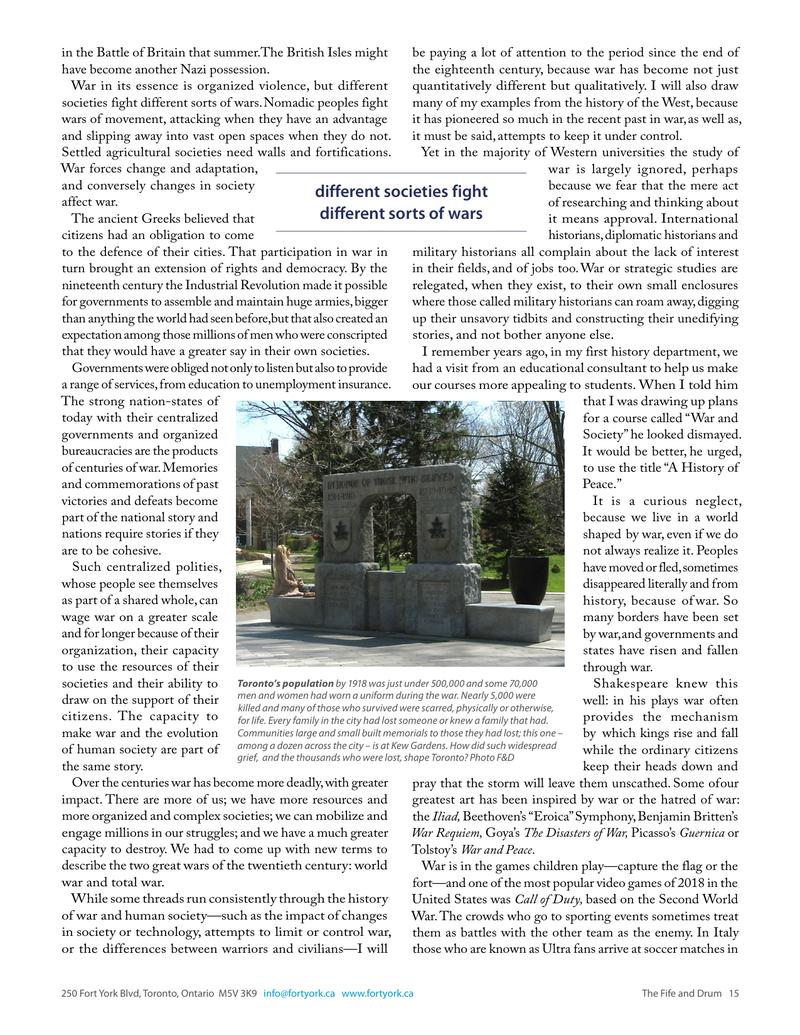
Women Filling Shells, painted by Mabel May in 1919, portrayed the extraordinary into industry during the previous four years. In Ontario and Quebec – and mostly in Toronto – more than 35,000 women worked in munitions industries. During the Second influx was far greater; the GECO complex in Scarborough alone hired some 15,000 most returned (many reluctantly) to more conventional roles after each war, many women had enjoyed an income and independence they had never before known. of freedom shape Toronto? Oil on canvas (84½” x 72”) courtesy Beaverbrook Collection 19710261-0389
psychologist Steven Pinker have popularized the view that Western societies have become less violent over the past two centuries and that the world as a whole has seen a decline in deaths from war. So while we formally mourn war is perhaps the the dead from our past wars once a year, we increasingly see of human war as something that happens when peace—the normal state of affairs—breaks down. At the same time we can indulge a fascination with great military heroes and their battles of the past; we admire stories of courage and daring exploits in war; the shelves of bookshops and libraries are packed with military histories; and movie and television producers know that war is always a popular subject. The public never seems to tire of Napoleon and his campaigns, Dunkirk, D-Day or the fantasies of Star Wars or The Lord of the Rings. We enjoy them in part because they are at a safe distance; we are confident that we ourselves will never have to take part in war. The result is that we do not take war as seriously as it deserves. We may prefer to avert our eyes from what is so often a grim and depressing subject, but we should not. Wars have repeatedly changed the course of human history, opening up pathways into the future and closing down others. The words of the Prophet Muhammad were carried out 14 The Fife and Drum April 2021
of the deserts of the Arabian Peninsula into the rich settled lands of the Levant and North Africa in a series of wars, and this has had a lasting impact on that region. Imagine what Europe might be like today if Muslim leaders had managed to conquer the whole continent, most organized as they came close to doing on a couple of occasions. Early activities in the eighth century Muslim invaders conquered Spain and moved north across the Pyrenees into what is today’s France. They were defeated at the Battle of Tours in 732, marking the end of the surge northward. Had it continued, it is possible to imagine a Muslim and not a Catholic France shaping French society and European history over the next centuries. Some 800 years later the great Ottoman leader Suleiman the Magnificent swept through the Balkans and most of Hungary; in 1529 his troops were outside Vienna. If they had taken that great city the centre of Europe might have become part of his empire and its history would have been a different one. The spires of Vienna’s many churches would have been joined by minarets and a young Mozart might have heard different forms of music played on different instruments. Closer to our own times, let us imagine what might have happened if the Germans had wiped out the British and the Allies at Dunkirk in May 1940 and then destroyed Britain’s fighter command
in the Battle of Britain that summer. The British Isles might have become another Nazi possession. War in its essence is organized violence, but different societies fight different sorts of wars. Nomadic peoples fight wars of movement, attacking when they have an advantage and slipping away into vast open spaces when they do not. Settled agricultural societies need walls and fortifications. War forces change and adaptation, different societies and conversely changes in society affect war. different sorts The ancient Greeks believed that citizens had an obligation to come to the defence of their cities. That participation in war in turn brought an extension of rights and democracy. By the nineteenth century the Industrial Revolution made it possible for governments to assemble and maintain huge armies, bigger than anything the world had seen before, but that also created an expectation among those millions of men who were conscripted that they would have a greater say in their own societies. Governments were obliged not only to listen but also to provide a range of services, from education to unemployment insurance. The strong nation-states of today with their centralized governments and organized bureaucracies are the products of centuries of war. Memories and commemorations of past victories and defeats become part of the national story and nations require stories if they are to be cohesive. Such centralized polities, whose people see themselves as part of a shared whole, can wage war on a greater scale and for longer because of their organization, their capacity to use the resources of their Toronto’s population by 1918 was just societies and their ability to men and women had worn a uniform during draw on the support of their killed and many of those who survived were for life. Every family in the city had lost someone citizens. The capacity to Communities large and small built memorials make war and the evolution among a dozen across the city – is at Kew of human society are part of grief, and the thousands who were lost, the same story. Over the centuries war has become more deadly, with greater impact. There are more of us; we have more resources and more organized and complex societies; we can mobilize and engage millions in our struggles; and we have a much greater capacity to destroy. We had to come up with new terms to describe the two great wars of the twentieth century: world war and total war. While some threads run consistently through the history of war and human society—such as the impact of changes in society or technology, attempts to limit or control war, or the differences between warriors and civilians—I will
in the Battle of Britain that summer. The British Isles might have become another Nazi possession. War in its essence is organized violence, but different societies fight different sorts of wars. Nomadic peoples fight wars of movement, attacking when they have an advantage and slipping away into vast open spaces when they do not. Settled agricultural societies need walls and fortifications. War forces change and adaptation, different societies and conversely changes in society affect war. different sorts The ancient Greeks believed that citizens had an obligation to come to the defence of their cities. That participation in war in turn brought an extension of rights and democracy. By the nineteenth century the Industrial Revolution made it possible for governments to assemble and maintain huge armies, bigger than anything the world had seen before, but that also created an expectation among those millions of men who were conscripted that they would have a greater say in their own societies. Governments were obliged not only to listen but also to provide a range of services, from education to unemployment insurance. The strong nation-states of today with their centralized governments and organized bureaucracies are the products of centuries of war. Memories and commemorations of past victories and defeats become part of the national story and nations require stories if they are to be cohesive. Such centralized polities, whose people see themselves as part of a shared whole, can wage war on a greater scale and for longer because of their organization, their capacity to use the resources of their Toronto’s population by 1918 was just societies and their ability to men and women had worn a uniform during draw on the support of their killed and many of those who survived were for life. Every family in the city had lost someone citizens. The capacity to Communities large and small built memorials make war and the evolution among a dozen across the city – is at Kew of human society are part of grief, and the thousands who were lost, the same story. Over the centuries war has become more deadly, with greater impact. There are more of us; we have more resources and more organized and complex societies; we can mobilize and engage millions in our struggles; and we have a much greater capacity to destroy. We had to come up with new terms to describe the two great wars of the twentieth century: world war and total war. While some threads run consistently through the history of war and human society—such as the impact of changes in society or technology, attempts to limit or control war, or the differences between warriors and civilians—I will
be paying a lot of attention to the period since the end of the eighteenth century, because war has become not just quantitatively different but qualitatively. I will also draw many of my examples from the history of the West, because it has pioneered so much in the recent past in war, as well as, it must be said, attempts to keep it under control. Yet in the majority of Western universities the study of war is largely ignored, perhaps fight because we fear that the mere act of researching and thinking about of wars it means approval. International historians, diplomatic historians and military historians all complain about the lack of interest in their fields, and of jobs too. War or strategic studies are relegated, when they exist, to their own small enclosures where those called military historians can roam away, digging up their unsavory tidbits and constructing their unedifying stories, and not bother anyone else. I remember years ago, in my first history department, we had a visit from an educational consultant to help us make our courses more appealing to students. When I told him that I was drawing up plans for a course called “War and Society” he looked dismayed. It would be better, he urged, to use the title “A History of Peace.” It is a curious neglect, because we live in a world shaped by war, even if we do not always realize it. Peoples have moved or fled, sometimes disappeared literally and from history, because of war. So many borders have been set by war, and governments and states have risen and fallen through war. under 500,000 and some 70,000 Shakespeare knew this the war. Nearly 5,000 were well: in his plays war often scarred, physically or otherwise, or knew a family that had. provides the mechanism to those they had lost; this one – by which kings rise and fall Gardens. How did such widespread while the ordinary citizens shape Toronto? Photo F&D keep their heads down and pray that the storm will leave them unscathed. Some of our greatest art has been inspired by war or the hatred of war: the Iliad, Beethoven’s “Eroica” Symphony, Benjamin Britten’s War Requiem, Goya’s The Disasters of War, Picasso’s Guernica or Tolstoy’s War and Peace. War is in the games children play—capture the flag or the fort—and one of the most popular video games of 2018 in the United States was Call of Duty, based on the Second World War. The crowds who go to sporting events sometimes treat them as battles with the other team as the enemy. In Italy those who are known as Ultra fans arrive at soccer matches in
250 Fort York Blvd, Toronto, Ontario M5V 3K9 info@fortyork.ca www.fortyork.ca
The Fife and Drum 15
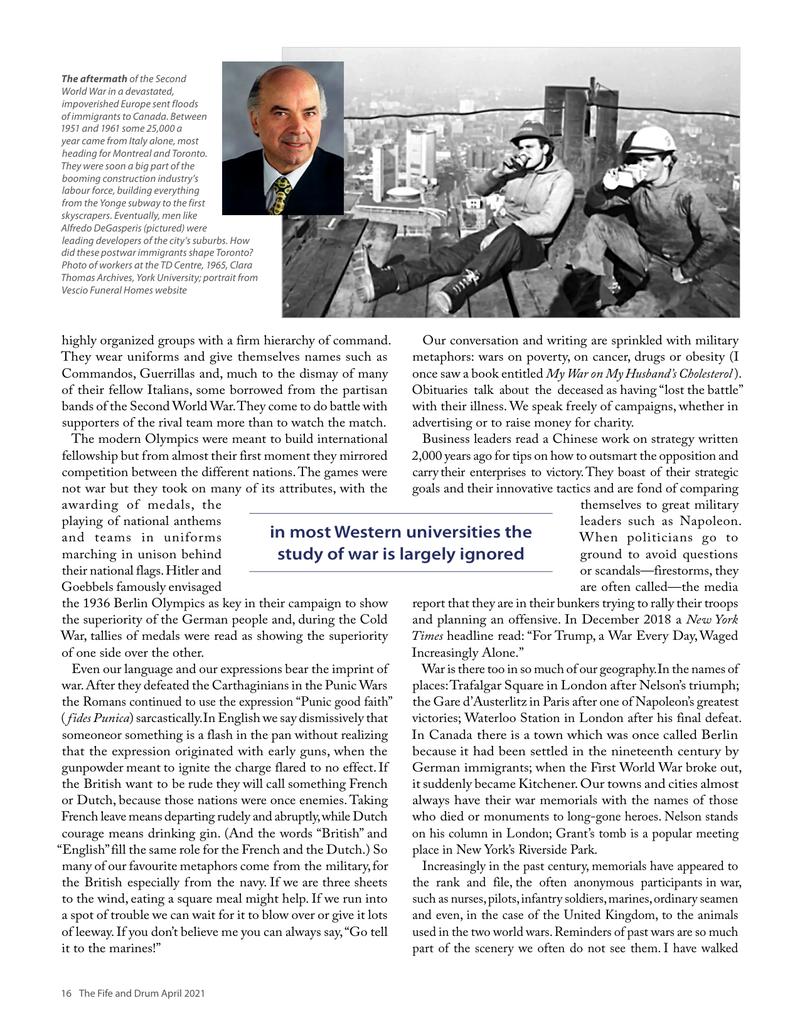
The aftermath of the Second World War in a devastated, impoverished Europe sent floods of immigrants to Canada. Between 1951 and 1961 some 25,000 a year came from Italy alone, most heading for Montreal and Toronto. They were soon a big part of the booming construction industry’s labour force, building everything from the Yonge subway to the first skyscrapers. Eventually, men like Alfredo DeGasperis (pictured) were leading developers of the city’s suburbs. How did these postwar immigrants shape Toronto? Photo of workers at the TD Centre, 1965, Clara Thomas Archives, York University; portrait from Vescio Funeral Homes website
highly organized groups with a firm hierarchy of command. They wear uniforms and give themselves names such as Commandos, Guerrillas and, much to the dismay of many of their fellow Italians, some borrowed from the partisan bands of the Second World War. They come to do battle with supporters of the rival team more than to watch the match. The modern Olympics were meant to build international fellowship but from almost their first moment they mirrored competition between the different nations. The games were not war but they took on many of its attributes, with the awarding of medals, the playing of national anthems in most Western and teams in uniforms study of war is largely marching in unison behind their national flags. Hitler and Goebbels famously envisaged the 1936 Berlin Olympics as key in their campaign to show the superiority of the German people and, during the Cold War, tallies of medals were read as showing the superiority of one side over the other. Even our language and our expressions bear the imprint of war. After they defeated the Carthaginians in the Punic Wars the Romans continued to use the expression “Punic good faith” ( fides Punica) sarcastically. In English we say dismissively that someone or something is a flash in the pan without realizing that the expression originated with early guns, when the gunpowder meant to ignite the charge flared to no effect. If the British want to be rude they will call something French or Dutch, because those nations were once enemies. Taking French leave means departing rudely and abruptly, while Dutch courage means drinking gin. (And the words “British” and “English” fill the same role for the French and the Dutch.) So many of our favourite metaphors come from the military, for the British especially from the navy. If we are three sheets to the wind, eating a square meal might help. If we run into a spot of trouble we can wait for it to blow over or give it lots of leeway. If you don’t believe me you can always say, “Go tell it to the marines!” 16 The Fife and Drum April 2021
Our conversation and writing are sprinkled with military metaphors: wars on poverty, on cancer, drugs or obesity (I once saw a book entitled My War on My Husband’s Cholesterol ). Obituaries talk about the deceased as having “lost the battle” with their illness. We speak freely of campaigns, whether in advertising or to raise money for charity. Business leaders read a Chinese work on strategy written 2,000 years ago for tips on how to outsmart the opposition and carry their enterprises to victory. They boast of their strategic goals and their innovative tactics and are fond of comparing themselves to great military leaders such as Napoleon. universities the When politicians go to ignored ground to avoid questions or scandals—firestorms, they are often called—the media report that they are in their bunkers trying to rally their troops and planning an offensive. In December 2018 a New York Times headline read: “For Trump, a War Every Day, Waged Increasingly Alone.” War is there too in so much of our geography. In the names of places: Trafalgar Square in London after Nelson’s triumph; the Gare d’Austerlitz in Paris after one of Napoleon’s greatest victories; Waterloo Station in London after his final defeat. In Canada there is a town which was once called Berlin because it had been settled in the nineteenth century by German immigrants; when the First World War broke out, it suddenly became Kitchener. Our towns and cities almost always have their war memorials with the names of those who died or monuments to long-gone heroes. Nelson stands on his column in London; Grant’s tomb is a popular meeting place in New York’s Riverside Park. Increasingly in the past century, memorials have appeared to the rank and file, the often anonymous participants in war, such as nurses, pilots, infantry soldiers, marines, ordinary seamen and even, in the case of the United Kingdom, to the animals used in the two world wars. Reminders of past wars are so much part of the scenery we often do not see them. I have walked
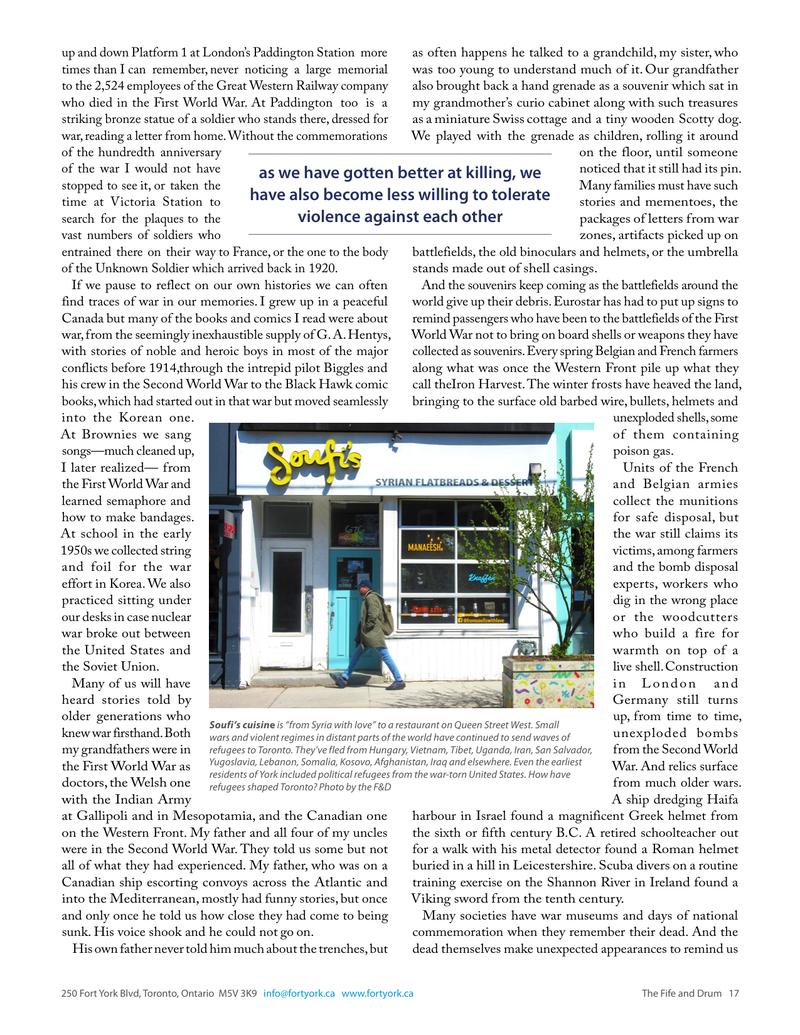
up and down Platform 1 at London’s Paddington Station more times than I can remember, never noticing a large memorial to the 2,524 employees of the Great Western Railway company who died in the First World War. At Paddington too is a striking bronze statue of a soldier who stands there, dressed for war, reading a letter from home. Without the commemorations of the hundredth anniversary as we have gotten better of the war I would not have stopped to see it, or taken the have also become less time at Victoria Station to violence against search for the plaques to the vast numbers of soldiers who entrained there on their way to France, or the one to the body of the Unknown Soldier which arrived back in 1920. If we pause to reflect on our own histories we can often find traces of war in our memories. I grew up in a peaceful Canada but many of the books and comics I read were about war, from the seemingly inexhaustible supply of G. A. Hentys, with stories of noble and heroic boys in most of the major conflicts before 1914, through the intrepid pilot Biggles and his crew in the Second World War to the Black Hawk comic books, which had started out in that war but moved seamlessly into the Korean one. At Brownies we sang songs—much cleaned up, I later realized— from the First World War and learned semaphore and how to make bandages. At school in the early 1950s we collected string and foil for the war effort in Korea. We also practiced sitting under our desks in case nuclear war broke out between the United States and the Soviet Union. Many of us will have heard stories told by older generations who Soufi’s cuisine is “from Syria with love” to a restaurant wars and violent regimes in distant parts of the knew war firsthand. Both refugees to Toronto. They’ve fled from Hungary, my grandfathers were in Yugoslavia, Lebanon, Somalia, Kosovo, Afghanistan, the First World War as residents of York included political refugees from refugees shaped Toronto? Photo by the F&D doctors, the Welsh one with the Indian Army at Gallipoli and in Mesopotamia, and the Canadian one on the Western Front. My father and all four of my uncles were in the Second World War. They told us some but not all of what they had experienced. My father, who was on a Canadian ship escorting convoys across the Atlantic and into the Mediterranean, mostly had funny stories, but once and only once he told us how close they had come to being sunk. His voice shook and he could not go on. His own father never told him much about the trenches, but
up and down Platform 1 at London’s Paddington Station more times than I can remember, never noticing a large memorial to the 2,524 employees of the Great Western Railway company who died in the First World War. At Paddington too is a striking bronze statue of a soldier who stands there, dressed for war, reading a letter from home. Without the commemorations of the hundredth anniversary as we have gotten better of the war I would not have stopped to see it, or taken the have also become less time at Victoria Station to violence against search for the plaques to the vast numbers of soldiers who entrained there on their way to France, or the one to the body of the Unknown Soldier which arrived back in 1920. If we pause to reflect on our own histories we can often find traces of war in our memories. I grew up in a peaceful Canada but many of the books and comics I read were about war, from the seemingly inexhaustible supply of G. A. Hentys, with stories of noble and heroic boys in most of the major conflicts before 1914, through the intrepid pilot Biggles and his crew in the Second World War to the Black Hawk comic books, which had started out in that war but moved seamlessly into the Korean one. At Brownies we sang songs—much cleaned up, I later realized— from the First World War and learned semaphore and how to make bandages. At school in the early 1950s we collected string and foil for the war effort in Korea. We also practiced sitting under our desks in case nuclear war broke out between the United States and the Soviet Union. Many of us will have heard stories told by older generations who Soufi’s cuisine is “from Syria with love” to a restaurant wars and violent regimes in distant parts of the knew war firsthand. Both refugees to Toronto. They’ve fled from Hungary, my grandfathers were in Yugoslavia, Lebanon, Somalia, Kosovo, Afghanistan, the First World War as residents of York included political refugees from refugees shaped Toronto? Photo by the F&D doctors, the Welsh one with the Indian Army at Gallipoli and in Mesopotamia, and the Canadian one on the Western Front. My father and all four of my uncles were in the Second World War. They told us some but not all of what they had experienced. My father, who was on a Canadian ship escorting convoys across the Atlantic and into the Mediterranean, mostly had funny stories, but once and only once he told us how close they had come to being sunk. His voice shook and he could not go on. His own father never told him much about the trenches, but
as often happens he talked to a grandchild, my sister, who was too young to understand much of it. Our grandfather also brought back a hand grenade as a souvenir which sat in my grandmother’s curio cabinet along with such treasures as a miniature Swiss cottage and a tiny wooden Scotty dog. We played with the grenade as children, rolling it around on the floor, until someone at killing, we noticed that it still had its pin. Many families must have such willing to tolerate stories and mementoes, the each other packages of letters from war zones, artifacts picked up on battlefields, the old binoculars and helmets, or the umbrella stands made out of shell casings. And the souvenirs keep coming as the battlefields around the world give up their debris. Eurostar has had to put up signs to remind passengers who have been to the battlefields of the First World War not to bring on board shells or weapons they have collected as souvenirs. Every spring Belgian and French farmers along what was once the Western Front pile up what they call the Iron Harvest. The winter frosts have heaved the land, bringing to the surface old barbed wire, bullets, helmets and unexploded shells, some of them containing poison gas. Units of the French and Belgian armies collect the munitions for safe disposal, but the war still claims its victims, among farmers and the bomb disposal experts, workers who dig in the wrong place or the woodcutters who build a fire for warmth on top of a live shell. Construction in London and Germany still turns up, from time to time, on Queen Street West. Small world have continued to send waves of unexploded bombs Vietnam, Tibet, Uganda, Iran, San Salvador, from the Second World Iraq and elsewhere. Even the earliest War. And relics surface the war-torn United States. How have from much older wars. A ship dredging Haifa harbour in Israel found a magnificent Greek helmet from the sixth or fifth century B.C. A retired schoolteacher out for a walk with his metal detector found a Roman helmet buried in a hill in Leicestershire. Scuba divers on a routine training exercise on the Shannon River in Ireland found a Viking sword from the tenth century. Many societies have war museums and days of national commemoration when they remember their dead. And the dead themselves make unexpected appearances to remind us
250 Fort York Blvd, Toronto, Ontario M5V 3K9 info@fortyork.ca www.fortyork.ca The Fife and Drum 17
Original printed pages