The campaigns to save Fort York present a saga of opposing public interests, political vacillation, commercial encroachment, and contextual issues of identity. In the 1840s Fort York had been replaced by new fortifications, named Stanley Barracks in 1893. Though the “Old Fort” continued to serve military purposes, by century’s end it displayed scattered relics, an ill-kept dirt road, and run-down storage facilities and living quarters, including the birthplace of burlesque star Florence Bennett.
Still, Toronto recognized the Old Fort as an important site. The Canadian Club was allowed to place markers there; elsewhere, veterans erected a memorial to the defenders of Canada during the War of 1812, among them those killed at Fort York. The city applied to the federal government in 1889 for possession of the fort but it was not until 1903 that an agreement was reached with a sympathetic Department of Militia and Defence, which bound the city to a course of preservation. The transfer was to be concluded once the militia had constructed new buildings.
Between 1905 and 1909 preservation was derailed by efforts to run a street railway through the fort to the Canadian National Exhibition. In the midst of the dispute, which pitted tenacious historical societies against wily railway officials, the militia department gave the city five cannon once mounted at the fort, with the intention “that they shall again be placed in position when the Old Fort is restored.” That same year (1908), the property was encroached upon by the Grand Trunk Railway on the north and the construction of the Park-Blackwell meat-packing plant at the southeast, where an old guardhouse was torn down. An undeterred Ontario Historical Society produced a comprehensive plan in 1909 to restore the fort, the streetcar line was put on hold, and federal pressures culminated in the actual transfer of the fort to the city.
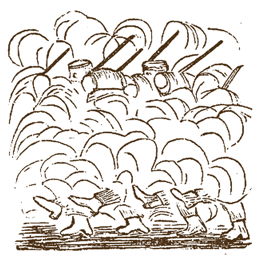
The movement was enlivened by press coverage and publications that drew attention to both the fort and the approaching centennial of the 1812 war. C. W. Jefferys’ famous sketch of “The Spirit of 1812,” ghostly redcoats blocking the street railway, appeared in the Toronto Daily Star in October 1905. Jean Earle Geeson’s pivotal The old fort of Toronto, 1793-1906, L. H. Irving’s Officers of the British forces in Canada, E. A. Cruikshank’s documentary collections, and legend-feeding biographies of General Isaac Brock are also representative.
Toronto’s takeover of the fort was no prelude, however, to implementation of the OHS plan. Committee scrutiny and stringent budgetary allocation produced minimal maintenance. The fort still housed ordnance stores and the 9th Battery Field Artillery, and responsibility for conditions there bounced between the city and the militia, which pressed for repairs, and restraint. In 1911 one officer complained that the parks department was using the old ramparts for infill along the lake-shore. As the anniversary of 1812 edged closer, organizations such as the Women’s Canadian Historical Society of Toronto revived the historical call; fresh debate about the war and related monuments ensued. In January 1912, city council, with some bluster, felt full restoration would provide fitting commemoration. Some work was undertaken that summer and fall. Between 1912 and 1914 funds were allocated to the roadway, which was “in an almost impassable condition” as a result of wagon and truck traffic, and repairs were made to the gun shed, blockhouse, remaining guardhouse, and barracks. New gates were pictured in the Star on 25 August 1913. Literary support kept pace. The indomitable Barlow Cumberland, who had led the OHS in the earlier campaign, wrote about the 1813 battle of York for a series marking the centennial. Other heroic figures, among them Laura Secord, Brock, and the York Rangers, also received attention, but for the fort, this celebratory momentum would soon stall.
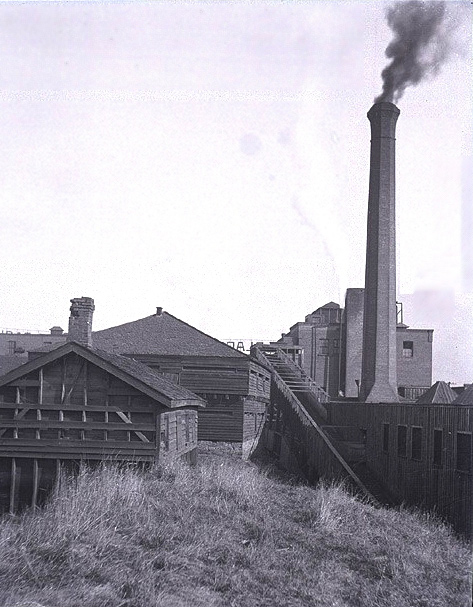
The use of the grounds by the militia gained priority as war clouds in Europe darkened. In August 1914 the city turned over the fort road to the military. Strengthening floors in old buildings for storage purposes and installing telephone poles trumped conservation. So too did the CNE’s needs, which again rendered the fort vulnerable. In the summer of 1916 the sad state of the roadway, which led to the exhibition, and the reputed impact on the fort grounds of its new eastern entrance sparked renewed debate. That year, in a seeming compromise, a streetcar line to the CNE sliced through the fort’s northern defensive wall. At the same time the road was widened and diggings from harbour improvements were dumped on the grounds. Sharing the view of acceptable reduction, the Star reasoned that the railway, regardless of its intrusion, gave exhibition goers “the historic scene of the defence of Toronto from American invaders over a century ago.” Following the war, the fort continued to be used for military needs, though it was little more than a subsidiary of Stanley Barracks.
City attitudes soon shifted once more. Efforts by the Toronto Harbor Commission to revive a programme of restoration were rebuffed by officials intent on guarding municipal turf. A battery was restored and the packinghouse was demolished. By 1926 the city’s continued re-engagement had been secured through the concerted push of the St George’s Society, St John’s Garrison Church, and the Military, National, Historical and Patriotic Societies. In 1931, in the midst of the Great Depression, the city agreed to let the Women’s Canadian Historical Society erect a cairn to the 1812 war and new gates at the fort’s western entrance. The street railway to the north was rerouted and small but important parcels of land around the fort were acquired. With Toronto’s own anniversary year (1934) nearing, a joint parks and centennial committee adopted in 1932 a “historically correct” plan for the fort’s full restoration. Though the Board of Control initially approved only work on the ramparts, the centennial, the need for relief work during the depression, and a strong restoration committee drove a comprehensive project forward in 1933-34.
Further Reading
Carl Benn, Historic Fort York, 1793–1993 (Toronto, 1993); Gerald Killan, “The first Old Fort York preservation movement, 1905-1909: an episode in the history of the Ontario Historical Society,” Ontario History, 64 (1972): 162-80.
Original printed pages