The mystery mulled over in the last F&D has been solved: it is indeed renovation going on beneath those white tarps enshrouding the Officers’ Quarters of the Stanley Barracks. It’s one of several nods to the New Fort’s history that Hotel X agreed to in its lease of the site from Exhibition Place.
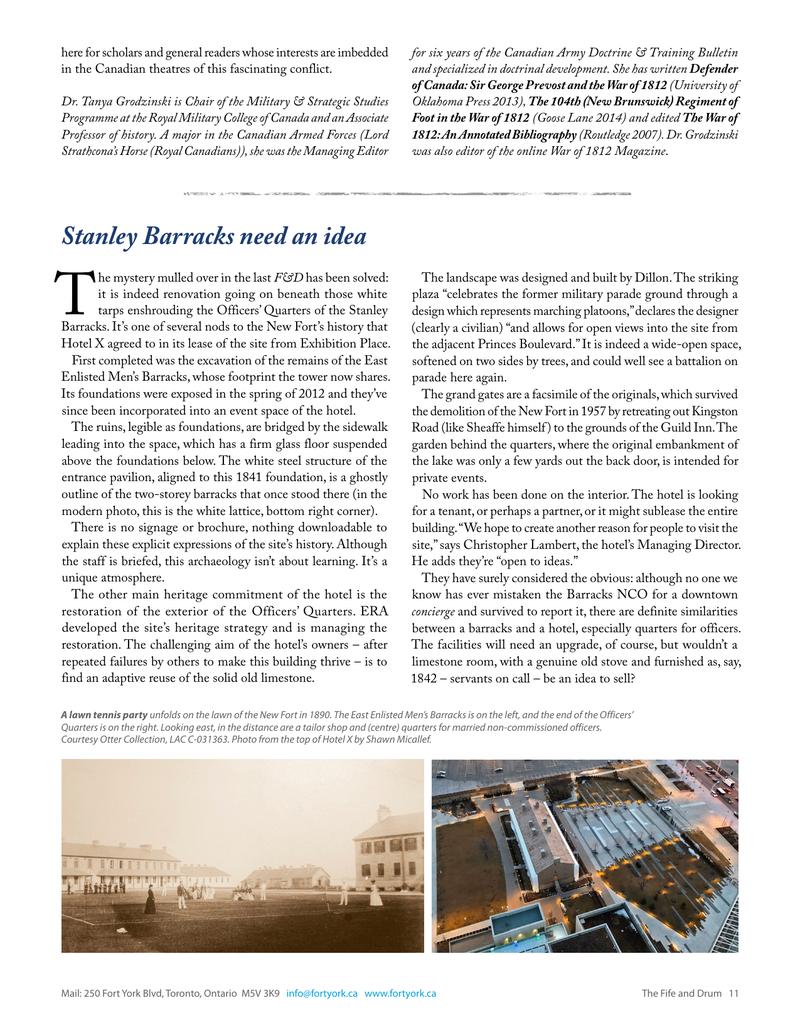
First completed was the excavation of the remains of the East Enlisted Men’s Barracks, whose footprint the tower now shares. Its foundations were exposed in the spring of 2012 and they’ve since been incorporated into an event space of the hotel. The ruins, legible as foundations, are bridged by the sidewalk leading into the space, which has a firm glass floor suspended above the foundations below. The white steel structure of the entrance pavilion, aligned to this 1841 foundation, is a ghostly outline of the two-storey barracks that once stood there (in the modern photo, this is the white lattice, bottom right corner). There is no signage or brochure, nothing downloadable to explain these explicit expressions of the site’s history. Although the staff is briefed, this archaeology isn’t about learning. It’s a unique atmosphere.
The other main heritage commitment of the hotel is the restoration of the exterior of the Officers’ Quarters. ERA developed the site’s heritage strategy and is managing the restoration. The challenging aim of the hotel’s owners – after repeated failures by others to make this building thrive – is to find an adaptive reuse of the solid old limestone.
The landscape was designed and built by Dillon. The striking plaza “celebrates the former military parade ground through a design which represents marching platoons,” declares the designer (clearly a civilian) “and allows for open views into the site from the adjacent Princes Boulevard.” It is indeed a wide-open space, softened on two sides by trees, and could well see a battalion on parade here again.
The grand gates are a facsimile of the originals, which survived the demolition of the New Fort in 1957 by retreating out Kingston Road (like Sheaffe himself) to the grounds of the Guild Inn. The garden behind the quarters, where the original embankment of the lake was only a few yards out the back door, is intended for private events.
No work has been done on the interior. The hotel is looking for a tenant, or perhaps a partner, or it might sublease the entire building. “We hope to create another reason for people to visit the site,” says Christopher Lambert, the hotel’s Managing Director. He adds they’re “open to ideas.”
They have surely considered the obvious: although no one we know has ever mistaken the Barracks NCO for a downtown concierge and survived to report it, there are definite similarities between a barracks and a hotel, especially quarters for officers. The facilities will need an upgrade, of course, but wouldn’t a limestone room, with a genuine old stove and furnished as, say, 1842 – servants on call – be an idea to sell?
Original printed pages