Part of the iconography of military historic sites, along with blockhouses, muskets and red-coats, is the heavy guns that loom over or poke through their fortified walls. These heavy iron and bronze artefacts are a quintessential symbol of Canada’s colonial past. Napoleon once said “with artillery, war is made” and considered it to be the “Queen of the battlefield”. The motto of Britain’s Royal Artillery is ubique, and indeed even today these hoary relics are all around us – not just at our museums – if one knows where to look.
Cannons fulfilled the opposing roles of defending fortifications or, knocking them down. They were horse-drawn or “man-handled” into the field, or brought into action on shipboard during naval engagements. Often however, active service was only the first stage in the life of a cannon. Once it has outlived its usefulness, or once the wear and tear from years of action had reduced the thickness of the barrel making it potentially dangerous to its gun crew, it was either melted down, used for ship’s ballast or, as was the case for two of Fort York’s guns, used as traffic bollards (see Fig.1).

Among the assortment of guns that Simcoe brought to Toronto in 1793 were some condemned 18 pounders. Due to a paucity of artillery in the North American theatre brought on by the war in Europe, these guns were pressed into service despite their poor condition. One of these guns was an antique when it was acquired by Simcoe. It was cast during the period when Oliver Cromwell was Lord Protector and England had its brief dalliance with Republicanism (1649 – 1660). When the Monarchy was restored in 1660, the markings on the piece were altered to reflect the change in regime, which is how the gun was identified – quite recently – as a Commonwealth artefact. This piece and another that was also condemned were later buried vertically in the ground, with their muzzles and part of their barrels protruding, in order to protect Fort York’s north and south brick soldiers’ barracks from damage from wagons and other vehicles. They were removed from the soil and turned into display pieces when Fort York opened as a museum, and are now a part of the artillery section of the Soldiers’ Trade exhibit housed in Blockhouse Number Two.
Several of the guns that Simcoe brought to Toronto saw action on April 27th 1813 when the United States attacked and captured the town of York during the War of 1812. Most of Toronto’s batteries were made use of during the attack, with the exception of the “marsh gun”. This particular piece was located on the west side of the Don Valley, about one hundred metres north of the harbour, and was positioned to cover the southern-most Don bridge and roadway that provided access to the peninsula. The U.S. commander, Major-General Henry Dearborn, opted to land in force to the west only and so the battle was confined to areas west of the garrison.
Simcoe also brought several 18 pounder carronades to Toronto. Carronades were short guns developed by and named after the Carron Company of Falkirk Scotland. The Carron Iron Works produced long guns as well (see Fig. 3) but are perhaps most famous for their innovative carronade. They were manufactured for the Royal Navy and quickly gained popularity because they were half the weight of an equivalent long gun but could propel a heavy projectile over a short distance. Rather than neatly piercing a ship’s hull like its longer counterpart, the carronade was very effective at smashing ships with very large low velocity projectiles. These smaller, lighter, highly maneuverable guns also found favour as garrison artillery where a small crew could use them to sweep ditches, curtain walls and other defensive works during an enemy assault. By 1814 Fort York’s defences included several of Simcoe’s18 pounders plus two 24 pounder carronades at the western battery (located near the present day Princes’ Gates), the Government House Battery (Historic Fort York’s circular battery) and the ravine battery at the mouth of Garrison creek.

Sadly, many of Fort York’s current collection of guns have been languishing without carriages for several years. One of the challenges in carriage replacement has been sourcing large enough pieces of naturally dried timber. One solution to this problem involves mounting guns on iron carriages, which is precisely what the British Army did historically. Used during peacetime, these carriages would allow for the storage of their wooden counterparts in order to protect them from the elements. Fort York has acquired three such carriages that eventually will allow for a 32 pounder to be displayed at the corner of Bathurst St. and Fort York Blvd., plus another 32 pounder and a 24 pounder in the Fort’s circular battery next to the flagpole.
A relatively recent arrival from the site of the former Marine Museum is a pair of 8 inch shell guns that are also awaiting carriages. These heavy guns were part of the Trent Affair Battery along the south wall of the fort. Shell guns were designed to fire shells that would lodge in a ship’s side, or penetrate between decks, where it could explode with devastating effect. Although the application of exploding shells dates back many centuries, they were used primarily on land fired on an angled trajectory from either mortars or howitzers. The Royal Navy resisted the adoption of exploding shells due to fears of the shells disintegrating or bursting in the barrel of the gun. There was also a naval prejudice against having exploding shells at sea because of the danger they posed to the ship and crew. However, technological advancements in the 19th century allowed for the safe application of long shell guns on board naval vessels and in sea batteries, like Fort York’s 1862 battery, that fired on straight trajectory.
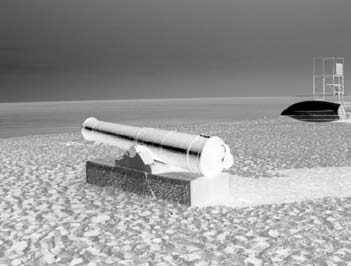
The final phase of a cannon’s life is the retirement phase. The lucky ones get to entertain visitors at historic site museums like Fort York; the others get scattered across our public parks where they provide space for graffiti or habitat for squirrels and birds. When the Hon. A.P. Caron, Minister of Militia and Defence, made a visit to Toronto in 1881, a local Alderman asked him for cannons with which to decorate Riverdale Park. Some months later five cannons on carriages arrived from Quebec City at the Yonge St. wharf, and were hauled by dray to Riverdale, where they were set up on a wooden platform in battery-like formation. All five were said to be 32-pounders, and to have been spiked – which doesn’t seem to have stopped them from being fired to celebrate Queen Victoria’s birthday for several years. One of these guns was moved in 1886 to the Broadview side of Riverdale Park, where it still resides today. Yet another was moved to Marie-Curtis Park at the mouth of the Etobicoke Creek (Fig. 2) right at the point where Hurricane Hazel swept a cottage community out into Lake Ontario in 1954. The remaining three guns presumably are eking out their twilight years in other Toronto area parks.
Original printed pages