Well informed readers of our summer issue will have noticed two (at least) errors of the editor worth correcting. Doing so led to a few fond memories.
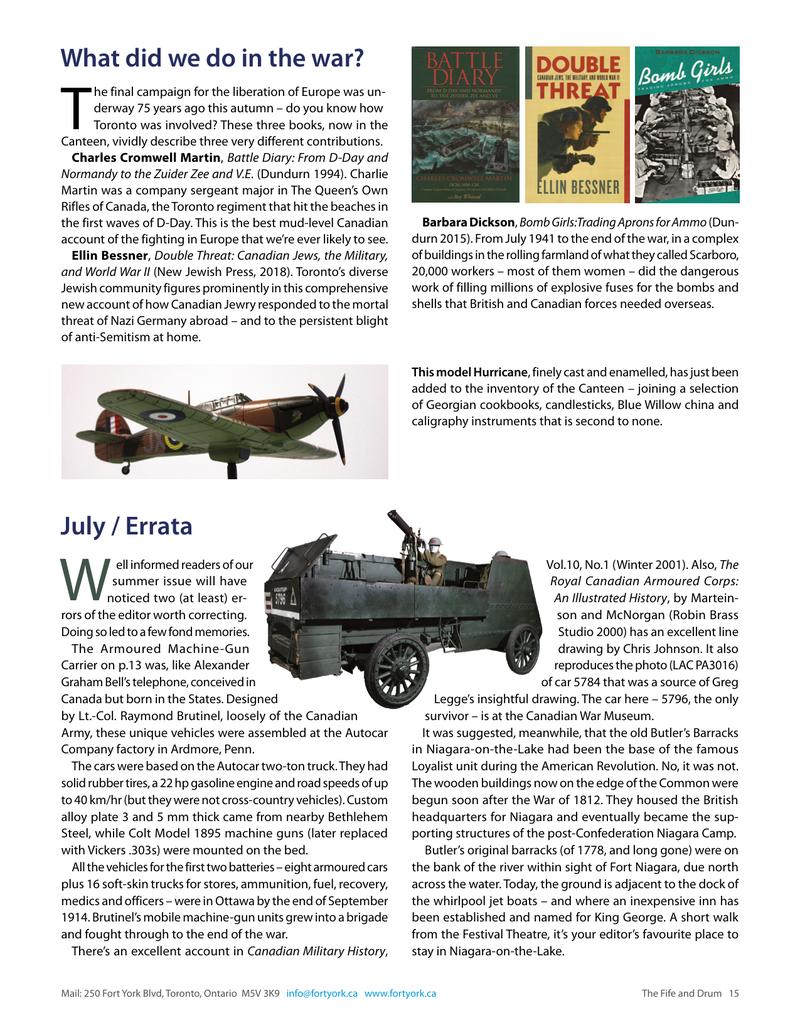
The Armoured Machine-Gun Carrier on p.13 was, like Alexander Graham Bell’s telephone, conceived in Canada but born in the States. Designed by Lt.-Col. Raymond Brutinel, loosely of the Canadian Army, these unique vehicles were assembled at the Autocar Company factory in Ardmore, Penn.
The cars were based on the Autocar two-ton truck. They had solid rubber tires, a 22 hp gasoline engine and road speeds of up to 40 km/hr (but they were not cross-country vehicles). Custom alloy plate 3 and 5 mm thick came from nearby Bethlehem Steel, while Colt Model 1895 machine guns (later replaced with Vickers .303s) were mounted on the bed.
All the vehicles for the first two batteries – eight armoured cars plus 16 soft-skin trucks for stores, ammunition, fuel, recovery, medics and officers – were in Ottawa by the end of September 1914. Brutinel’s mobile machine-gun units grew into a brigade and fought through to the end of the war.
There’s an excellent account in Canadian Military History, Vol.10, No.1 (Winter 2001). Also, The Royal Canadian Armoured Corps: An Illustrated History, by Marteinson and McNorgan (Robin Brass Studio 2000) has an excellent line drawing by Chris Johnson. It also reproduces the photo (LAC PA3016) of car 5784 that was a source of Greg Legge’s insightful drawing. The car here – 5796, the only survivor – is at the Canadian War Museum.
It was suggested, meanwhile, that the old Butler’s Barracks in Niagara-on-the-Lake had been the base of the famous Loyalist unit during the American Revolution. No, it was not. The wooden buildings now on the edge of the Common were begun soon after the War of 1812. They housed the British headquarters for Niagara and eventually became the supporting structures of the post-Confederation Niagara Camp.
Butler’s original barracks (of 1778, and long gone) were on the bank of the river within sight of Fort Niagara, due north across the water. Today, the ground is adjacent to the dock of the whirlpool jet boats – and where an inexpensive inn has been established and named for King George. A short walk from the Festival Theatre, it’s your editor’s favourite place to stay in Niagara-on-the-Lake.
Original printed pages