

In a neat and attractive package, Derek Hayes shows us Toronto through the power of maps. Maps use a specialized language that points up relationships in space—what is close to what, what aligns with what, and so forth—so they often present fresh concepts. And since these are reproductions of historical maps (“facsimiles”) they are also cultural artifacts and are a product of the culture and intent of their authors. As Hayes puts it, they “record, promote, define, or illustrate”. They are also just simply intriguing, and often beautiful.
Readers of Fife and Drum will no doubt find much of interest in the maps and accompanying text on the defences of the city. There is one chapter specifically devoted to the defences of the 1812-15 period and another to those of the 1860s, but a careful perusal of the whole work will uncover some seventy depictions of the defences, ranging in date from the mid-eighteenth century to a 2002 view of Fort York in context. Some appear merely as stylized point symbols, but others—many others—are absolutely stunning in their detail and, indeed, their beauty. Trained British military officers of the eighteenth and early nineteenth centuries received drawing as one of their four main courses–for several decades from one of England’s top water colourists—and the maps in pen and ink and colour wash are works of art.
There are twenty-nine chapters in the book (and more than 300 maps), arranged in roughly chronological order, with themes as diverse as public transit, trends in residential planning, the railways, and the waterfront. Each chapter uses a wide variety of map types, map technologies, and commercial art–a rich feast of flavours, textures and colours.
Many will look at this Atlas solely as an attractive art book. But it also offers an extensive text. To provide an interpretive text—and it is such—puts enormous demands on a specialist not in the history of Toronto, but in maps, but Hayes has risen to the task, and has also provided us with a bibliography of the best sources for further reading. (By the way, the maps themselves are also identified carefully enough to trace them to their sources.)
Speaking as one who has co-authored a parallel work, I know the challenges of a realistic budget and time-frame. Hayes has selected the content well. Since he appears to have had personal control over design, he has been able to integrate the text and graphics in a flexible layout that brings map and word together and at the same time provide striking visual interest. He has made full use of the great advances in digital technology that now allows cost-effective solutions to the problems that facsimile maps pose in simultaneously presenting an overall image (like a painting) and the minute details analogous to the characters in an alphabetic language that are the critical smallest characters in map language that make it possible to read, not just view, a map.
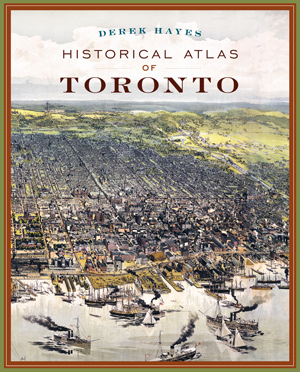
Overall, the Historical Atlas of Toronto is an amazing value. As readers of Fife and Drum, you will want to own it, but the price and compact size have made it practical for public libraries to move this atlas from the usual reference area to the lending section. It is a major contribution to our knowledge and appreciation of Toronto.
New Committee Chair
Michael Moir is the new chair of the History and Archaeology Committee succeeding Andrew Stewart who has taken on additional responsibilities with the Foundation and Bicentennial planning. A member of the board since October 2008, Michael is serving his sixth year as president of the Champlain Society.
Original printed pages


