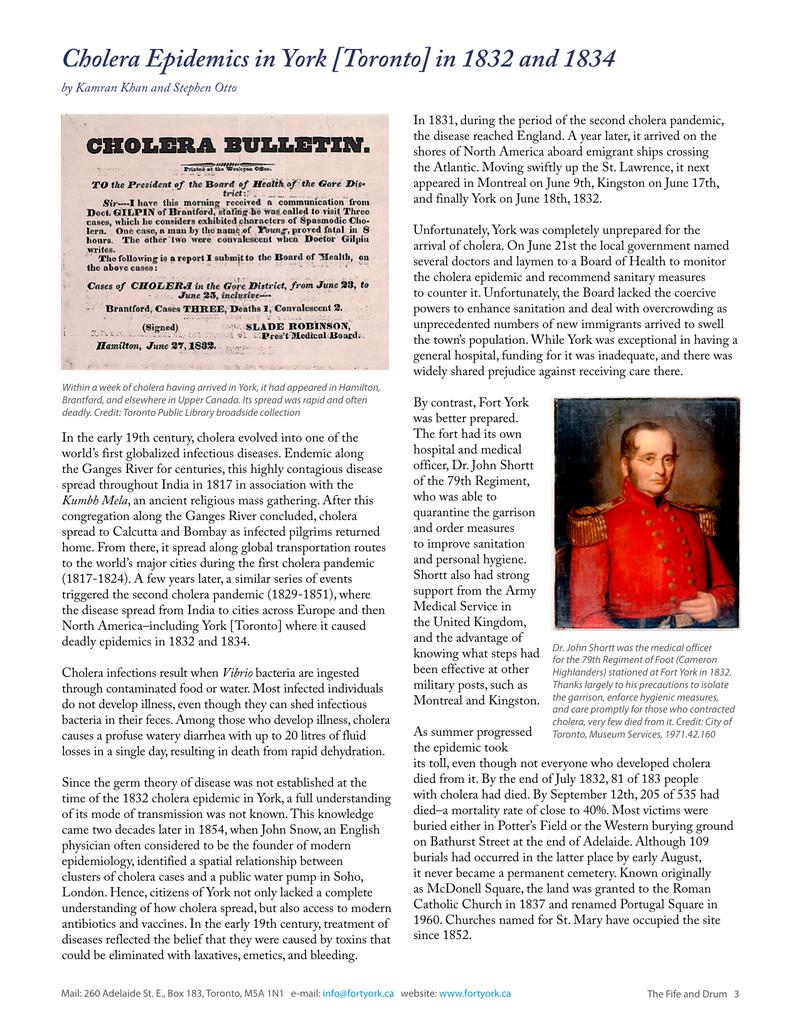
In the early 19th century, cholera evolved into one of the world’s first globalized infectious diseases. Endemic along the Ganges River for centuries, this highly contagious disease spread throughout India in 1817 in association with the Kumbh Mela, an ancient religious mass gathering. After this congregation along the Ganges River concluded, cholera spread to Calcutta and Bombay as infected pilgrims returned home. From there, it spread along global transportation routes to the world’s major cities during the first cholera pandemic (1817-1824). A few years later, a similar series of events triggered the second cholera pandemic (1829-1851), where the disease spread from India to cities across Europe and then North America–including York [Toronto] where it caused deadly epidemics in 1832 and 1834.
Cholera infections result when Vibrio bacteria are ingested through contaminated food or water. Most infected individuals do not develop illness, even though they can shed infectious bacteria in their feces. Among those who develop illness, cholera causes a profuse watery diarrhea with up to 20 litres of fluid losses in a single day, resulting in death from rapid dehydration.
Since the germ theory of disease was not established at the time of the 1832 cholera epidemic in York, a full understanding of its mode of transmission was not known. This knowledge came two decades later in 1854, when John Snow, an English physician often considered to be the founder of modern epidemiology, identified a spatial relationship between clusters of cholera cases and a public water pump in Soho, London. Hence, citizens of York not only lacked a complete understanding of how cholera spread, but also access to modern antibiotics and vaccines. In the early 19th century, treatment of diseases reflected the belief that they were caused by toxins that could be eliminated with laxatives, emetics, and bleeding.
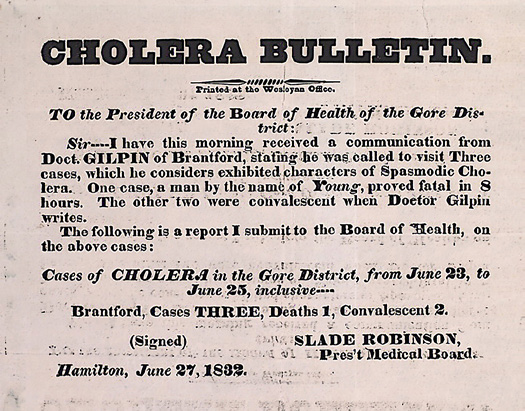
In 1831, during the period of the second cholera pandemic, the disease reached England. A year later, it arrived on the shores of North America aboard emigrant ships crossing the Atlantic. Moving swiftly up the St. Lawrence, it next appeared in Montreal on June 9th, Kingston on June 17th, and finally York on June 18th, 1832.
Unfortunately, York was completely unprepared for the arrival of cholera. On June 21st the local government named several doctors and laymen to a Board of Health to monitor the cholera epidemic and recommend sanitary measures to counter it. Unfortunately, the Board lacked the coercive powers to enhance sanitation and deal with overcrowding as unprecedented numbers of new immigrants arrived to swell the town’s population. While York was exceptional in having a general hospital, funding for it was inadequate, and there was widely shared prejudice against receiving care there.

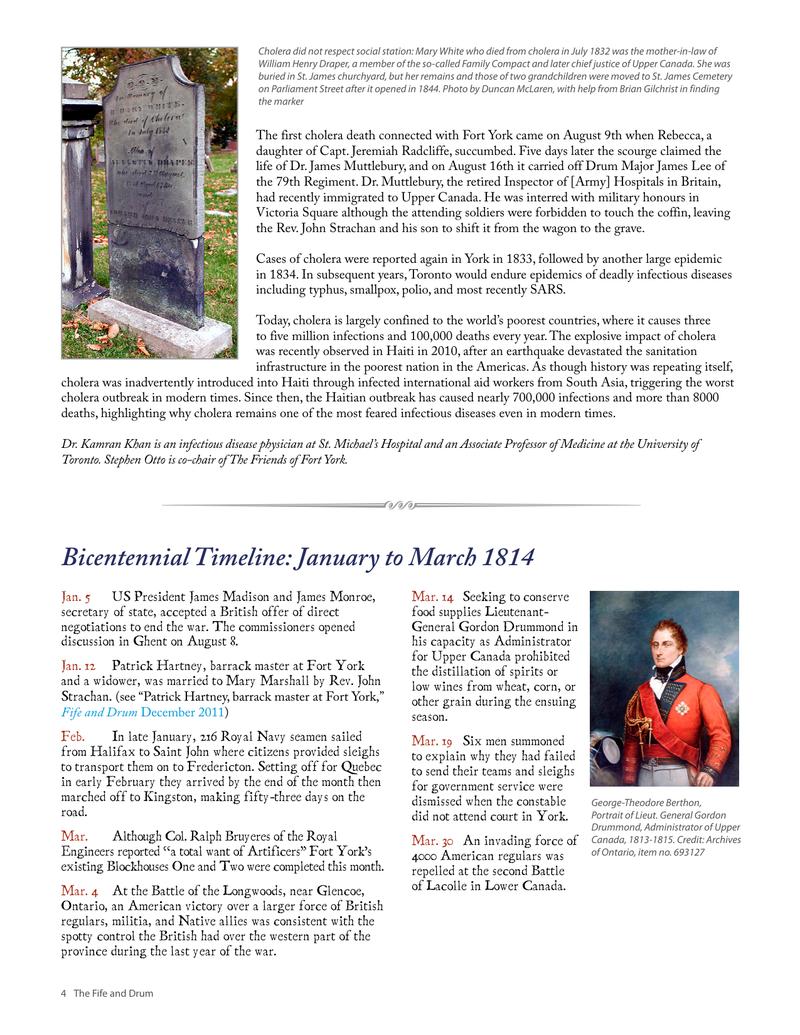
By contrast, Fort York was better prepared. The fort had its own hospital and medical officer, Dr. John Shortt of the 79th Regiment, who was able to quarantine the garrison and order measures to improve sanitation and personal hygiene. Shortt also had strong support from the Army Medical Service in the United Kingdom, and the advantage of knowing what steps had been effective at other military posts, such as Montreal and Kingston.
As summer progressed the epidemic took its toll, even though not everyone who developed cholera died from it. By the end of July 1832, 81 of 183 people with cholera had died. By September 12th, 205 of 535 had died–a mortality rate of close to 40%. Most victims were buried either in Potter’s Field or the Western burying ground on Bathurst Street at the end of Adelaide. Although 109 burials had occurred in the latter place by early August, it never became a permanent cemetery. Known originally as McDonell Square, the land was granted to the Roman Catholic Church in 1837 and renamed Portugal Square in 1960. Churches named for St. Mary have occupied the site since 1852.

The first cholera death connected with Fort York came on August 9th when Rebecca, a daughter of Capt. Jeremiah Radcliffe, succumbed. Five days later the scourge claimed the life of Dr. James Muttlebury, and on August 16th it carried off Drum Major James Lee of the 79th Regiment. Dr. Muttlebury, the retired Inspector of [Army] Hospitals in Britain, had recently immigrated to Upper Canada. He was interred with military honours in Victoria Square although the attending soldiers were forbidden to touch the coffin, leaving the Rev. John Strachan and his son to shift it from the wagon to the grave.
Cases of cholera were reported again in York in 1833, followed by another large epidemic in 1834. In subsequent years, Toronto would endure epidemics of deadly infectious diseases including typhus, smallpox, polio, and most recently SARS.
Today, cholera is largely confined to the world’s poorest countries, where it causes three to five million infections and 100,000 deaths every year. The explosive impact of cholera was recently observed in Haiti in 2010, after an earthquake devastated the sanitation infrastructure in the poorest nation in the Americas. As though history was repeating itself, cholera was inadvertently introduced into Haiti through infected international aid workers from South Asia, triggering the worst cholera outbreak in modern times. Since then, the Haitian outbreak has caused nearly 700,000 infections and more than 8000 deaths, highlighting why cholera remains one of the most feared infectious diseases even in modern times.
Original printed pages