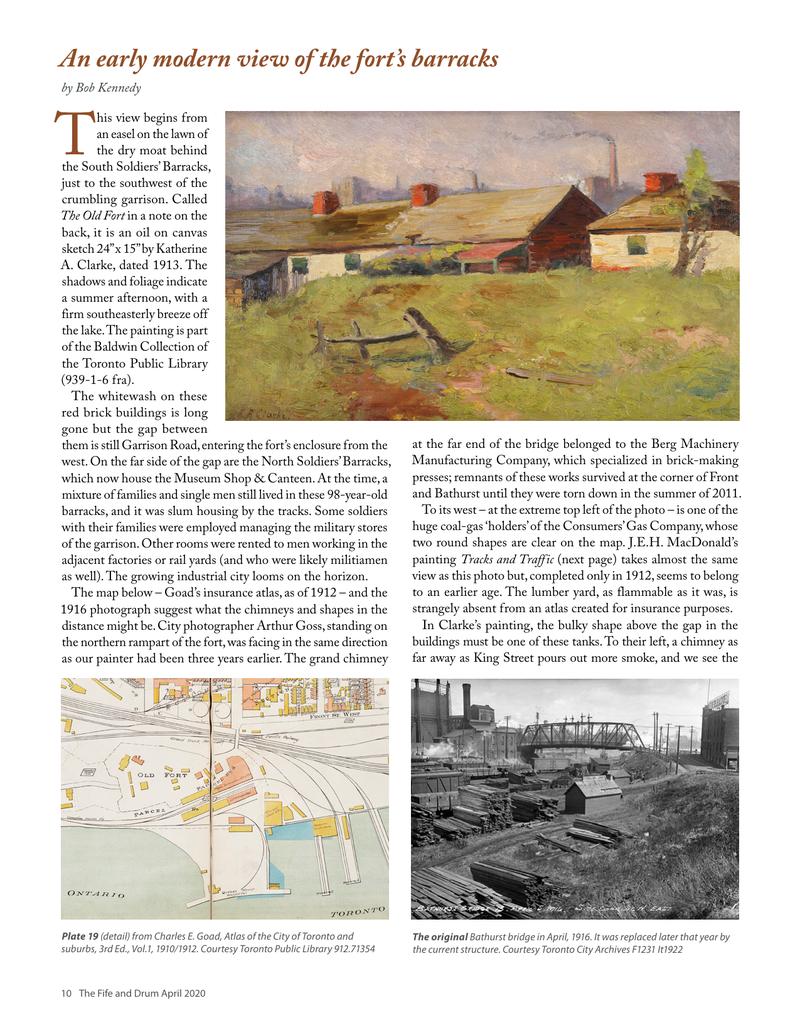
This view begins from an easel on the lawn of the dry moat behind the South Soldiers’ Barracks, just to the southwest of the crumbling garrison. Called The Old Fort in a note on the back, it is an oil on canvas sketch 24″ x 15″ by Katherine A. Clarke, dated 1913. The shadows and foliage indicate a summer afternoon, with a firm southeasterly breeze off the lake. The painting is part of the Baldwin Collection of the Toronto Public Library (939-1-6 fra).
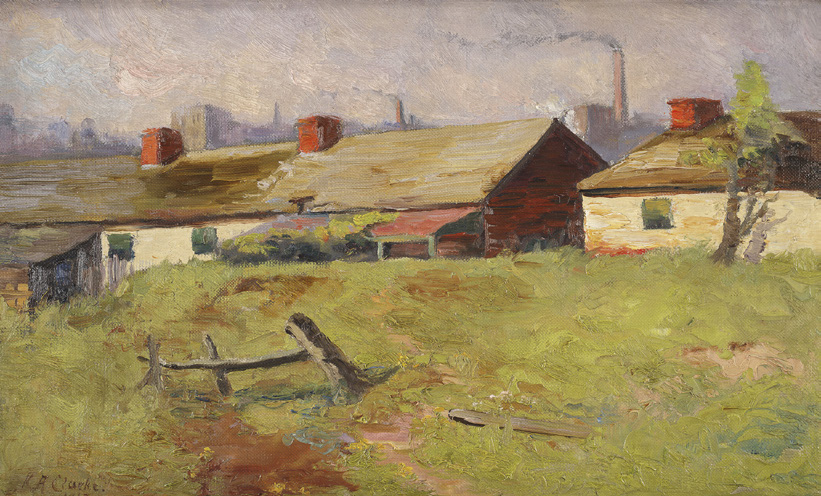
The whitewash on these red brick buildings is long gone but the gap between them is still Garrison Road, entering the fort’s enclosure from the west. On the far side of the gap are the North Soldiers’ Barracks, which now house the Museum Shop & Canteen. At the time, a mixture of families and single men still lived in these 98-year-old barracks, and it was slum housing by the tracks. Some soldiers with their families were employed managing the military stores of the garrison. Other rooms were rented to men working in the adjacent factories or rail yards (and who were likely militiamen as well). The growing industrial city looms on the horizon.
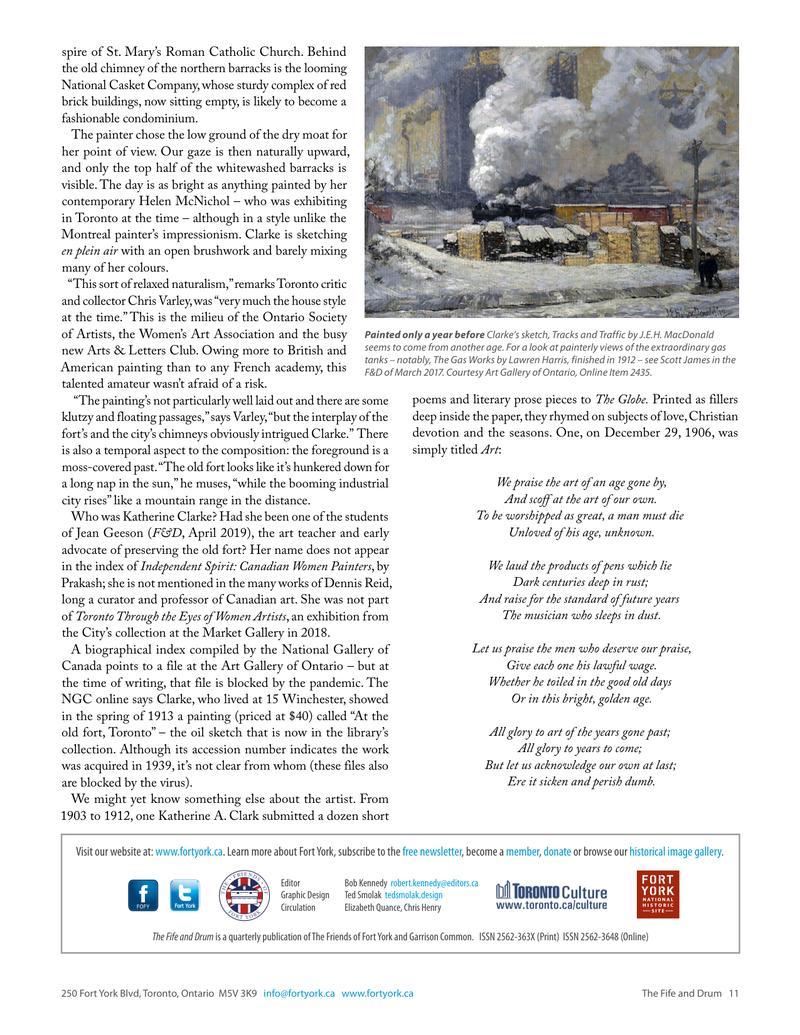
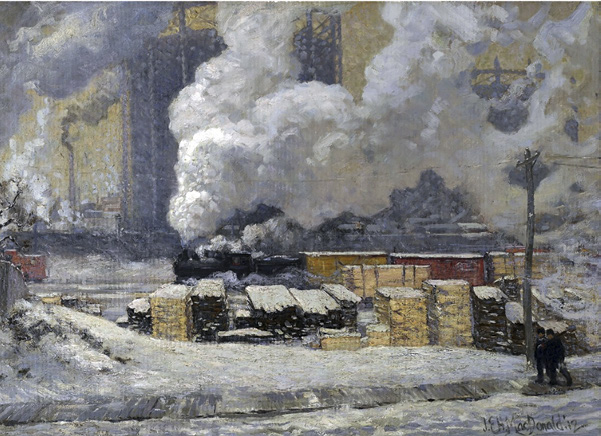
The map below – Goad’s insurance atlas, as of 1912 – and the 1916 photograph suggest what the chimneys and shapes in the distance might be. City photographer Arthur Goss, standing on the northern rampart of the fort, was facing in the same direction as our painter had been three years earlier. The grand chimney at the far end of the bridge belonged to the Berg Machinery Manufacturing Company, which specialized in brick-making presses; remnants of these works survived at the corner of Front and Bathurst until they were torn down in the summer of 2011. To its west – at the extreme top left of the photo – is one of the huge coal-gas ‘holders’ of the Consumers’ Gas Company, whose two round shapes are clear on the map. J.E.H. MacDonald’s painting Tracks and Traffic (next page) takes almost the same view as this photo but, completed only in 1912, seems to belong to an earlier age. The lumber yard, as flammable as it was, is strangely absent from an atlas created for insurance purposes.
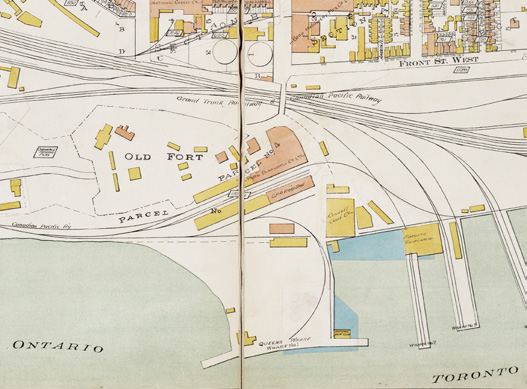
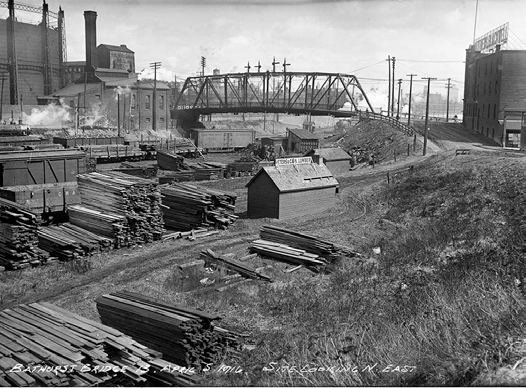
In Clarke’s painting, the bulky shape above the gap in the buildings must be one of these tanks. To their left, a chimney as far away as King Street pours out more smoke, and we see the spire of St. Mary’s Roman Catholic Church. Behind the old chimney of the northern barracks is the looming National Casket Company, whose sturdy complex of red brick buildings, now sitting empty, is likely to become a fashionable condominium.
The painter chose the low ground of the dry moat for her point of view. Our gaze is then naturally upward, and only the top half of the whitewashed barracks is visible. The day is as bright as anything painted by her contemporary Helen McNichol – who was exhibiting in Toronto at the time – although in a style unlike the Montreal painter’s impressionism. Clarke is sketching en plein air with an open brushwork and barely mixing many of her colours.
“This sort of relaxed naturalism,” remarks Toronto critic and collector Chris Varley, was “very much the house style at the time.”
This is the milieu of the Ontario Society of Artists, the Women’s Art Association and the busy new Arts & Letters Club. Owing more to British and American painting than to any French academy, this talented amateur wasn’t afraid of a risk.
“The painting’s not particularly well laid out and there are some klutzy and floating passages,” says Varley, “but the interplay of the fort’s and the city’s chimneys obviously intrigued Clarke.” There is also a temporal aspect to the composition: the foreground is a moss-covered past. “The old fort looks like it’s hunkered down for a long nap in the sun,” he muses, “while the booming industrial city rises” like a mountain range in the distance.
Who was Katherine Clarke? Had she been one of the students of Jean Geeson (F&D, April 2019), the art teacher and early advocate of preserving the old fort? Her name does not appear in the index of Independent Spirit: Canadian Women Painters, by Prakash; she is not mentioned in the many works of Dennis Reid, long a curator and professor of Canadian art. She was not part of Toronto Through the Eyes of Women Artists, an exhibition from the City’s collection at the Market Gallery in 2018.
A biographical index compiled by the National Gallery of Canada points to a file at the Art Gallery of Ontario – but at the time of writing, that file is blocked by the pandemic. The NGC online says Clarke, who lived at 15 Winchester, showed in the spring of 1913 a painting (priced at $40) called “At the old fort, Toronto” – the oil sketch that is now in the library’s collection. Although its accession number indicates the work was acquired in 1939, it’s not clear from whom (these files also are blocked by the virus).
We might yet know something else about the artist. From 1903 to 1912, one Katherine A. Clark submitted a dozen short poems and literary prose pieces to The Globe. Printed as fillers deep inside the paper, they rhymed on subjects of love, Christian devotion and the seasons. One, on December 29, 1906, was simply titled Art:
We praise the art of an age gone by,
And scoff at the art of our own.
To be worshipped as great, a man must die
Unloved of his age, unknown.We laud the products of pens which lie
Dark centuries deep in rust;
And raise for the standard of future years
The musician who sleeps in dust.Let us praise the men who deserve our praise,
Give each one his lawful wage.
Whether he toiled in the good old days
Or in this bright, golden age.All glory to art of the years gone past;
All glory to years to come;
But let us acknowledge our own at last;
Ere it sicken and perish dumb.
Original printed pages