

Since 1987, the ongoing restoration program at Fort York has included extensive archaeological investigations in every part of the fort, including the interior of each building. This twenty-five year program has identified scores of buried historic features, recovered 275,000 artifacts, and generated numerous reports. Because of this archaeology the loss of information that could have occurred as a result of potentially damaging restoration activities has been reduced and the history of the fort is much better understood.
The Ontario Heritage Act together with its Standards and Guidelines for Archaeologists defines stages of research necessary to investigate and mitigate the conflict between development and archaeological sites. Most of the recent archaeology done in the Fort York area was preceded by Stage 1 reports which examined the history of the area in advance of development to determine the potential for buried remains. In many areas, Stage 2 investigative field work was recommended to assess the actual remains that were preserved in the ground. More intense Stage 3 and Stage 4 excavations to precisely define the archaeology or to excavate and document it have also been undertaken in advance of construction activities
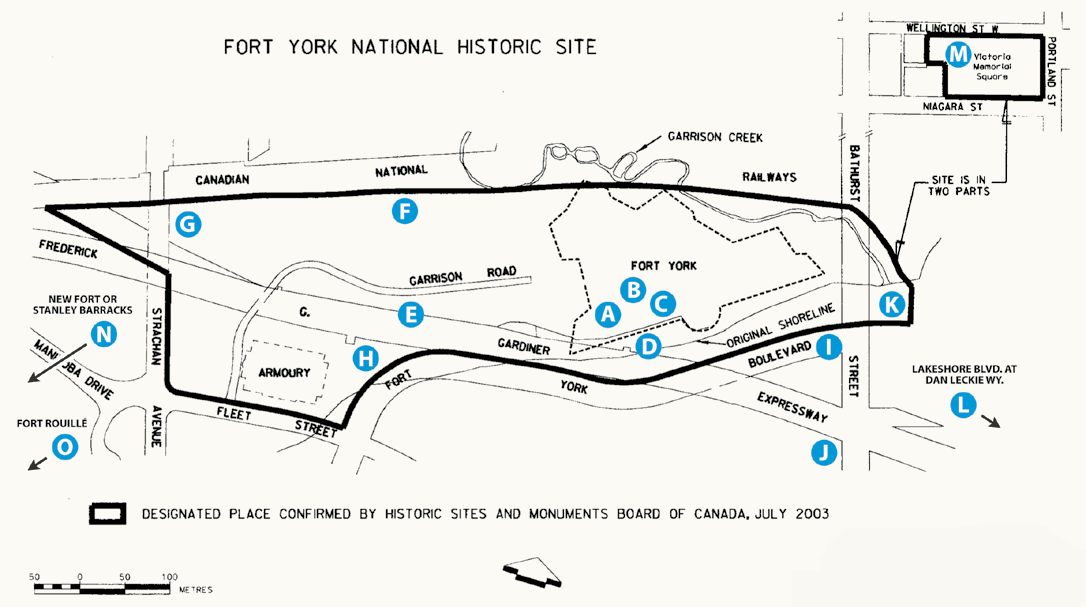
Work directly related to the restoration and rehabilitation of the buildings and landscape at the fort continues as it is required. In 2009, for example, the South Room of the South Soldiers’ Barracks (A) was partially excavated in advance of reconstruction and restoration. Deep stratigraphic deposits were uncovered and interesting domestic and military artifacts were collected. These include a beautiful uniform button of an officer of the 89th Regiment of Foot which served at York in the War of 1812 (see Fife and Drum, August 2009, pp 1-2). And just this fall, a small excavation in the ditch of the Stone Magazine (B) investigated the area of a new drain before it is installed adjacent to the building.
Also in 2011, archaeology inside Fort York on the South Parade Ground (C) saw excavations aimed at uncovering remains of the Lieutenant-Governor’s House completed. This work was recorded for a film production celebrating the anniversary of the War of 1812. Test trenching on the south Rampart in the area where the Grand Magazine (D) was thought to have been located took place at the same time.
While restoration continues, and with it archaeology, planning for the construction of the new Visitor Centre (E) west of the fort proper has included much more extensive archaeological work.
In 2009, both geophysical testing using ground penetrating radar and Stage 2 archaeological test trenching in the area of the proposed building were completed. Significant buried remains recorded there include wooden piles for military stores buildings, an extensive post-1868 engineered surface of stone, a brick footing for a military store office, a cistern, ceramic drain pipes, and old surfaces of the Garrison Road.
Mail: 260 Adelaide St. E., Box 183, Toronto, M5A 1N1
E-mail: fofy@sympatico.ca / Phone: 416-860-6493 / Website: www.fortyork.ca
Because there was so much evidence of important, well preserved archaeological deposits in this area, the location of the Visitor Centre building was shifted to the west in order to avoid destroying these remains during construction. Further Stage 4 excavations were also recommended and in 2010 and 2011, the area of the new building east of the present Fort York entrance drive was systematically excavated.
Regularly spaced wooden piles that supported framed buildings, telegraph pole bases, and 80,000 artifacts were found. Most significant among the artifacts are several twisted copper barrel hoops. These hoops are from barrels of gunpowder that were stored in the Grand Magazine of Fort York. When the magazine was blown up by the British during the American attack in April of 1813 the hoops were blasted into the air and scattered across the land west of the fort. These Stage 4 excavations have helped to identify and define the actual War of 1812 battlefield.
While the Visitor Centre is under construction, areas not already subjected to excavation will be monitored by archaeologists.
Another major project planned for the site was the proposed new Fort York Pedestrian and Cycling Bridge (F) that crossed the rail corridors from the north edge of the Garrison Common to a point south of Wellington Street (see Fife and Drum, July 2011, p 2).
At the south end of the bridge where an access ramp was to be built, Stage 2 testing took place in the Garrison Common just west of the Garrison Nursery. A grid of thirty-five test pits was opened and dug to subsoil. A few 20th-century artifacts were found but, more importantly, a small number of prehistoric Aboriginal artifacts was recovered. They consist of a small piece of chert, a notched stone, possibly a net sinker, and one undecorated ceramic pot sherd. The clay pot sherd is highly significant because no other Native ceramic fragments have been so far recovered from the Fort or any surrounding area. Together with a few other bits and pieces of Aboriginal material, this is growing evidence of the use of the Fort York area by First Nations groups.
Further Stage 2 testing occurred in the area of the Garrison Nursery in 2010. Deep deposits of fill were encountered and except for one area near the Garrison Road where a very deep deposit included early 19th-century refuse, there were no significant archaeological deposits found in the Nursery area.
Stage 2 archaeological testing was done at the north end of the proposed bridge in two parking lots south of Wellington Street. Test trenches opened here revealed only disturbed soil layers associated with the construction of the parking lots.
Additional testing was completed in September of 2010 in the Ordnance Street Triangle lands between the two railway corridors where the central pier of the bridge was to be built. Modern trash lying above sterile clay was recorded here and parts of a concrete wall and floor but no early historic or railway associated deposits were found.
To the west, the retaining wall of the Strachan Avenue Bridge was slated for improvement in 2006 so the westernmost part of the Garrison Common was archaeologically tested to make sure that no graves associated with the Old Military Burying Ground (G) (a.k.a. the Strachan Avenue Cemetery) extended as far west as the slope of Strachan Avenue. No graves or any other materials were found.
Also within the boundaries of Fort York National Historic Site a Stage 2 assessment of a small parking lot northeast of the Fort York Armoury (H) took place in 2001. The original shoreline of Lake Ontario, rarely encountered, was documented in this area.
In June of 2001, archaeological test trenching was undertaken just south of the South-East Bastion (I) of the fort in the area of the soon-to-be-built Fort York Boulevard. A stone and brick foundation wall, probably representing remains of the Grand Trunk Railway and a 19th-century wharf or pier jutting southwards into the harbour were recorded.
Because well preserved wooden remains of the Queen’s Wharf (J) were seen in 2006 during excavation for a new condominium development in Block 7 at the northwest corner of Bathurst and Fleet Streets, archaeological investigations took place with the cooperation of the land developer. Extensive, intact remains of ten wooden cribs of the western extension of the Queen’s Wharf were documented. A part of one of the cribs was removed and is currently on display outside the West Gate of Fort York.
Stage 2 archaeological field work was also conducted in 2006 on Block 36 (K) east of Bathurst Street, in an area to be redeveloped as public housing and park lands. At the same time, lands beneath the Bathurst Street Bridge east of the fort were test trenched in anticipation of the reconstruction of the bridge. Remains of structural features associated with the head of the Queen’s Wharf and remains most likely associated with the cruciform-shaped Grand Trunk Railway engine house (1856) were documented. This work formed the basis of much more extensive Stage 4 archaeological work in 2011 when the entire Block 36 development area east of Bathurst Street was documented by archaeologists. Remains uncovered here include the east end of the GTR engine house, parts of the Queen’s Wharf, the original shoreline, and the channelized Garrison Creek. Those lucky enough to have viewed this site from the Bathurst Street Bridge saw one of the largest, most complex archaeological investigations ever undertaken in the City. Importantly, here are important parts of the history and development of the fort and surrounding area.
In 2008 during monitoring of construction activities on the lands at Lakeshore Blvd. and Dan Leckie Way (L), east of the former Loblaws warehouse at Bathurst, the terminus of the east pierhead of the Wharf was documented
Other work includes geophysical and archaeological testing in 2008 of the property on the southwest corner of Queen and Portland Streets (where the Bathurst Street Barracks once stood); Stage 4 excavations of a residential property on King Street just east of Bathurst Street in 2011 (where regimental uniform buttons were found); and an assessment of 400 Wellington Street West (the site of the Commissariat Office in 2007. Geophysical survey, archaeological testing, and monitoring also occurred at Victoria Memorial National Wildlife Refuge (part of the Fort York National Historic Site) in 2002, 2004, 2006, and 2008.
Slightly farther afield are the remains of the New Fort (1841), now known as Stanley Barracks (N), located in the grounds of the Canadian National Exhibition. Archaeology in advance of the construction of the National Trade Centre took place throughout this area in the 1990s. Several seasons of archaeology directly around the Stanley Barracks and major excavations in the area of the East Range of Soldiers’ Barracks in advance of proposed hotel and banquet were conducted. Archaeological excavations of Fort Rouillé (1751) (O) west of the New Fort were also done in 1982-84.
The numerous archaeological investigations in the Fort York Neighbourhood have been undertaken because of the obvious significance of the fort itself but also because the City of Toronto has an Archaeological Master Plan. This tool identifies areas of archaeological significance so that Heritage Preservation Services in the City Planning Division can examine development plans to determine if new construction will have a negative impact on known or suspected archaeological resources in these areas. Many archaeological assessments have occurred as a condition of development.
Since the fort is surrounded by growth of all kinds the archaeological remains associated with the fort, known or suspected, are in constant danger of damage or destruction The Fort York Neighbourhood has now become one of the most intensely studied areas of the City. Archaeology will continue and future development is unlikely to occur without consideration of what might be buried below the ground.
Original printed pages


