↗ View this article in the original PDF newsletter
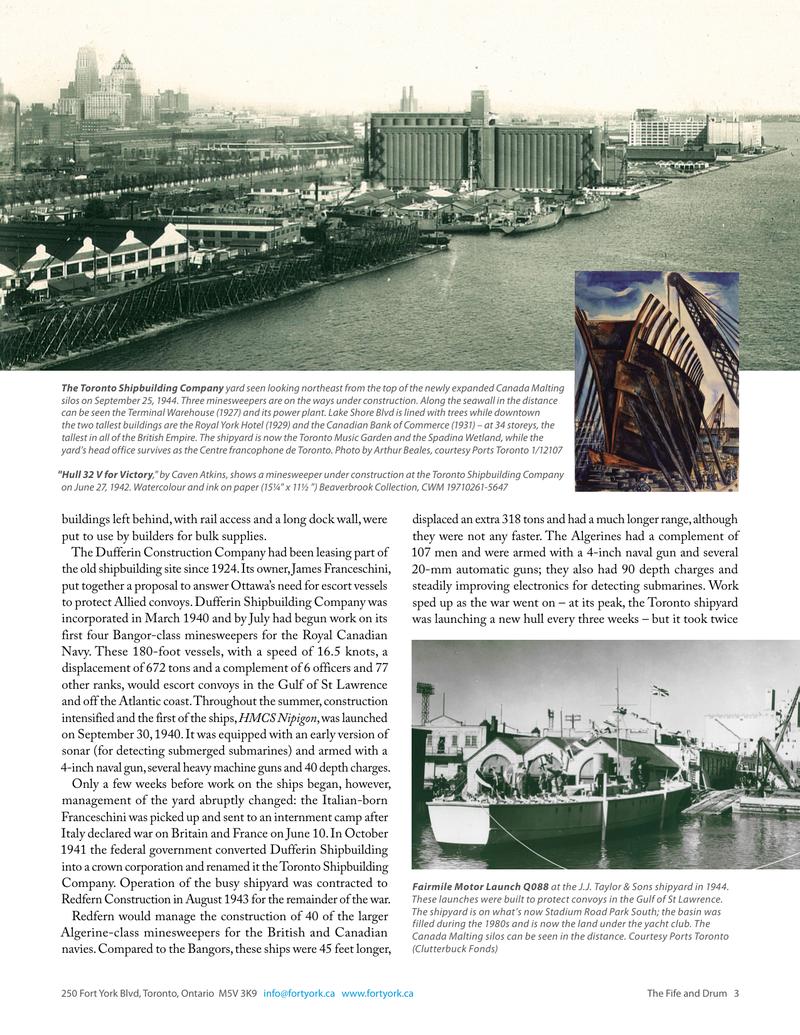
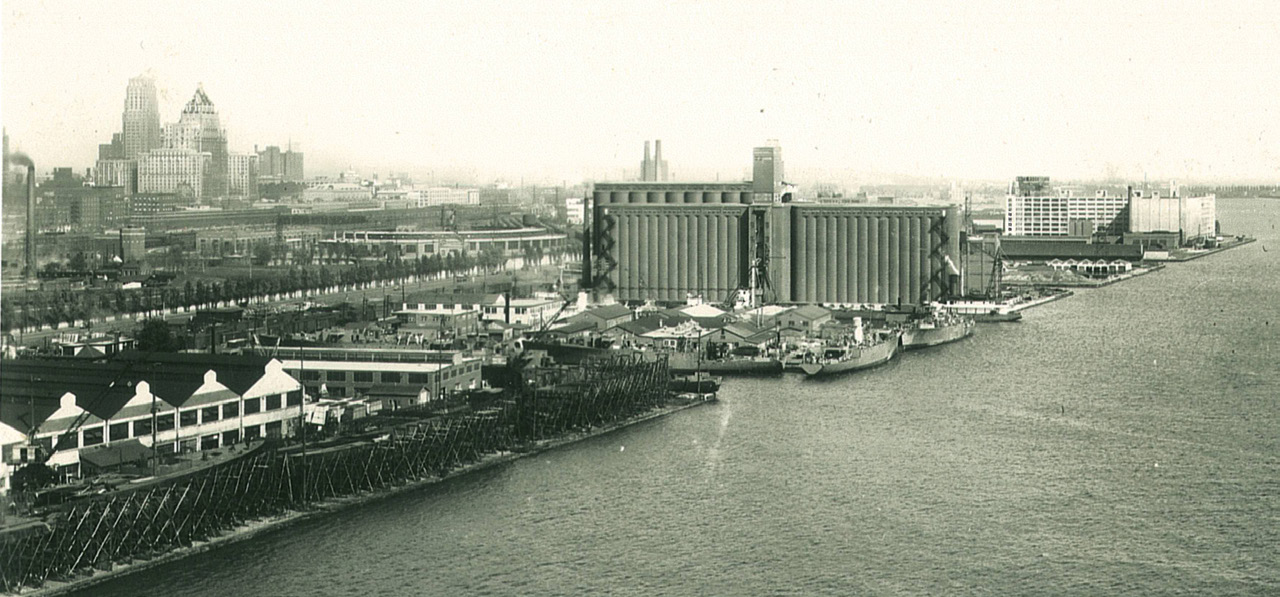
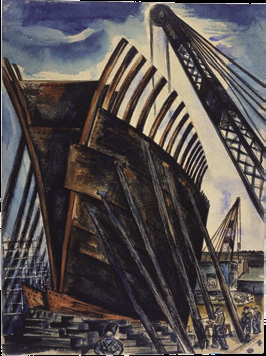
The Toronto Shipbuilding Company yard seen looking northeast from the top silos on September 25, 1944. Three minesweepers are on the ways under construction. can be seen the Terminal Warehouse (1927) and its power plant. Lake Shore Blvd is the two tallest buildings are the Royal York Hotel (1929) and the Canadian Bank of tallest in all of the British Empire. The shipyard is now the Toronto Music Garden and yard’s head office survives as the Centre francophone de Toronto. Photo by Arthur


The Toronto Shipbuilding Company yard seen looking northeast from the top silos on September 25, 1944. Three minesweepers are on the ways under construction. can be seen the Terminal Warehouse (1927) and its power plant. Lake Shore Blvd is the two tallest buildings are the Royal York Hotel (1929) and the Canadian Bank of tallest in all of the British Empire. The shipyard is now the Toronto Music Garden and yard’s head office survives as the Centre francophone de Toronto. Photo by Arthur
buildings left behind, with rail access and a long dock wall, were put to use by builders for bulk supplies. The Dufferin Construction Company had been leasing part of the old shipbuilding site since 1924. Its owner, James Franceschini, put together a proposal to answer Ottawa’s need for escort vessels to protect Allied convoys. Dufferin Shipbuilding Company was incorporated in March 1940 and by July had begun work on its first four Bangor-class minesweepers for the Royal Canadian Navy. These 180-foot vessels, with a speed of 16.5 knots, a displacement of 672 tons and a complement of 6 officers and 77 other ranks, would escort convoys in the Gulf of St Lawrence and off the Atlantic coast. Throughout the summer, construction intensified and the first of the ships, HMCS Nipigon, was launched on September 30, 1940. It was equipped with an early version of sonar (for detecting submerged submarines) and armed with a 4-inch naval gun, several heavy machine guns and 40 depth charges. Only a few weeks before work on the ships began, however, management of the yard abruptly changed: the Italian-born Franceschini was picked up and sent to an internment camp after Italy declared war on Britain and France on June 10. In October 1941 the federal government converted Dufferin Shipbuilding into a crown corporation and renamed it the Toronto Shipbuilding Company. Operation of the busy shipyard was contracted to Redfern Construction in August 1943 for the remainder of the war. Redfern would manage the construction of 40 of the larger Algerine-class minesweepers for the British and Canadian navies. Compared to the Bangors, these ships were 45 feet longer,
displaced an extra 318 tons and had a much longer range, although they were not any faster. The Algerines had a complement of 107 men and were armed with a 4-inch naval gun and several 20-mm automatic guns; they also had 90 depth charges and steadily improving electronics for detecting submarines. Work sped up as the war went on – at its peak, the Toronto shipyard was launching a new hull every three weeks – but it took twice
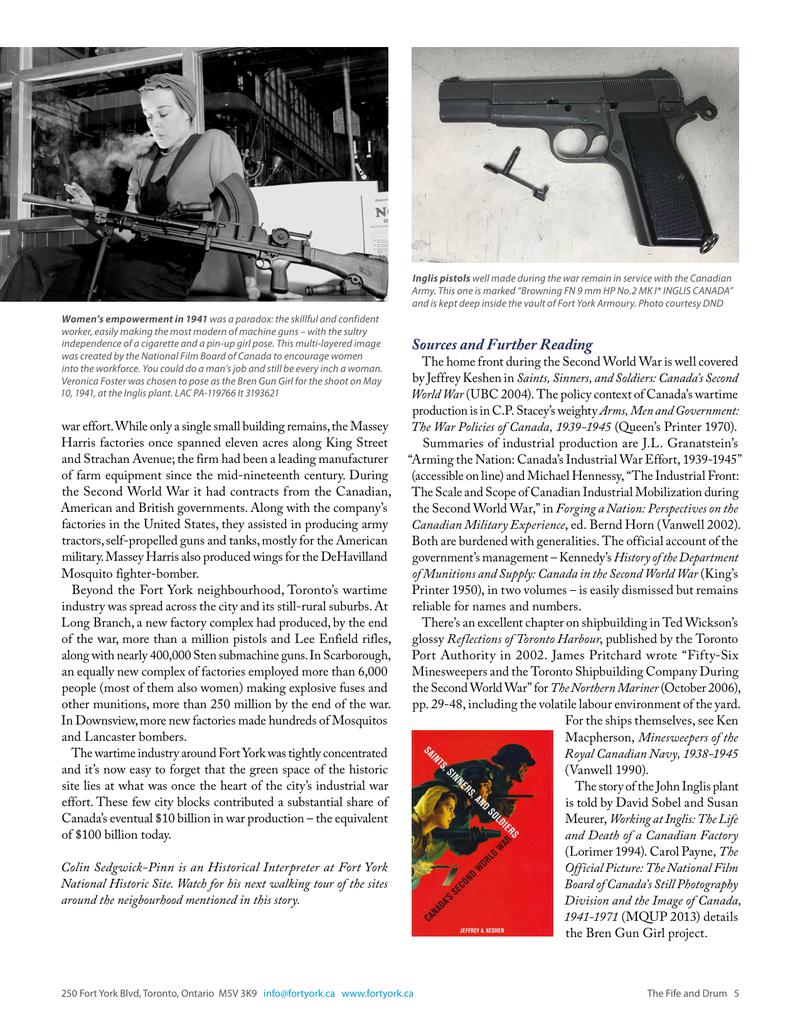
Fairmile Motor Launch Q088 at the J.J. Taylor & Sons shipyard in 1944. These launches were built to protect convoys in the Gulf of St Lawrence. The shipyard is on what’s now Stadium Road Park South; the basin was filled during the 1980s and is now the land under the yacht club. The Canada Malting silos can be seen in the distance. Courtesy Ports Toronto (Clutterbuck Fonds)

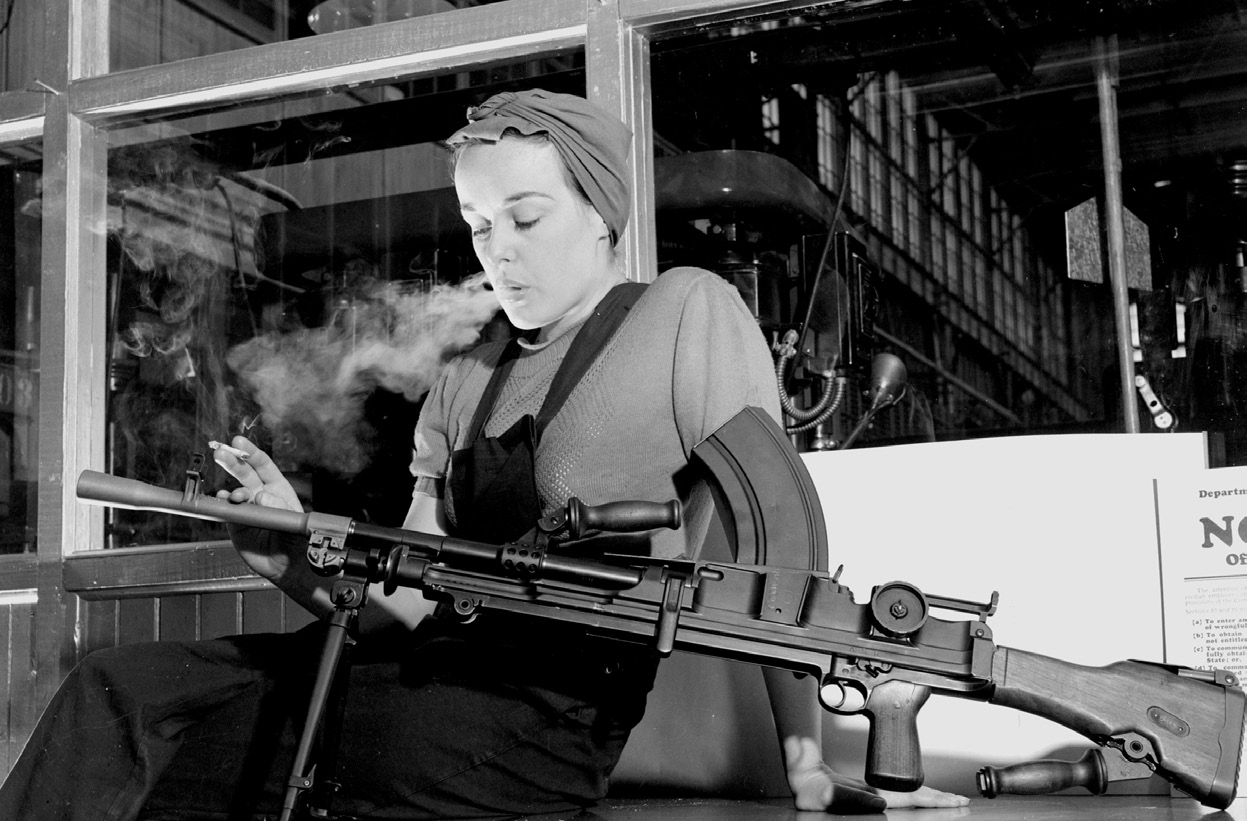
Women’s empowerment in 1941 was a paradox: the skillful and confident worker, easily making the most modern of machine guns – with the sultry independence of a cigarette and a pin-up girl pose. This multi-layered image was created by the National Film Board of Canada to encourage women into the workforce. You could do a man’s job and still be every inch a woman. Veronica Foster was chosen to pose as the Bren Gun Girl for the shoot on May 10, 1941, at the Inglis plant. LAC PA-119766 It 3193621 war effort. While only a single small building remains, the Massey Harris factories once spanned eleven acres along King Street and Strachan Avenue; the firm had been a leading manufacturer of farm equipment since the mid-nineteenth century. During the Second World War it had contracts from the Canadian, American and British governments. Along with the company’s factories in the United States, they assisted in producing army tractors, self-propelled guns and tanks, mostly for the American military. Massey Harris also produced wings for the DeHavilland Mosquito fighter-bomber. Beyond the Fort York neighbourhood, Toronto’s wartime industry was spread across the city and its still-rural suburbs. At Long Branch, a new factory complex had produced, by the end of the war, more than a million pistols and Lee Enfield rifles, along with nearly 400,000 Sten submachine guns. In Scarborough, an equally new complex of factories employed more than 6,000 people (most of them also women) making explosive fuses and other munitions, more than 250 million by the end of the war. In Downsview, more new factories made hundreds of Mosquitos and Lancaster bombers. The wartime industry around Fort York was tightly concentrated and it’s now easy to forget that the green space of the historic site lies at what was once the heart of the city’s industrial war effort. These few city blocks contributed a substantial share of Canada’s eventual $10 billion in war production – the equivalent of $100 billion today.
Sources & Further Reading
Sources and Further Reading The home front during the Second World War is well covered by Jeffrey Keshen in Saints, Sinners, and Soldiers: Canada’s Second World War (UBC 2004). The policy context of Canada’s wartime production is in C.P. Stacey’s weighty Arms, Men and Government: The War Policies of Canada, 1939-1945 (Queen’s Printer 1970). Summaries of industrial production are J.L. Granatstein’s “Arming the Nation: Canada’s Industrial War Effort, 1939-1945” (accessible on line) and Michael Hennessy, “The Industrial Front: The Scale and Scope of Canadian Industrial Mobilization during the Second World War,” in Forging a Nation: Perspectives on the Canadian Military Experience, ed. Bernd Horn (Vanwell 2002). Both are burdened with generalities. The official account of the government’s management – Kennedy’s History of the Department of Munitions and Supply: Canada in the Second World War (King’s Printer 1950), in two volumes – is easily dismissed but remains reliable for names and numbers. There’s an excellent chapter on shipbuilding in Ted Wickson’s glossy Reflections of Toronto Harbour, published by the Toronto Port Authority in 2002. James Pritchard wrote “Fifty-Six Minesweepers and the Toronto Shipbuilding Company During the Second World War” for The Northern Mariner (October 2006), pp. 29-48, including the volatile labour environment of the yard. For the ships themselves, see Ken Macpherson, Minesweepers of the Royal Canadian Navy, 1938-1945 (Vanwell 1990). The story of the John Inglis plant is told by David Sobel and Susan Meurer, Working at Inglis: The Life and Death of a Canadian Factory (Lorimer 1994). Carol Payne, The Official Picture: The National Film Board of Canada’s Still Photography Division and the Image of Canada, 1941-1971 (MQUP 2013) details the Bren Gun Girl project.
The first document is the Nominal filled with the briefest accounts of sickness, Return (the list of names) of all those who heartbreak and poverty. had served in the two flank companies of Of the 28 individual cases in the return, the 3rd York for any period during 1812. three are ordinary mistakes: one man was They were commanded by Major William missed because he was on guard duty, Allan, who had an adjutant to help with and two others were in a detachment the paperwork and Sergeant Major Robert sent to Detroit. Four were for casualties Moore to help manage the men. (all privates) at Queenston Heights on The report has only four columns: No., October 13: Thomas Smith was killed Rank, Names, Remarks. The numbers and John Tirer sufferred “a Musket Ball don’t identify soldiers but simply count the through both legs.” Andrew Kennedy and rows, and the men are listed alphabetically Thomas Major were wounded severely by first name. enough to remain in hospital at Fort The return tells us that Captain George for months (all three should have Duncan Cameron’s 1st Company had been paid while they were recovering). four lieutenants (one, Edward McMahon, detached to serve with General Brock), They turned out very four sergeants and 64 privates. It also cheerfully, but already show included a quartermaster and his sergeant a spirit of impatience. to look after the stores, presumably for both companies. Captain Steven Heward’s 2nd Company lists three lieutenants, five William Brock, on the other hand, simply sergeants, 60 privates and a drummer “went into the County to see his friends.” named Elisha Dexter. But in at least 18 of the cases, the men Against the 124 names of the privates, had either become too sick to serve or there are only 26 remarks – and 23 of them were given leave to return to families tell us the soldier deserted (of the others, facing desperate circumstances. Sgt two were “discharged from infirmary” and William Huntington, for example, was a third had a “certificate” whose definition given leave November 18 “to return to is lost). Only four desertions are detailed. his family residing in the Township of Eli Ludden “Deserted and joined the Whitby, they being in great want … his Enemy” (a potentially fatal mistake if aged Parents depending on [him] for caught). George Alten “Deserted on the support his father is since Dead.” Two route to Detroit.” Andrew Driver had other sergeants, Thomas Bright and help: “Deserted & kept hidden by family John Thompson, were given leave in in the woods.” And we can only imagine mid November “their families standing how special Private George Cary must much in want of their assistance.” Private have been: “Deserted and useless upon Leonard Marsh also was allowed to return all occasions.” to a family “who were in great distress & The second document is richer in wholly depending on him for support.” information because its purpose was to Likewise, Thomas Adams, “his family correct deficiencies in the pay of individual being sick (his Wife since died).” soldiers. This is the Supplementary Pay Among those falling sick in early List for one flank company of the 1st November was the drummer Elisha Dexter, York and the two companies of the 3rd allowed to go home “being dangerously ill.” York that we met above. Being a more But was Elisha determined to serve – or complicated return – it’s about money – it was he desperate for the meagre pay? “As has eleven columns: row, Rank, Names, soon as he recovered,” the entry continues, Companies, Periods for which Payment “he returned to his Company on the Lines has been made (From, To, Number of on the last of November.” days), Amount issued (in pounds, shillings, Why was desertion and sickness so pence), and Remarks. It covers all the common? Surprisingly little has been additional pay to these three companies written about either (see Further Reading from July 25 to December 24, 1812 (the below) but commanders at the time were usual pay period was from the 25th of well aware of the conditions their men a month to the 24th of the next). It is
were enduring. The main reasons for desertion varied by season and by what modern commanders call the operational tempo. There was also a wide variation in the behaviours, durations and meaning of all that is here called desertion. “My first object has been the calling out of the flank companies of militia,” Brock reported early in July, “which has produced a force on this line of about 800 men. They turned out very cheerfully, but already show a spirit of impatience. The King’s stores are now at such a low ebb that they can scarely furnish any article of use or comfort. Blankets, haversacks and kettles are all to be purchased, and the troops in watching the banks of the river stand in the utmost need of tents.” In a subsequent report, dated July 12 and also from Fort George, Brock pointed to another problem for the men: “So great was their clamour to return and attend to their farms that I found myself in some measure compelled to sanction the departure of a large proportion,” he conceded, “and I am not without my apprehensions that the remainder will … leave the service the moment the harvest commences.” The lack of equipment, the absence of any fighting and the life-and-death need to keep their farms going (to feed both their families and the growing army) all drew men away from the increasing boredom of repetitive training, patrolling and the grunt work of hauling supplies and digging fortifications. Worse, their camps were more than likely to be unhealthy, being crowded and with doubtful sanitation, leading to more and more sickness as the weather worsened. In November, Major General Sheaffe – who assumed Brock’s command after Queenston – reported that his militiamen were still “in a very destitute state with respect to clothing, and all in what regards bedding and barracks comforts.” Although he had ordered new equipment from Quebec, little had been distributed before the waterways froze. On the last day of 1812, his report to the Secretary of War, Lord Bathurst, admitted that his men were “exposed to wants and privations which many bore for some time with commendable consistency.” And, like Brock, he knew that many were farmers: “In their absence from their homes, their
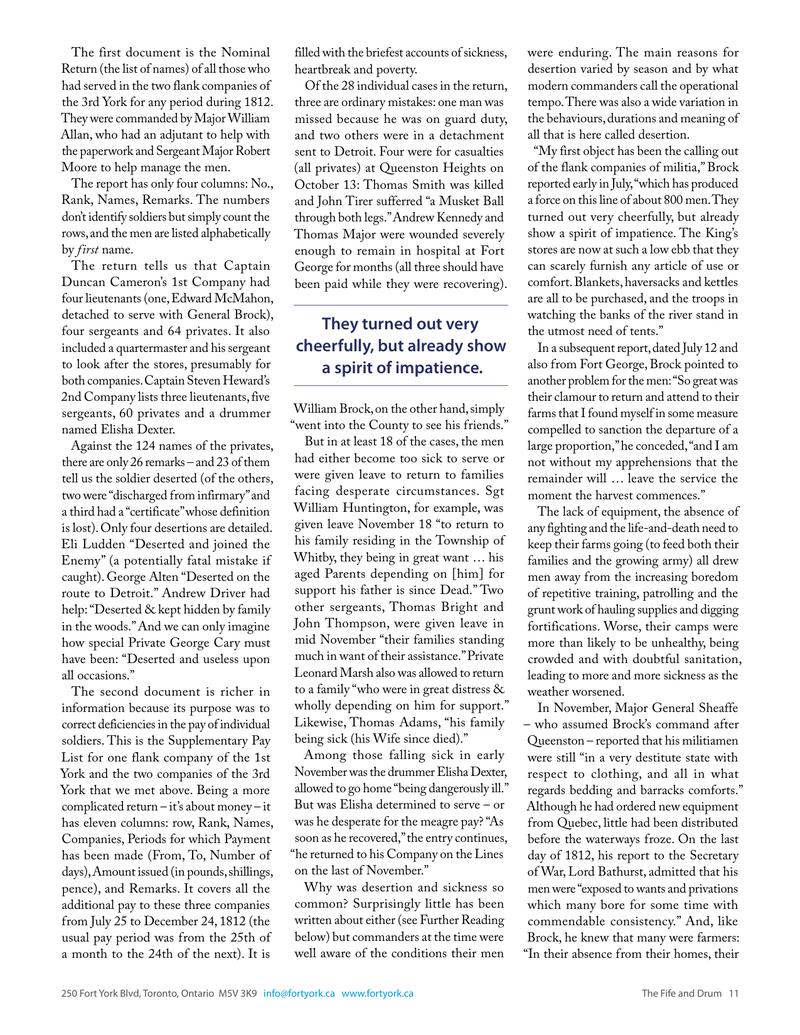
Major Peter Martinis MB CD orders The Royal Regiment of Canada to “Present Arms!” (top right). Behind him Remembrance parade on November 9 in the grand park south of their headquarters at Fort York Armoury. Anchoring on his sleeve, is Chief Warrant Officer Vishnu Persaud, the Regimental Sergeant Major. After laying a wreath, the Second World War memorial. The sentry on the front page is MCpl Kevin Kwan. Photos by Phillip Cheung

12 The Fife and Drum December 2019
Remembrance in Coronation Park
farms were suffering from neglect, much Sources and Further Reading of their produce was lost and many of Fred Blair has transcribed the complete texts of the 3rd York militia rolls and their families were in distress. This state generously made them available online here. of things caused desertions.…” They are the basis of an ongoing project While Brock worried about the loyalty combining service records with family and commitment of Upper Canada’s histories to gain new insights into the settlers, he would have been reassured backgrounds and wartime experiences by the willingness of so many to appear of these citizen soldiers. The original when there was actually some fighting to documents at Library & Archives Canada do. He had seen them marching toward can be accessed here. Queenston in October and, the following The standard reference to the local April, they were mustered for the Battle militia is William Gray, Soldiers of York. And while many were in their of the King: The Upper Canadian fields and away from Fort George in late Militia 1812-1815, A Reference May – despite daily expecting invasion, Guide (Stoddart 1995). He which came on May 27 – “at the moment outlines the records at LAC, of attack,” a sympathetic British officer traces the development of wrote a week later, “instead of diminishing, the Militia Act, distinguishes [the militia] actually increased to nearly among the many varieties double its numbers by the influx of its of units and provides their brave members who were within reach of nominal rolls. Blair’s transcripts the scene of the action.” They were, after fill in the detail. all, defending their own homes, and some The great collector and publisher of could have heard the cannon in the distance. records of the war was E.A. Cruikshank. His Documentary History of the Campaign Fred Blair is retired and living in Orillia, upon the Niagara Frontier, in many where he pursues local church history and volumes, contains the letters from Brock brings to light the documents and family and Sheaffe cited above (Vol.1, pp.93, 122; Vol.2, p.338). stories of the War of 1812.
Sources & Further Reading
farms were suffering from neglect, much Sources and Further Reading of their produce was lost and many of Fred Blair has transcribed the complete texts of the 3rd York militia rolls and their families were in distress. This state generously made them available online here. of things caused desertions.…” They are the basis of an ongoing project While Brock worried about the loyalty combining service records with family and commitment of Upper Canada’s histories to gain new insights into the settlers, he would have been reassured backgrounds and wartime experiences by the willingness of so many to appear of these citizen soldiers. The original when there was actually some fighting to documents at Library & Archives Canada do. He had seen them marching toward can be accessed here. Queenston in October and, the following The standard reference to the local April, they were mustered for the Battle militia is William Gray, Soldiers of York. And while many were in their of the King: The Upper Canadian fields and away from Fort George in late Militia 1812-1815, A Reference May – despite daily expecting invasion, Guide (Stoddart 1995). He which came on May 27 – “at the moment outlines the records at LAC, of attack,” a sympathetic British officer traces the development of wrote a week later, “instead of diminishing, the Militia Act, distinguishes [the militia] actually increased to nearly among the many varieties double its numbers by the influx of its of units and provides their brave members who were within reach of nominal rolls. Blair’s transcripts the scene of the action.” They were, after fill in the detail. all, defending their own homes, and some The great collector and publisher of could have heard the cannon in the distance. records of the war was E.A. Cruikshank. His Documentary History of the Campaign Fred Blair is retired and living in Orillia, upon the Niagara Frontier, in many where he pursues local church history and volumes, contains the letters from Brock brings to light the documents and family and Sheaffe cited above (Vol.1, pp.93, 122; Vol.2, p.338). stories of the War of 1812.
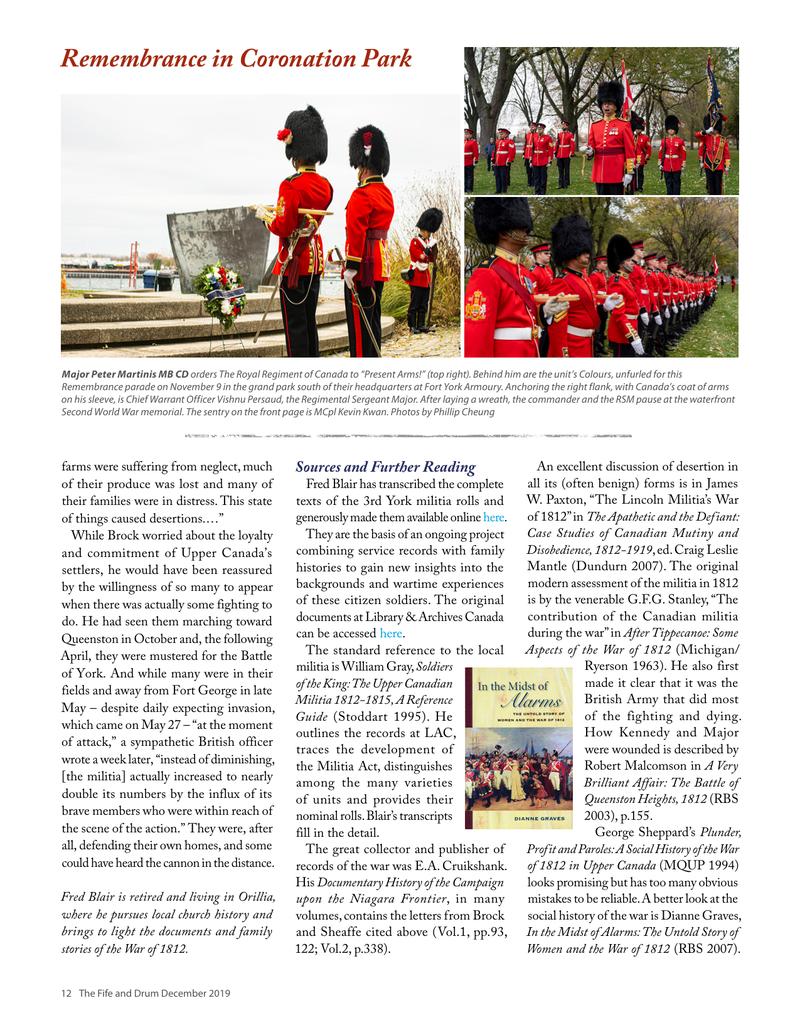
An excellent discussion of desertion in all its (often benign) forms is in James W. Paxton, “The Lincoln Militia’s War of 1812” in The Apathetic and the Defiant: Case Studies of Canadian Mutiny and Disobedience, 1812-1919, ed. Craig Leslie Mantle (Dundurn 2007). The original modern assessment of the militia in 1812 is by the venerable G.F.G. Stanley, “The contribution of the Canadian militia during the war” in After Tippecanoe: Some Aspects of the War of 1812 (Michigan/ Ryerson 1963). He also first made it clear that it was the British Army that did most of the fighting and dying. How Kennedy and Major were wounded is described by Robert Malcomson in A Very Brilliant Affair: The Battle of Queenston Heights, 1812 (RBS 2003), p.155. George Sheppard’s Plunder, Profit and Paroles: A Social History of the War of 1812 in Upper Canada (MQUP 1994) looks promising but has too many obvious mistakes to be reliable. A better look at the social history of the war is Dianne Graves, In the Midst of Alarms: The Untold Story of Women and the War of 1812 (RBS 2007).
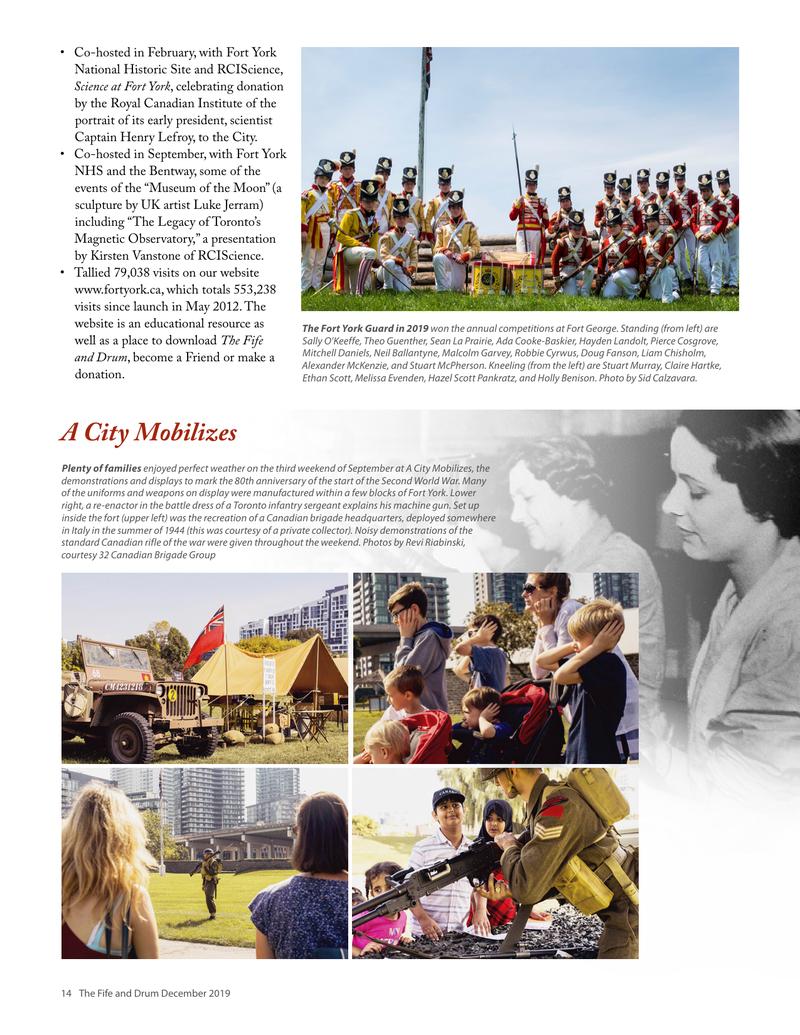
A City Mobilizes Plenty of families enjoyed perfect weather on the third weekend of September at A City Mobilizes, the demonstrations and displays to mark the 80th anniversary of the start of the Second World War. Many of the uniforms and weapons on display were manufactured within a few blocks of Fort York. Lower right, a re-enactor in the battle dress of a Toronto infantry sergeant explains his machine gun. Set up inside the fort (upper left) was the recreation of a Canadian brigade headquarters, deployed somewhere in Italy in the summer of 1944 (this was courtesy of a private collector). Noisy demonstrations of the standard Canadian rifle of the war were given throughout the weekend. Photos by Revi Riabinski, courtesy 32 Canadian Brigade Group
14 The Fife and Drum December 2019