

Fort York Armoury stands at the intersection of Canada’s wars and the social history of Toronto. The first soldiers marched into the new armoury in January of 1935, at the depth of the Depression, when only the prescient could see the approach of war. That first decade was the most intense: thousands of troops passing through on their way to war; community-wide efforts to overcome the country’s unreadiness; the seemingly endless casualties of the units based there. Yet the basic routines of a Militia regiment in garrison, even during war, have not changed very much over the past eighty years.
That is because regiments in the Militia–now called the Army Reserve–are composed entirely of part-time soldiers, men (and, since the 1980s, women) who hold down full-time jobs or are still in high school, college, or university. They are your neighbours and co-workers, and they don’t have much spare time.
They’re expected to be at the armoury one evening each week and to spend at least one weekend a month in uniform, either at the armoury or out in the field. During the summer, they might give two weeks of vacation to a career course and then beg another ten days off work (and away from family) for a large-scale field exercise. On top of this are many social and ceremonial occasions, plus a steady stream of extra tasks from headquarters–everything from carrying the flag at a Blue Jays game to filling a slot in a Regular unit heading overseas.
For most of its career, Fort York Armoury has been the home of four regiments, and two of the current occupants–the Queen’s York Rangers and the Royal Regiment of Canada– have been there, in one form or another, since 1935. By 1939 most of the men had some sort of a job but the leadership of at least one regiment made sure that those who didn’t were slipped a couple of streetcar tickets and a chit for a meal in the canteen. When the Royals were mobilized in September, 1939, they quickly set up recruiting offices around the city. It took about two weeks to fill the ranks. “Most recruits,” records the regiment’s history, “had nothing but thin civilian shoes” and many were underfed as well. “The Women’s Auxiliary undertook to provide a pint of milk per day for 40 undernourished recruits,” continues the history, “in the hope of raising their medical category.”
Mobilizing and dispatching these regiments to Europe revealed the depth of the city’s involvement. When it was announced that unheated, unfurnished buildings at the CNE would house the expanding regiments, donations of everything from sweaters to typewriters poured in. The first regiment to head overseas from Fort York was the Toronto Scottish, marching to Union Station on 5 December 1939. “Tears and liquor flowed without restraint,” records a brief history written just after the war. “One last-minute marriage was performed on the station platform,” recalls the writer, and “much excitement was occasioned when two wives arrived to bid farewell to the same husband.” When the Royal Regiment of Canada left the CNE grounds the following spring, some 5000 people attended the farewell picnic.
Left behind by each regiment was a cadre at headquarters that became the nucleus of their new 2nd Battalions, part of the Reserve for home defence and raising and training replacements for overseas. They mounted countless band concerts and sham battles to support recruiting.
Throughout the first three years of the war, as the news went from bad to worse–the fall of France, of Hong Kong, of Singapore–men were leaving Reserve battalions weekly for units that had a prospect of action. The low point came in August 1942, when our 2nd Division–including all of the Royals, a quarter of the Scottish, and many of the engineers from Fort York–mounted the disastrous raid on Dieppe. Of 554 members of the Royal Regiment of Canada who embarked, 207 were killed in a few terrifying hours on the beach. Only 65 made it back to England; the rest were taken prisoner. These were the men who’d joined the army for a decent meal and $1.30 a day.
By the summer of 1945, ships were beginning to bring nearly half a million soldiers and airmen home, and the great reunion parades began from the Summerhill and Union stations.
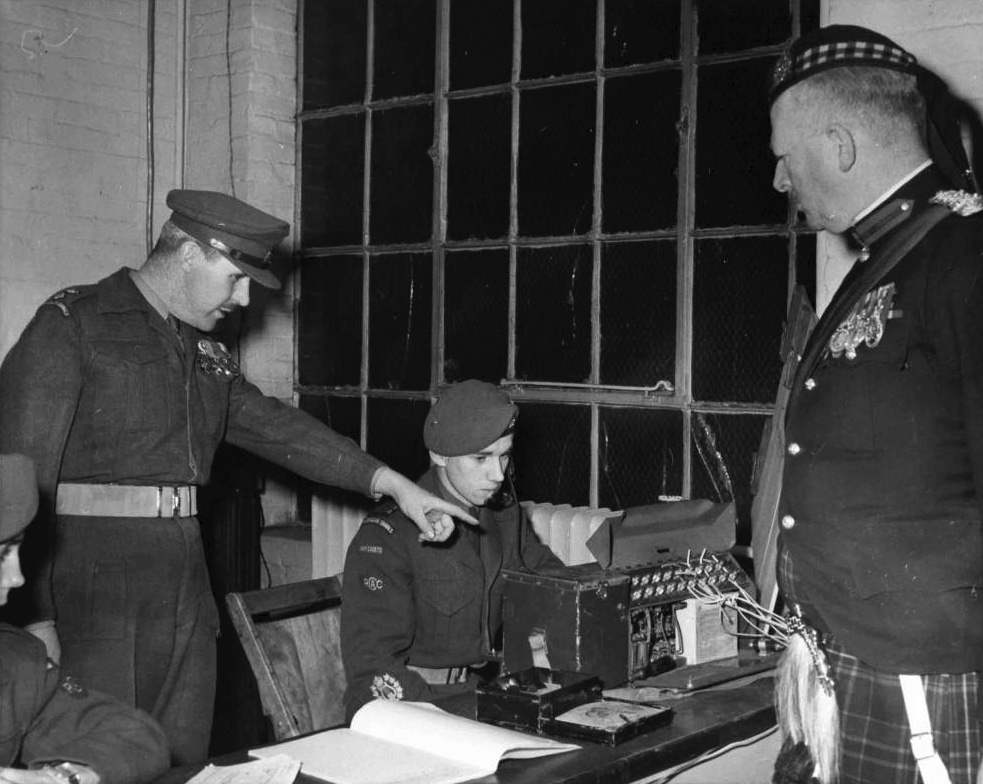
The new challenge at Fort York Armoury was to integrate the Reserve battalions with the few veterans from overseas who wanted to remain in the peacetime regiments. Every soldier who joined in the 1950s and 1960s can remember the war veteran who was his most rigorous teacher and who told the best stories. And for the first time, just after the war, small cadres of the Regular army were added to each Militia regiment.
The 1950s brought the civil defence fad to the Militia, then thought to be irrelevant in a nuclear age. Those who’d joined to learn soldiering had little enthusiasm for, say, directing the mass evacuation of the city. But Mother Nature found something else for them: Hurricane Hazel. In October of 1954, the destruction in the Humber valley led to intense activity at Fort York. Troops were deployed to search for bodies while engineers quickly built a series of wartime Bailey Bridges across the upper ravines. This task of responding to a natural disaster remains a principal role of the Army Reserve.

Social history and warfare intersect at the armoury because these soldiers, being part-time, remain integrated into Canadian society in a way that Regular soldiers, now sequestered on bases, are not. Reservists, men and women, typically spend their entire career in a single regiment not far from home. Especially in the cities their regiments are more exposed to trends in immigration. A survey a few years ago found a twenty-onemember reconnaissance troop of the Queen’s York Rangers that among them could speak fourteen languages.
The peacekeeping missions of the Cold War rarely involved many troops, and few Militiamen were required. That changed in the first big postwar operation in the Balkans, when Reservists were required in large numbers, usually deploying as individuals to fill in the gaps. During the last decade, a steady stream of soldiers has left Fort York Armoury for service in the far corners of the globe: more than 200 to the Balkans, the Middle East, Africa, and especially Afghanistan. They follow a calling as old as the armoury itself.
Original printed pages


