Although the British Army has frequently (and with reason) been described as a collection of sovereign regiments whose quirky peculiarities hindered the inculcation of common doctrine and a shared way of doing things, for a century and a half it has nevertheless had a cultural and professional “centre”: Salisbury Plain in southern England and the associated sprawl there that encompasses Aldershot, the Royal Military Academy Sandhurst, and the Staff College, Camberley.
Is there a similar thing in Canada–a single cultural and professional “home” for the Canadian Army? I suspect not, but several locations might make a claim to at least a share. Kingston probably has the strongest because it has been home to the Royal Military College of Canada/ le Collège militaire royale du Canada since 1876 and the Canadian Army Staff College since the Second World War. The current generation of soldiers might point to Wainwright, Alberta–formerly a regional training area which gained “national” standing because of the state of the art facility developed there for the combat in Afghanistan. An earlier generation might suggest Gagetown, New Brunswick, purpose-built in the 1950s and home to the Combat Training Centre and Cold War collective training for decades. Historically, Valcartier, Quebec, was home to the First Contingent of the Canadian Expeditionary Force, while Petawawa, Ontario, developed just before the First World War, was the training ground for the Permanent Force, Canada’s professional standing army, once its role was expanded beyond providing instruction to the part-time militia.

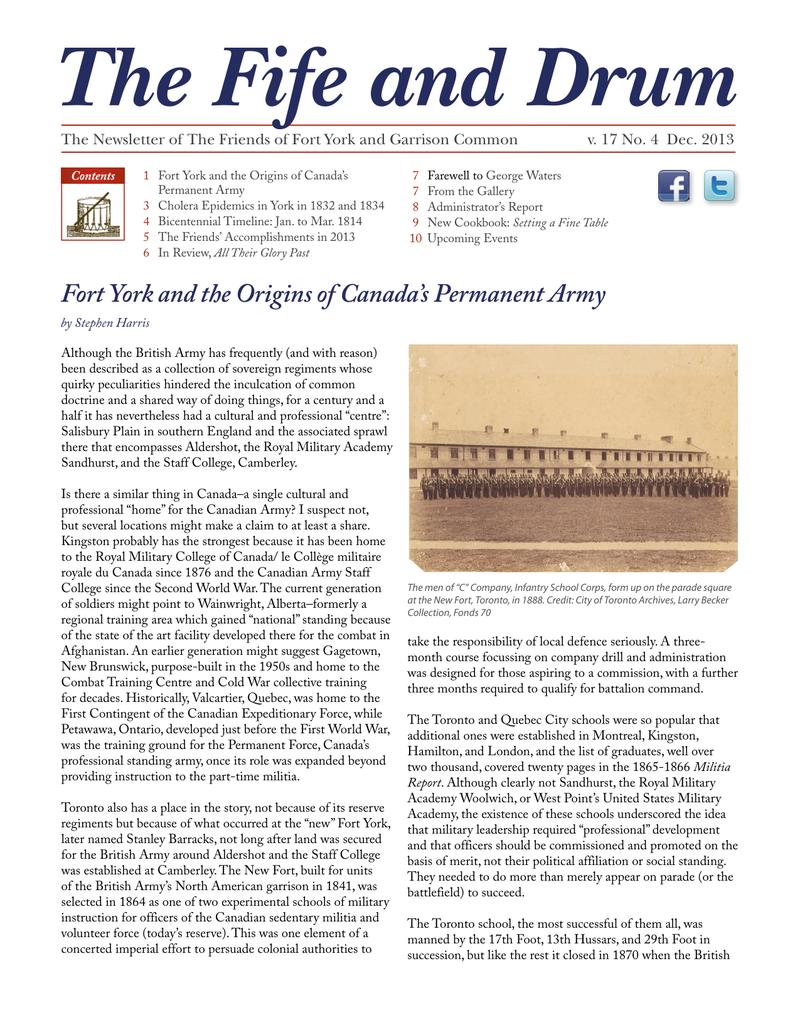
Toronto also has a place in the story, not because of its reserve regiments but because of what occurred at the “new” Fort York, later named Stanley Barracks, not long after land was secured for the British Army around Aldershot and the Staff College was established at Camberley. The New Fort, built for units of the British Army’s North American garrison in 1841, was selected in 1864 as one of two experimental schools of military instruction for officers of the Canadian sedentary militia and volunteer force (today’s reserve). This was one element of a concerted imperial effort to persuade colonial authorities to take the responsibility of local defence seriously. A three-month course focussing on company drill and administration was designed for those aspiring to a commission, with a further three months required to qualify for battalion command.
The Toronto and Quebec City schools were so popular that additional ones were established in Montreal, Kingston, Hamilton, and London, and the list of graduates, well over two thousand, covered twenty pages in the 1865-1866 Militia Report. Although clearly not Sandhurst, the Royal Military Academy Woolwich, or West Point’s United States Military Academy, the existence of these schools underscored the idea that military leadership required “professional” development and that officers should be commissioned and promoted on the basis of merit, not their political affiliation or social standing. They needed to do more than merely appear on parade (or the battlefield) to succeed.
The Toronto school, the most successful of them all, was manned by the 17th Foot, 13th Hussars, and 29th Foot in succession, but like the rest it closed in 1870 when the British government withdrew its troops from Canada except for the garrison at the Halifax Citadel. Canadian officers on long-term contracts maintained a modicum of instruction (without benefit of attached troops) after the British left, but all the schools died a natural death by 1874: voting with their feet, students simply stopped attending. The two artillery schools established at Kingston and Quebec flourished, however, because they were permanently manned; and although the process would take almost a decade, once it was clear that the Royal Military College of Canada would never satisfy militia requirements, the pressure to replicate the training that had existed in the mid-1860s mounted. Finally, in June 1883, the Canadian government agreed with those who maintained that the country needed better organized schools of military instruction, and infantry and cavalry “school corps” were established to provide instruction to the militia–and pointedly NOT to serve as an embryonic, standing army.

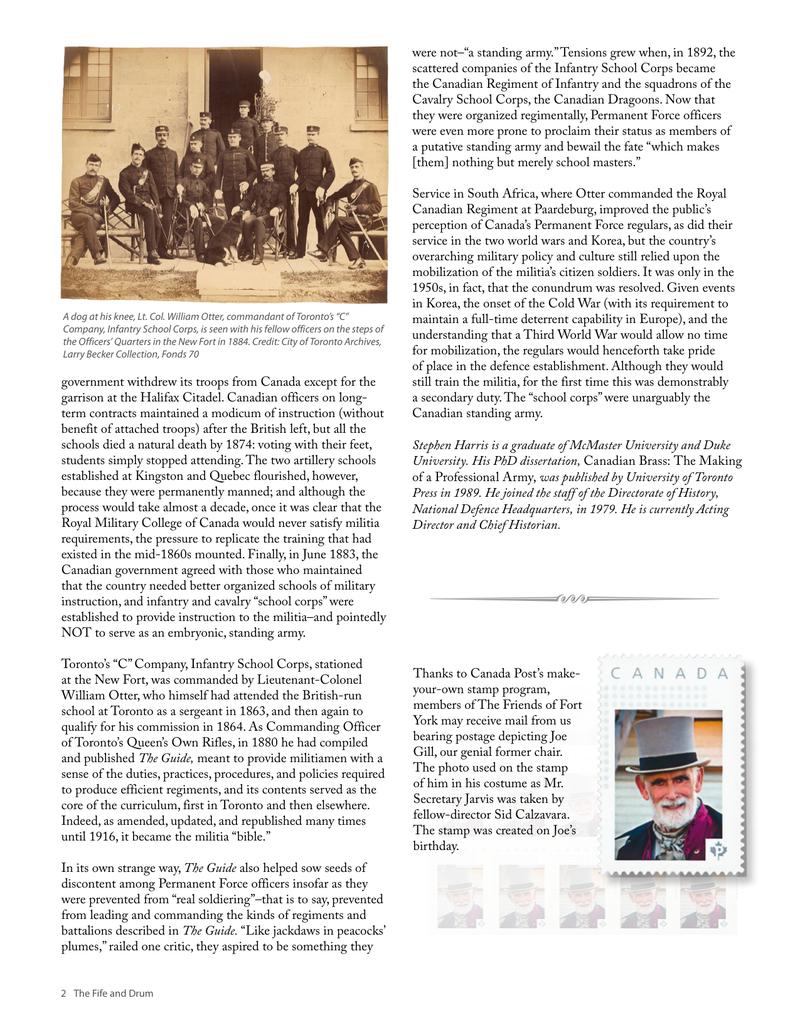
Toronto’s “C” Company, Infantry School Corps, stationed at the New Fort, was commanded by Lieutenant-Colonel William Otter, who himself had attended the British-run school at Toronto as a sergeant in 1863, and then again to qualify for his commission in 1864. As Commanding Officer of Toronto’s Queen’s Own Rifles, in 1880 he had compiled and published The Guide, meant to provide militiamen with a sense of the duties, practices, procedures, and policies required to produce efficient regiments, and its contents served as the core of the curriculum, first in Toronto and then elsewhere. Indeed, as amended, updated, and republished many times until 1916, it became the militia “bible.”
In its own strange way, The Guide also helped sow seeds of discontent among Permanent Force officers insofar as they were prevented from “real soldiering”–that is to say, prevented from leading and commanding the kinds of regiments and battalions described in The Guide. “Like jackdaws in peacocks’ plumes,” railed one critic, they aspired to be something they were not–”a standing army.” Tensions grew when, in 1892, the scattered companies of the Infantry School Corps became the Canadian Regiment of Infantry and the squadrons of the Cavalry School Corps, the Canadian Dragoons. Now that they were organized regimentally, Permanent Force officers were even more prone to proclaim their status as members of a putative standing army and bewail the fate “which makes [them] nothing but merely school masters.”
Service in South Africa, where Otter commanded the Royal Canadian Regiment at Paardeburg, improved the public’s perception of Canada’s Permanent Force regulars, as did their service in the two world wars and Korea, but the country’s overarching military policy and culture still relied upon the mobilization of the militia’s citizen soldiers. It was only in the 1950s, in fact, that the conundrum was resolved. Given events in Korea, the onset of the Cold War (with its requirement to maintain a full-time deterrent capability in Europe), and the understanding that a Third World War would allow no time for mobilization, the regulars would henceforth take pride of place in the defence establishment. Although they would still train the militia, for the first time this was demonstrably a secondary duty. The “school corps” were unarguably the Canadian standing army.

Original printed pages