↗ View this article in the original PDF newsletter
of the costs of war. On the quiet Swedish island of Gotland archeologists unearthed the body of a local soldier in his chain mail. He had been killed along with many of his fellows fighting Danish invaders in 1361. Bodies can be preserved for centuries if they are buried in mud or mummified in hot countries. In the summer of 2018 archeologists surveying land near Ypres for a housing development found the remains of 125 soldiers, German mainly, but also Allied, who had lain there since they fell in the First World War. In 2002 thousands of corpses, still dressed in their blue uniforms with buttons bearing the numbers of their regiments, were discovered in a mass grave outside Vilnius. They had died during Napoleon’s retreat from Moscow in 1812. When we pause to does war bring out remember war we think of human nature its costs—the waste of human beings and resources—its violence, its unpredictability and the chaos it can leave in its wake. We less often recognize just how organized war is. In 1940 Germany tried to force Britain into surrender and for nearly two months London was bombed day and night. Many nonessential civilians were evacuated to the countryside. Those who remained slept in makeshift shelters or the Underground. The British Broadcasting Corporation—the BBC—which was based in the centre of London, sent several departments away. Music went to Bedford, Drama and Variety to Bristol, until that got too dangerous, and Variety went off to languish rather glumly in the sedate town of Bangor in North Wales. The remaining staff often could not get home at night so the BBC—not nicknamed Auntie for nothing—turned its Radio Theatre into a dormitory, with a curtain down the middle to keep the sexes apart. In October two bombs hit the building. Seven members of staff died as they tried to remove an unexploded one and the fire department rushed to the scene to keep the flames from spreading. The news reader for the nine o’clock news paused briefly as the building shook and then kept going, covered in soot and dust. By the next morning scaffolding had gone up around Broadcasting House and the rubble was being cleared. Think for a moment of the organization that was involved in that single episode, a tiny one in the overall history of the war. The German bombers, with their fighter escorts, were the products of Germa ny’s war industry, which had mobilized resources from materials to labour and factories in order to get the planes made and into the air. Their crews had been chosen and trained. German intelligence and planners had done their best to select important targets. And the British response was equally organized. The Royal Air Force tracked the incoming planes and did its best to stop them, while on the ground crews manned barrage balloons and searchlights. The blackout over London and other key cities was complete and carefully monitored. The BBC had made contingency plans, the fire department came and the work of clearing up started at once.
18 The Fife and Drum April 2021
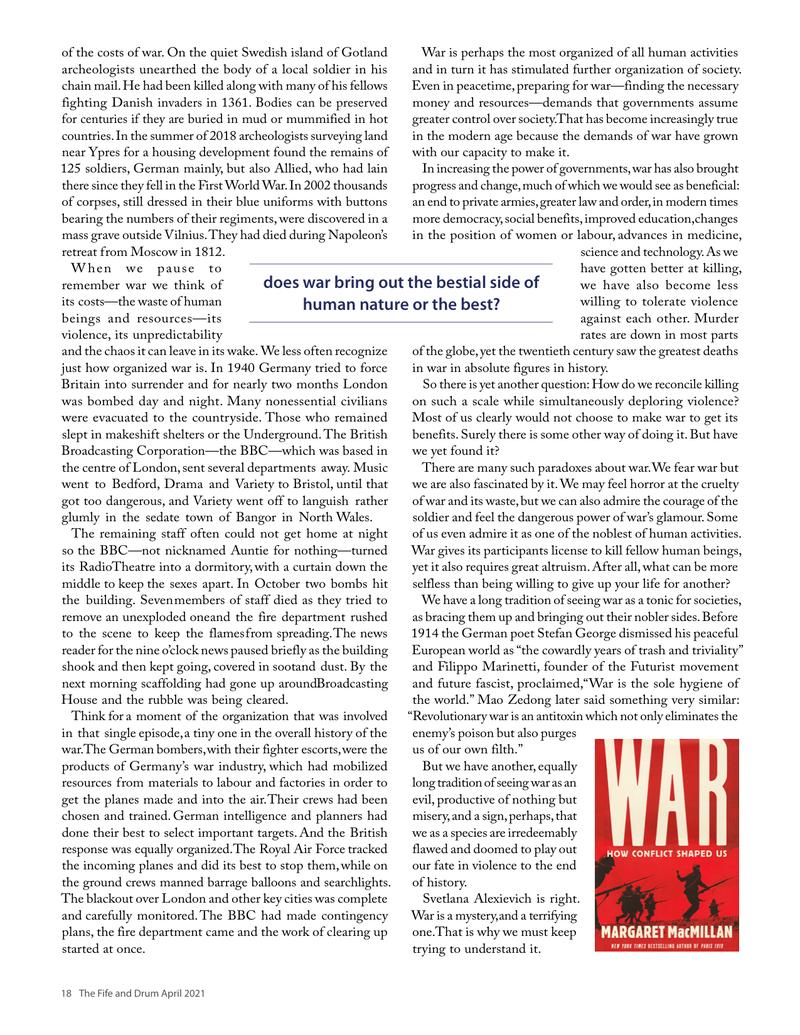
War is perhaps the most organized of all human activities and in turn it has stimulated further organization of society. Even in peacetime, preparing for war—finding the necessary money and resources—demands that governments assume greater control over society. That has become increasingly true in the modern age because the demands of war have grown with our capacity to make it. In increasing the power of governments, war has also brought progress and change, much of which we would see as beneficial: an end to private armies, greater law and order, in modern times more democracy, social benefits, improved education, changes in the position of women or labour, advances in medicine, science and technology. As we have gotten better at killing, the bestial side of we have also become less or the best? willing to tolerate violence against each other. Murder rates are down in most parts of the globe, yet the twentieth century saw the greatest deaths in war in absolute figures in history. So there is yet another question: How do we reconcile killing on such a scale while simultaneously deploring violence? Most of us clearly would not choose to make war to get its benefits. Surely there is some other way of doing it. But have we yet found it? There are many such paradoxes about war. We fear war but we are also fascinated by it. We may feel horror at the cruelty of war and its waste, but we can also admire the courage of the soldier and feel the dangerous power of war’s glamour. Some of us even admire it as one of the noblest of human activities. War gives its participants license to kill fellow human beings, yet it also requires great altruism. After all, what can be more selfless than being willing to give up your life for another? We have a long tradition of seeing war as a tonic for societies, as bracing them up and bringing out their nobler sides. Before 1914 the German poet Stefan George dismissed his peaceful European world as “the cowardly years of trash and triviality” and Filippo Marinetti, founder of the Futurist movement and future fascist, proclaimed, “War is the sole hygiene of the world.” Mao Zedong later said something very similar: “Revolutionary war is an antitoxin which not only eliminates the enemy’s poison but also purges us of our own filth.” But we have another, equally long tradition of seeing war as an evil, productive of nothing but misery, and a sign, perhaps, that we as a species are irredeemably flawed and doomed to play out our fate in violence to the end of history. Svetlana Alexievich is right. War is a mystery, and a terrifying one. That is why we must keep trying to understand it.
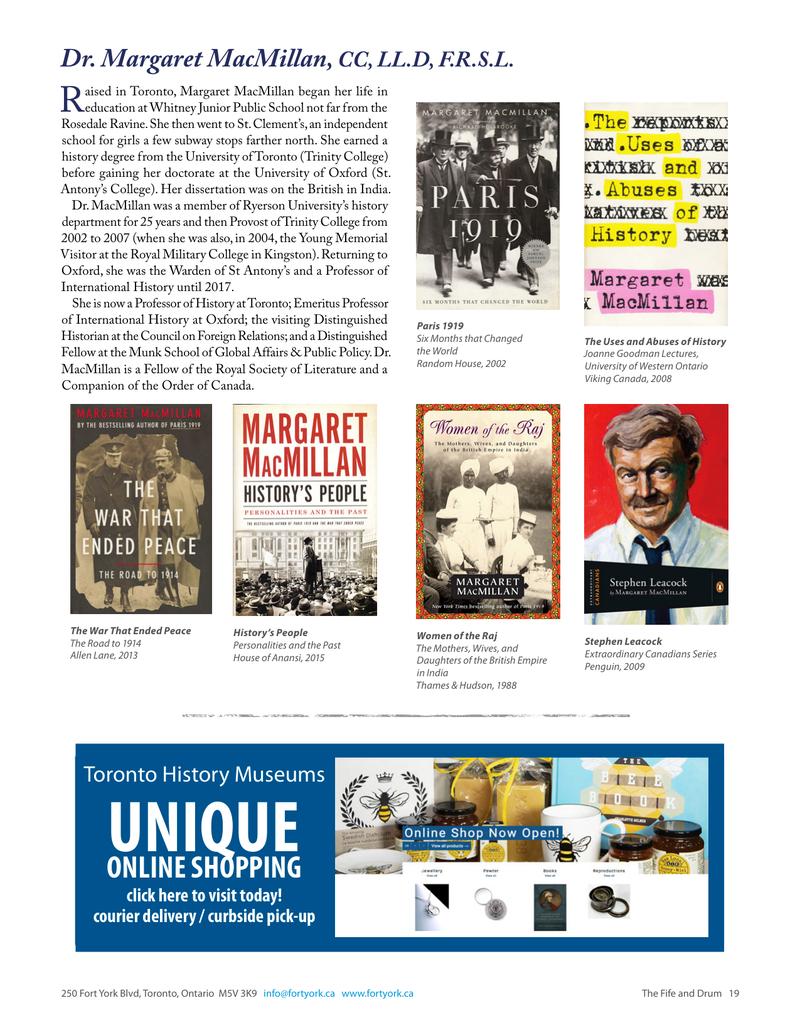
Dr. Margaret MacMillan, CC, LL.D, F.R.S.L. aised in Toronto, Margaret MacMillan began her life in R education at Whitney Junior Public School not far from the Rosedale Ravine. She then went to St. Clement’s, an independent school for girls a few subway stops farther north. She earned a history degree from the University of Toronto (Trinity College) before gaining her doctorate at the University of Oxford (St. Antony’s College). Her dissertation was on the British in India. Dr. MacMillan was a member of Ryerson University’s history department for 25 years and then Provost of Trinity College from 2002 to 2007 (when she was also, in 2004, the Young Memorial Visitor at the Royal Military College in Kingston). Returning to Oxford, she was the Warden of St Antony’s and a Professor of International History until 2017. She is now a Professor of History at Toronto; Emeritus Professor of International History at Oxford; the visiting Distinguished Paris 1919 Six Months that Changed Historian at the Council on Foreign Relations; and a Distinguished the World Fellow at the Munk School of Global Affairs & Public Policy. Dr. Random House, 2002 MacMillan is a Fellow of the Royal Society of Literature and a Companion of the Order of Canada.

The Uses and Abuses of History Joanne Goodman Lectures, University of Western Ontario Viking Canada, 2008

The War That Ended Peace History’s People Women of the Raj The Road to 1914 Personalities and the Past The Mothers, Wives, and Allen Lane, 2013 House of Anansi, 2015 Daughters of the British Empire in India Thames & Hudson, 1988

The War That Ended Peace History’s People Women of the Raj The Road to 1914 Personalities and the Past The Mothers, Wives, and Allen Lane, 2013 House of Anansi, 2015 Daughters of the British Empire in India Thames & Hudson, 1988

Dr. Margaret MacMillan, CC, LL.D, F.R.S.L. aised in Toronto, Margaret MacMillan began her life in R education at Whitney Junior Public School not far from the Rosedale Ravine. She then went to St. Clement’s, an independent school for girls a few subway stops farther north. She earned a history degree from the University of Toronto (Trinity College) before gaining her doctorate at the University of Oxford (St. Antony’s College). Her dissertation was on the British in India. Dr. MacMillan was a member of Ryerson University’s history department for 25 years and then Provost of Trinity College from 2002 to 2007 (when she was also, in 2004, the Young Memorial Visitor at the Royal Military College in Kingston). Returning to Oxford, she was the Warden of St Antony’s and a Professor of International History until 2017. She is now a Professor of History at Toronto; Emeritus Professor of International History at Oxford; the visiting Distinguished Paris 1919 Six Months that Changed Historian at the Council on Foreign Relations; and a Distinguished the World Fellow at the Munk School of Global Affairs & Public Policy. Dr. Random House, 2002 MacMillan is a Fellow of the Royal Society of Literature and a Companion of the Order of Canada.

Stephen Leacock Extraordinary Canadians Series Penguin, 2009