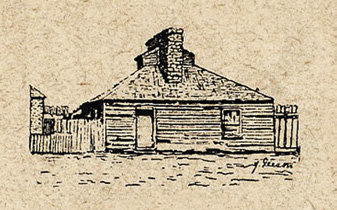
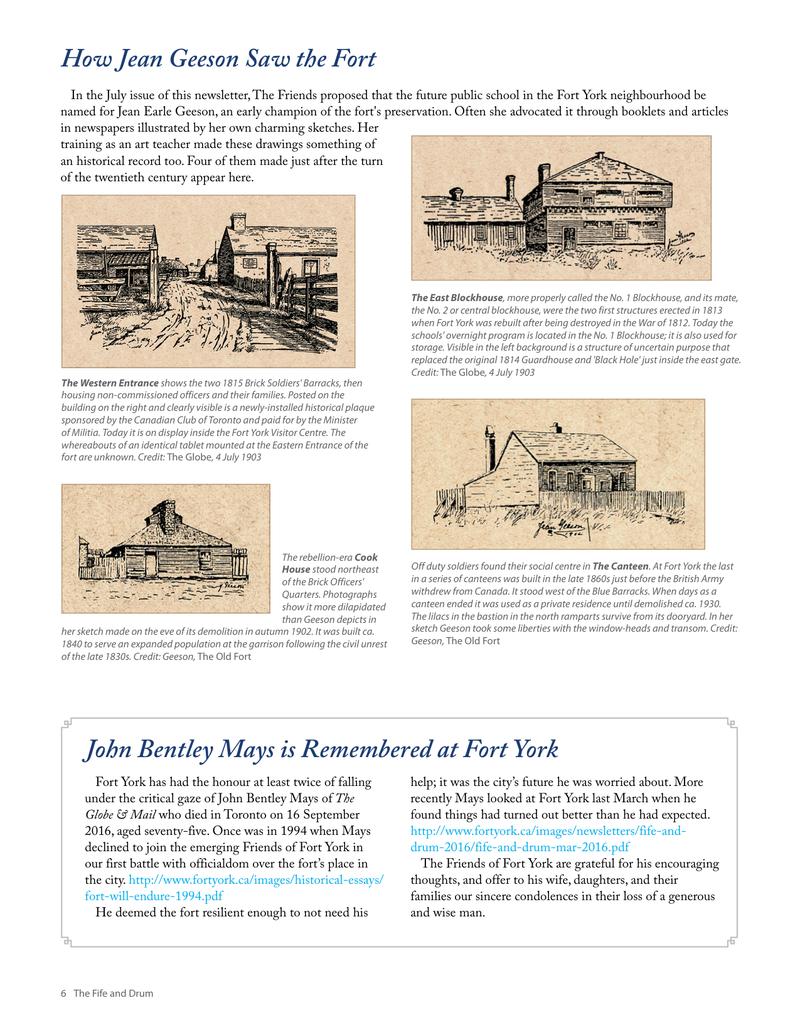
In the July issue of this newsletter, The Friends proposed that the future public school in the Fort York neighbourhood be named for Jean Earle Geeson, an early champion of the fort’s preservation. Often she advocated it through booklets and articles in newspapers illustrated by her own charming sketches. Her training as an art teacher made these drawings something of an historical record too. Four of them made just after the turn of the twentieth century appear here.
The Western Entrance shows the two 1815 Brick Soldiers’ Barracks, then housing non-commissioned officers and their families. Posted on the building on the right and clearly visible is a newly-installed historical plaque sponsored by the Canadian Club of Toronto and paid for by the Minister of Militia. Today it is on display inside the Fort York Visitor Centre. The whereabouts of an identical tablet mounted at the Eastern Entrance of the fort are unknown. Credit: The Globe, 4 July 1903The East Blockhouse, more properly called the No. 1 Blockhouse, and its mate, the No. 2 or central blockhouse, were the two first structures erected in 1813 when Fort York was rebuilt after being destroyed in the War of 1812. Today the schools’ overnight program is located in the No. 1 Blockhouse; it is also used for storage. Visible in the left background is a structure of uncertain purpose that replaced the original 1814 Guardhouse and ‘Black Hole’ just inside the east gate. Credit: The Globe, 4 July 1903The rebellion-era Cook House stood northeast of the Brick Officers’ Quarters. Photographs show it more dilapidated than Geeson depicts in her sketch made on the eve of its demolition in autumn 1902. It was built ca. 1840 to serve an expanded population at the garrison following the civil unrest of the late 1830s. Credit: Geeson, The Old FortOff duty soldiers found their social centre in The Canteen. At Fort York the last in a series of canteens was built in the late 1860s just before the British Army withdrew from Canada. It stood west of the Blue Barracks. When days as a canteen ended it was used as a private residence until demolished ca. 1930. The lilacs in the bastion in the north ramparts survive from its dooryard. In her sketch Geeson took some liberties with the window-heads and transom. Credit: Geeson, The Old Fort
John Bentley Mays is Remembered at Fort York
Fort York has had the honour at least twice of falling under the critical gaze of John Bentley Mays of The Globe & Mail who died in Toronto on 16 September 2016, aged seventy-five. Once was in 1994 when Mays declined to join the emerging Friends of Fort York in our first battle with officialdom over the fort’s place in the city. http://www.fortyork.ca/images/historical-essays/fort-will-endure-1994.pdf
The Friends of Fort York are grateful for his encouraging thoughts, and offer to his wife, daughters, and their families our sincere condolences in their loss of a generous and wise man.