When George Ramsay, the ninth Earl of Dalhousie and Governor-in-Chief of Canada, made a grand tour through Upper Canada in 1821, he took with him John Elliott Woolford as official draughtsman. Woolford made extensive sketches, recording the scenery and all the principal places along the Governor’s route. Many of his pictures survive, including one of Fort York. This sepia-washed pencil sketch of 1821 is one of the earliest views of the fort known. Made from the east side of Garrison Creek, it records the fort’s principal buildings including Blockhouse No. 1, the Guardhouse, Commandant’s House and rear wings of the Officers’ Brick Barracks. The ramparts at the east end appear with their wooden fraises. More importantly, the East Gate is clearly visible.
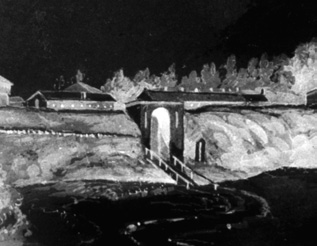
When Fort York was rebuilt in 1813-16, its main entrance was at the east or ‘town’ end, overlooking Garrison Creek. The East Gate, built probably at that time, is almost unknown except for Woolford’s sketch. He depicted it as an impressive square-topped structure with an arched doorway, approached on an inclined bridge or gangway with railings. The ascent from Garrison Creek up to the gate and into the fort was steep and difficult. It was made easier, however, by a long feature that appears within the fort on both Hughes’ site plan of 1814 and on Nicolls’ better known plan of 1816.
It has been interpreted as two retaining walls flanking an upward-sloping roadway that extended about 100 feet west from the gate. Archaeological excavations have twice unearthed there a roadway surface formed of logs like a ‘corduroy road.’ A few courses of unmortared flat stone found on the north side of the road are almost certainly evidence of a retaining wall.
Details about the gate itself are few. An estimate made in 1818 for repairs to Barracks requested funds “to renew the retaining wall on each side of the entrance to the Fort and to shingle the roof over the arched Gateway”. A report on the state of defenses at Fort York in 1838 noted that the “Main Entrance Consisting externally of a Counterpoise barrier and internally of an 8 inch Oak folding door” was very much out of repair. This counterpoise gate, like the drawbridge at a medieval castle, would have used chains and a heavy weight to raise a section of the railed bridge shown in Woolford’s sketch. Ordinary wooden gates provided a second means of closing. The counterpoise machinery and internal folding gates were housed in the gate head. Slits that the artist showed on either side of the portal may have been openings for the counterpoise chains.
Records from two other Canadian forts suggest what the Fort York gate looked like. A sectional drawing of the drawbridge at Fort Mississauga shows a wooden bridge crossing the ditch in front of the fort. The last part of the bridge was lifted up to close the gateway when a weight attached to chains was lowered into a pit inside the gate. Fort Mississauga also had interior wooden barrier gates.
Several historic photographs and drawings show details of the large northeast gate at Fort Lennox at Ile aux Noix, Que. It is strikingly similar in appearance to the gate at Fort York in Woolford’s view. A plan and section of the Fort Lennox gateway shows a counterpoise attached by means of iron chains to the last 12-foot section of an entrance bridge. Cast iron weighing more than 700 pounds formed the actual counter weight of the drawbridge. Several excellent photographs of the Quebec fortification (minus the counterpoise) have survived and give a wonderful impression of what the Fort York gate may have looked like.

The stout stone gate at Fort Lennox measured about 26 feet in width and was about 20 feet high. Scaling Nicolls’ 1816 plan, it appears the gate at Fort York was about 27 feet wide. And while no archaeological evidence has been found yet to show the Fort York portal was built of stone, like Fort Lennox, the area where it stood has seen much disturbance over the years and may not have yielded up all its secrets yet.
The great East Gate of Fort York probably lasted from the fort’s reconstruction at the end of the War of 1812 until just after the 1837 Rebellion. A report on the fort’s defenses in 1838 states that there was a counterpoise and folding gate. An estimate made a year later seeks money to make an entrance through the curtain of the western front and to make and hang two barrier gates through the palisades to both east and west fronts. The old counterpoise gate may have been removed about this time. It does not appear in an 1840s lithograph by Hugh Scobie after a watercolour by John Gillespie.
In 1860, a large wooden trestle bridge was built from the foot of Bathurst Street at Front across the creek towards the east gate of the fort. At about the same time, new wooden barrier gates were erected at both the east and west entrances to the fort. They consisted of stout square posts with folding gates; the remnants of them can be seen in several late 19th century pictures of the fort. They seem to have decayed and finally disappeared around 1900.
The early 20th century saw the east entrance opened completely, with no barriers to stop traffic passing through the fort. In 1909 a well known Toronto architect, W. Ford Howland, designed impressive stone gatehouses in the gothic style for both entrances. Proposed to be named after Simcoe and Brock, they were never built.
After the Park-Blackwell meat-packing plant on the fort’s east edge was demolished in 1929, the ramparts there were reconstructed, but for a short time there was no gate at all. Access was by means of a stile or set of stairs over the wall at the foot of the new walkway from Bathurst Street. However, when the fort was restored in 1932-34 as part of Toronto’s Centennial celebrations, a new gate was built at the north-east angle. It was not located accurately, however, and in 1981 the south-east bastion and the entire east wall, including the gate, were demolished and rebuilt in their present positions.
The entrance today is built of stone to match the 1932 stone revetment wall, with a short stone retaining wall on the exterior. Aligned more or less correctly towards the corner of Bathurst and Front Streets, it has heavy barrier gates and a small watch-gate opening. But outside it the ground now slopes gently down to railway lands. Gone are the Garrison Creek, steep banks and wooden bridge. The present barrier only hints at the impressive gateway that once dominated this spot. Fort York: Adding New Buildings proposes that eventually the gate should be reconstructed in all its grandeur. This would make a significant contribution to the fort’s appearance if done in concert with improvements to the surrounding landscape.
Original printed pages