

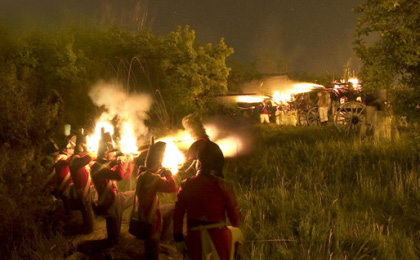
With bayonets charged, the little party set off down the road at a run reverting to the most basic form of warfare when man-to-man combat with edged weapons was the standard and impromptu charges the norm. Certainly there was little in Formation, Field Exercises and Movements of His Majesty’s Forces governing middle-of-the-night headlong dashes against enemy artillery.
So writes James Elliot in describing the British charge which sounded the death knell for American forces in his much anticipated book Strange Fatality: The Battle of Stoney Creek, 1813. The section quoted above is one of many gripping moments in a very readable account of a battle that brought the Americans campaign in the Niagara Peninsula to a halt in the late spring of 1813.
Facts and perceptions of participants and observers are well presented such that the reader gets new insight into a battle and war that is clouded by the mists of time. For many Canadians the War of 1812 represents a golden age when we, as Canadians, resisted American invaders and then took a trip to Washington to burn their, soon to be renamed and repainted “White House”. In refreshing contrast Mr. Elliot follows the lead of historian A.R.M. Lower who characterized the war as “a succession of timorous advances and hasty retreats, of muddle-headed planning and incompetent generalship, interspersed with a few sharp actions and adroit manoeuvres which reflected credit on a few individuals and discredit on many.”
This is an important book because the battle resonates in Stoney Creek, the City of Hamilton and the surrounding region as the premiere event in the long past that defined the place in which it happened. The battle lives on in the minds of the local people because of the annual battle re-enactment and because of the monument erected at the centennial in 1913, rising majestically over the field—a constant and stirring tribute to courage, fortitude and success in the face of overwhelming odds. It is also the event that spawned the story of local hero William “Billy” Green in which he expertly led British forces to the American encampment on the Gage farmstead now known as “Battlefield House Museum.”
The work itself does not glorify the events surrounding the battle but in fact takes a hard look at the role of various personages: Billy Green, would-be scout; Brigadier General John Vincent, overall British Commander during the battle lost in the bushes and nearly captured; as well as Major General Henry Dearborn over whom a strange fatality seemed to loom which, when combined with an often complained of infirmity, led to his dismissal as American Commander of Forces.
The scene of carnage in the aftermath of the battle is set in contrast to the tranquility of the site today. It is also in contrast to the appendix of the book on the human remains from Smith’s Knoll, the site of the American artillery battery and the section of the American position that received the most spirited bayonet attack when Major Plenderleath of the 49th, saviour of the British efforts at Stoney Creek, led his contingent forward through bright flashing cacophony to have-at and capture the American artillery on the Knoll.
A fascinating account of the analysis of the skeletal material from the battle reveals the grisly nature of this and by association many of the battles in the War of 1812. Arguably, in comparison to the short ranged inaccuracy of flintlock muskets, it is really the bayonet that is the much more dependable part of the weapons system, though to our sensibilities a much more horrific one. In an age where weaponry promises death from a distance in war, it is slightly macabre to brush up against a skeletal sample of rib bones clearly notched by bayonet thrusts. Fans of the popular television show “CSI” will enjoy the osteological detective work that was used to confirm the findings.
While considerable critical acumen is applied to the subject matter, Mr. Elliot falls into the trap of assuming that the loss of the battle by the British would have meant the loss of Canada. The notion that the battle was pivotal is reasonable in terms of the Niagara Campaign of 1813 – whether we would be American as a result of a different outcome to the battle is questionable, given that the overarching strategy of the Governor General and Commander of Forces in British North America was to show caution in the approach to the war so as to preserve resources and restrict provocation. The province of Upper Canada was always considered expendable. The real prizes were Montreal, Quebec and Halifax. Logically as long as those three deep water ports remained in British hands there was always a means by which Great Britain could mass a suitable force and retake what we call Southern Ontario today.
James Elliot has combined exhaustive primary research with a master story-teller’s turn of phrase and a reporter’s nose for human interest and quest for truth. In so doing he has produced the most significant account of the battle since Ernest Cruikshank’s treatment of the subject in 1913.
Original printed pages


