

Among the midway amusements, model airplanes buzzing around the Coliseum, and other attractions on Children’s Day at the 1936 Canadian National Exhibition, one of the exhibits had, C.H.J. Snider recalled in the Toronto Telegram on October 3, “so many visitors that the attendants feared it would be crushed flat inside its plate glass case.” Contained within the glass case was an exact, elaborately detailed ship model—measuring eight feet long and six feet high—of the Nancy, a Great Lakes fur trader that served in the War of 1812 and sank into the silt of the Nottawasaga River.

By day’s end, the glass “cover was misted over with a pattern of little round blurs, calling cards left by hundreds of thousands of button-like noses and pudgy thumbs and fingers.”
The model was popular with both kids—some of whom stood on each other’s shoulders for a better view—and adults, many of whom had to make special trips back to the CNE to pick up a descriptive pamphlet after the day’s supply ran out. Snider, a well-known nautical historian whose “Schooner Days” column appeared in the Telegram each Saturday for over twenty-five years, felt that the model ship’s appearance at the Ex “did more to popularize history than a regiment of professors.”
Snider was not, however, an impartial observer because, as chairman of the Historical Subcommittee of the Nancy Committee, he had, over the course of a decade, tirelessly researched the ship and oversaw the model’s construction—a task that proved far more dramatic and troublesome than he could have anticipated.
When Dr. F.J. Conboy, Director of Dental Services in the Provincial Department of Health (and a future mayor of Toronto), unearthed the Nancy‘s shipwreck near Wasaga with the assistance of Snider, artist C.W. Jefferys, and other cottagers and local enthusiasts in the mid-1920s, a committee was struck to found a museum and spur public interest in the Nancy‘s history.
At the museum’s official opening on August 14, 1928, Conboy was presented a token of gratitude: a small wooden model of the Nancy built by former Toronto fireman, Thomas Corbett, using wood salvaged from the original’s hull. Undoubtedly the large crowds attracted while the model had been on display recently in the windows of the Telegram‘s Bay Street offices influenced the committee’s discussions about potential displays for the new museum.
In 1929, the committee discussed the cost of obtaining a model of the Nancy—similar to the Corbett model, but larger and entirely historically accurate—so that, as Snider later explained, “our children and students, know what the Nancy was like in life.” There was little apparent urgency, however, because it took until November 1931 for Snider to be given the official instructions to commission a model costing no more than $500.
There was another long delay before construction on the model would begin. Mary Dawson Snider, his wife and well-respected journalist, took ill in April 1932, putting any thoughts of the model on hiatus until she succumbed five months later.
It also took significant time for Snider to research the Nancy and complete the model’s design. From examination of the ship remains at Wasaga, Snider easily determined the Nancy‘s dimensions, essential shape, and where her masts stood. But, as he would put it in the Telegram on November 11, 1933, “it would necessarily be conjectural in those characteristic details which give every ship her own individuality.” There were no original plans, period pictures, or schematics from which to work or to devise the model plans.
So Snider made a thorough examination of her logbook, the papers of her builder, the Hon. John Richardson, as well as 18th-century tables for rigging and sparring. He also made close examinations of paintings of contemporary ships, spoke with leading naval architects in Halifax and Massachusetts, and would visit the model ship collections at the South Kensington Museum, the Royal Naval College Museum at Greenwich, and Smithsonian Institution in Washington. From his copious research, he was able to authentically recreate the Nancy‘s sails, spars, deck arrangements, and figurehead on his plans for the model.
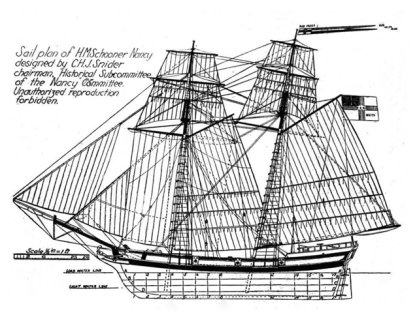
Snider contacted model shipbuilder G.E. Anderson of Toronto who, because news of the proposed model had been leaked in the newspaper, had expressed interest in the project to the Committee in 1929. “Being a professional shipmodeler,” he told them, “probably the only out and out modeler in this country, may I put my name before you. I have made a life study of this work, and for workmanship of the type you require, the best is essential.” At Snider’s house in early February 1933, Anderson spent an entire evening examining Snider’s plans and discussing his model-building methods. Within days, the pair signed a contract, calling for Anderson to be paid $300 upon the model’s delivery in June 1933. Snider had provided the craftsman with a small piece of the Nancy‘s white oak planking, blackened through 144 years underwater, for use as the model’s keel, and Anderson set to work.
Progress was expected to be slow because Anderson would use the rib-and-plank method, mimicking a real ship’s construction with narrow wooden strips fastened onto frames. With “patient, skilled workmanship,” Snider later wrote, Anderson would drive “some 60,000 little wooden pins, like shoe-pegs, representing the spikes fastening the planking of the Nancy‘s decks and sides.”
Trouble started almost immediately. First, Anderson changed his mind and wanted to be paid in instalments. He claimed to have received “picayune treatment as regards the financial end.” Snider responded curtly, reminding Anderson of the terms of the contract. Next, Anderson prompted a weekslong argument by finding fault with the design’s scale and dimensions, suggesting that Snider’s plans were flawed. By early March, Snider was so fed up that he suggested that if Anderson were so dissatisfied, he could “bring back his contract and the material and I would release him.” Snider suspected—correctly, it seems—that Anderson had been influenced by some nameless third party into breaking the contract as a means of coercing more money from the Committee. Snider was less than impressed. “Your conduct and attitude so far has not impressed me favorably,” he wrote in mid-March, “I hope you will give me reason to change my opinion.”
Snider’s weekly visits to Anderson’s workshop at 301 Parliament Street probably seemed an overbearing intrusion to Anderson. But from Snider’s perspective, the souring relationship made them a necessity. Nevertheless, delays persisted and the original deadline of June 1933 came and went. “In all my calls,” Snider would later complain, “I only once found him working on the Nancy model; he was always engaged with customers for model parts or working upon toy boats which he was building to sell.”
By mid-September, when the planking on the model was still not quite completed, a desperate Anderson urgently demanded the first $100 of the contract because he had no money for materials and could not keep working. When Snider offered to pay for the work completed so far, void the contract, and walk away, Anderson became erratic and exclaimed that “he would smash it first.” Disaster was averted by Snider’s offer of a $25 advance.
On another visit, Snider found Anderson despondent because, having not paid his rent since June, Anderson’s landlord was garnisheeing all his earnings. The shipbuilder saw no point in continuing but, over the course of their conversation, Anderson’s mood swung wildly from dejected resignation that the project was impossible to excited optimism about completing it. Over the coming months, however, the journalist was made to feel increasingly unwelcome on his weekly visits and by December Anderson wouldn’t even see him.
In the fall of 1933, Snider began a twenty-one part series in the Telegram—entitled “From Stick to Ship”—detailing the model’s construction that presented an entirely different version of events framed in a more positive outlook. In these newspaper accounts, Snider had nothing but praise for Anderson’s craftsmanship and, in a subtle attempt to help Anderson make calm, encouraged readers to stop by his shop, see him at work, and order a model of their own to be made.
Each week, these columns reported progress as planking was completed, rail and bulwarks added, portholes cut, rudder finalized, and the cabin windows completed right down to the draped curtains. Eventually, however, the columns caught up to the real-life difficulties—stopping abruptly in March 1934—no matter how much Snider conceded just how far his relationship with Anderson had deteriorated.
The landlord—Snider discovered in a December 21, 1933 letter—had had the bailiff seize “all Anderson’s stock in trade, including boats, models, etc.” to put it under the hammer at public auction. Snider was livid that after all his years of research, he had not sought a contract to buy back the plans and material that were rightfully his. Seeing himself as paying Anderson for a service not a product, Snider asked his lawyers in February 1934 to send a “good stiff letter” to the landlord “demanding the surrender of all [his] plans, specifications, material, and money.”
Still eager to have the model completed as quickly as possible, a few days later Snider sought a compromise. He offered to pay Anderson the balance of the contract if the model could be completed by March 1—or he’d pay for work completed and take the unfinished model at that time. Then he offered $25 per week for five weeks. Anderson, once again despondent, again threatened to smash the model before finally agreeing to Snider’s proposal. It was all for naught because the shipbuilder did not follow through.
On March 8, 1934, Snider accompanied sheriff’s officers to Anderson’s workshop with court order in hand. As the officers collected the items identified by Snider, Anderson grew abusive, accusing Snider of bullying and mischief.
With this troublesome chapter at a close, Snider’s personal papers at the Archives of Ontario do not record the names of the craftsmen who subsequently worked on the model or any details about the project at all until it was finally finished in late July 1936.
“The model is historically correct in every detail,” Snider boasted to the secretary of the Nancy Committee on July 23, 1936, “and fulfills my original design of showing what the Nancy was, and how she was built, rigged, armed, and navigated.” He was possessed by the model’s historical accuracy and would fill several newspaper columns over the years with copious detail and minutiae justifying his every decision on its construction. He chose, for example, to have it fly the white ensign with red St. George’s cross, and the red-white-and-blue swallow-tailed pendant because similar flags were known to have flown on the H.M.S. Queen Charlotte of the Lake Erie fleet. If Snider showed obvious pride in his abundant research, he also had frequent like-minded guests at his home, such as the instructor at the Ontario College of Art and other artists who admired the model’s fine artistic and historical detailing.
The Nancy‘s figurehead depicted a brown-haired young lady in a blue and white bouffant costume of the 18th century with a hat and feather. It is quite elaborate for a merchant vessel and thought to represent shipbuilder Richardson’s daughter, Anne, whose pet name was “Nancy.” The model’s representation was based on descriptions given by a Simcoe County farmer whose maternal grandfather had served on the Nancy and recovered the figurehead after the Nancy was sunk. He kept it in a tool-shop that burned down with all contents in about 1880.
Although the sails differ from the most famous image of the Nancy—a drawing in the John Ross Robertson Collection—the model’s five workable square sails match, Snider wrote in “Schooner Days” in 1956, “the standard rig of schooners for the Provincial Marine” and follow descriptions in her ship’s logbook. The rigging, also accurate to logbook descriptions, was so complicated with booms, bridles, and bowlines that, Snider wrote in a 1936 column, “the forward side of each mast looks like a strung fiddle.”
In addition to the keel, other elements on the model were made from relics salvaged from the original Nancy. The anchor was constructed from an eighteen lead found in her hold and original oak, while the quarter rails used red cedar from her hull.
One ahistorical element Snider included was the figure of a young girl at the tiller, intended to show the real ship’s dimensions on a human scale. In 1936, Snider expressed hope that a complete set of figures of the crew —”nine for the fur-trader or thirty-seven for her as a man-of-war”—might be “carved and colored in the costumes of the time.” This was never done and the girl at the tiller was subsequently removed.
By the summer of 1936, when the Nancy Committee was eagerly checking on the model’s progress, Snider was taking it for granted that the model was his alone. He had insured it and paid for a glass case to be built, and already arranged, through Dr. Leonard Simpson, the Minister of Education, to have the model shown publicly for the first time at the Department’s exhibit at the CNE.
In correspondence with the Committee that summer to discuss where the model should be permanently located, Snider said: “It is my intention to bequeath the model to the Nancy Committee, or some other such appropriate authority, outright, in trust for the public, for perpetual exhibition. Having paid all the bills and done all the work in the creation of the model, during my lifetime I wish to retain the proprietary interest in it. This, I think, will appeal to the Committee as reasonable. I do not wish it to be sold, and will not sell it myself. The model will be at the disposal of the Committee, subject to my approval of its location and the provision made for its care, and to such arrangements as I myself may feel called upon to make for its display to the public. As our objects in this are identical and one and the same, I do not think any difficulty should arise while I retain ownership of it.”
Although he also suggested the Nancy Committee might build a permanent case for it at Wasaga, within a few days he was also corresponding—at Dr. Simpson’s suggestion—with the director of the Royal Ontario Museum of Archaeology, Dr. C.T. Currelly. Offering the model for permanent display, Snider was willing to deed it to the museum as long as he might retain the right to remove it for display around the province, at Wasaga for example, from time to time. The museum accepted it although the terms of the arrangement are not known, and placed it on the ground floor, straight through from the main Queen’s Park entrance.
The Nancy Committee might not have been happy but they accepted the outcome. From the beginning, the composition of the committee, which included full-time residents of Simcoe County and Torontonians who summered there, had led to some inevitable friction over whether the Nancy wreck itself was best left in situ as a piece of Simcoe County history or relocated so it could be seen by a much larger audience in Toronto. The model’s fate simply followed the same pattern.
The following summer, the Committee made inquiries about having the model displayed at Wasaga for the autumn season. After consideration, Snider declined, citing the difficulties of transportation and the danger of damage to the model. The two photographs Snider sent must have been a small consolation for the disappointed committee members. However, one committee member, Dr. Simpson, admitted that, with the slow pace of making improvements to the museum, the building was likely not secure enough to house the model.
On September 28, 1948, Gerard Brett, Director of the ROM from 1947 to 1955, informed Snider of a proposal to transfer the model to the Naval Hall in the Museum at Fort George. “It has been apparent to us for some time that the model of the Nancy schooner is not, so to speak, pulling its weight here,” Brett wrote. “This model is of great historical importance to the province, and as such it really requires a proper setting, in fact a naval setting. This, of course, we cannot provide.” An aghasté Snider protested that the museum simply hadn’t done enough to acquire exhibits on loan to complement the isolated model. “If this model is no longer welcome in the Royal Ontario Museum of Archaeology,” Snider responded with an air of bitterness, “I will be glad to remove it.” So he did.
With the model cast off, less is known about its exact whereabouts in the coming years as it drifted from port to port. The model was unveiled in the Council Chambers at City Hall in April 1949, and afterward adorned one of its corridors for a number of years. Snider would bequeath the model to the city, but it is not clear whether he did it at this point, at his retirement from the Telegram after 63 years in the late 1950s, or upon his death in December 1971. By 1956, the model was housed—in season—in the Provincial Marine room at Old Fort York, then subsequently displayed at the Marine Museum of Upper Canada in the Stanley Barracks, and the Pier Museum until its closure in 2001.
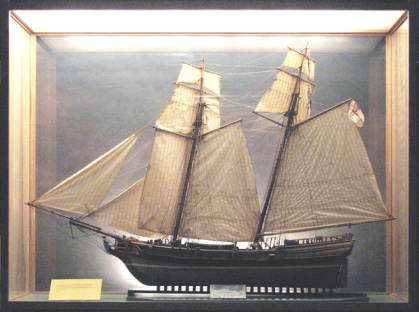
Since its arrival back at Fort York, improvements to the model’s setting have been made possible by donations from the descendants and family of Robert Nurse upon the death in 2008 of the former director of the Friends of Fort York. Professional exhibit designer and a current director of the Friends, Michael Peters, designed new lighting and a painted backdrop for the display case, which were recently installed by Chris Baker, Exhibit Co-ordinator at Toronto Culture.
In the eight decades since it was originally conceived and commissioned, the Nancy model had journeyed over somewhat stormy seas. But it has once again landed in a setting befitting Snider’s aspiration that the model show what the Nancy was like in life for the education and enjoyment of the general public in perpetuity.
Original printed pages


