

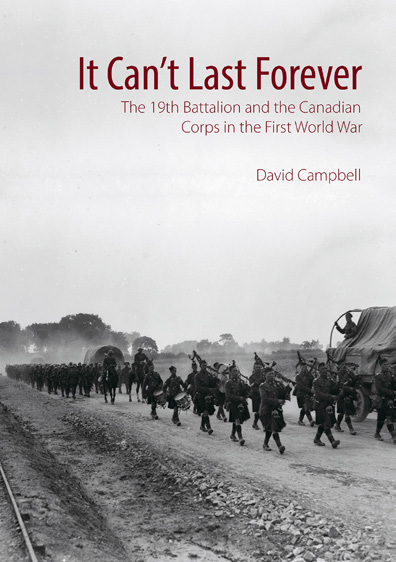
It Can’t Last Forever is the third volume in WLUP’s Canadian Unit, Formation, and Command Histories series. The preceding volume, Toronto’s Fighting 75th in the Great War, 1915-1919, was reviewed in the April issue of The Fife and Drum, and like that volume, this history of the 19th Battalion is a hefty, exceptionally well made book. Credit should also go to the Argyll Regimental Foundation, which commissioned it and broadly supports the Argyll and Sutherland Highlanders of Canada, the Hamilton reserve regiment that perpetuates the historical legacy of the 19th. It was the Argylls, as the 91st Highlanders, that provided the battalion’s command structure, its pipes and drums, and one of its four rifle companies.
Drawing as well from regiments in Toronto, Brantford, St Catharines and Sault Ste Marie, the 19th was one of the numbered battalions formed in 1914 for the Canadian Expeditionary Force. Histories of the Argylls in 1928 and 1953 were written to celebrate anniversaries; they wanted one on the battalion in the Great War for its 100th anniversary. A search among the new generation of military historians led to David Campbell, then preparing a thesis on the Canadian Corps’ 2nd Division, which included the 19th. Now a history professor in Nova Scotia, he has also written a handful of articles on Canadians in the First World War.
The series aims to blend “traditional operational history with innovative approaches in military scholarship.” Campbell achieves this admirably, drawing heavily from the19th’s war diary (a daily log of its activity) at Library and Archives Canada, which he calls “one of the most complete and extensive war diaries” he has ever seen (page xviii). The operational detail, meticulously researched and presented, may be overly exhaustive for some readers. At the same time, other new scholarship has been effectively absorbed.
The result in It Can’t Last Forever is 22 chronological chapters on the battalion’s service in Europe within the 2nd Division, from September 1915 until the 19th’s official disbandment in 1920. Regrettably no battalion veterans remained to be interviewed. Enlivened wherever possible by wartime letters, later newsletters and useful asides – for instance, on trench life, mustard gas, fear and heroism, and death in the “wasteland” of mud – these chapters are supplemented by 23 colour maps, almost 200 illustrations (only some of which are specific to the 19th) and the usual appendices on casualties and injuries, discipline, commanding officers, and honours and awards.
In readable, sometimes dramatic fashion, Campbell takes us into the thick of the division’s telling participation in such notable battles as the Somme, Vimy Ridge, Passchendaele, Amiens and Cambrai, with a firm focus on the 19th and a knack for clear-headed assessment. Canada’s success at Vimy, for example, nevertheless revealed the weakness of “set-piece tactics” (page 253). The operation was a “subsidiary one” tied to Anglo-French offensives, the failure of which meant Canada’s victory had “little more than a purely local impact.” Campbell’s explanations of overall organization and how battalions interacted and operated as part of a corps are welcome and necessary, in part to reduce the narrowness of viewing the war through the prism of just one infantry battalion (out of the 48 that served in the Canadian Corps). The exemplary indexing of divisions, brigades and battalions on pages 652-54 is decidedly useful.

Any restriction of focus can be an asset or a drawback, depending on what the reader wants from It Can’t Last Forever. As operational history, it sets a golden standard; in the story of Ontario at war, it merely contributes. The regiments beyond Hamilton – Toronto produced half the 19th’s personnel – receive scant attention, although the author is on stronger ground during his examination of motivation within the ranks.
Newspapers from the towns and counties of the constituent regiments are absent from the author’s research, a shortcoming given the series’ professed aim to address the “societal” theme. Some reinforcements to the battalion were from Hamilton’s 91st, but many more, including conscripts, came from elsewhere. What can we know about them? John Gaetz, whose hopeful letter to his sister in October 1918 provided the title, “It can’t last forever,” was a farmer from Alberta.
It is from the archives of the Toronto Star and the Globe (not Campbell’s book) that we learn the 19th Battalion Association was organized at the Toronto Armouries on May 6, 1919. In a minor revelation from 1937, the Star noted that the “battalion historian” was gathering material for a 19th Battalion history. What happened there? we wonder. And one final grumble: the book’s epilogue, which does salute the 19th’s veteran, is nonetheless a hurried, disappointing kind of conclusion. The book’s editors let the author off the hook there.
Yet all things considered, It Can’t Last Forever is an outstanding work. We should thank WLUP and the Argyll Regimental Foundation for making it happen.
Original printed pages


