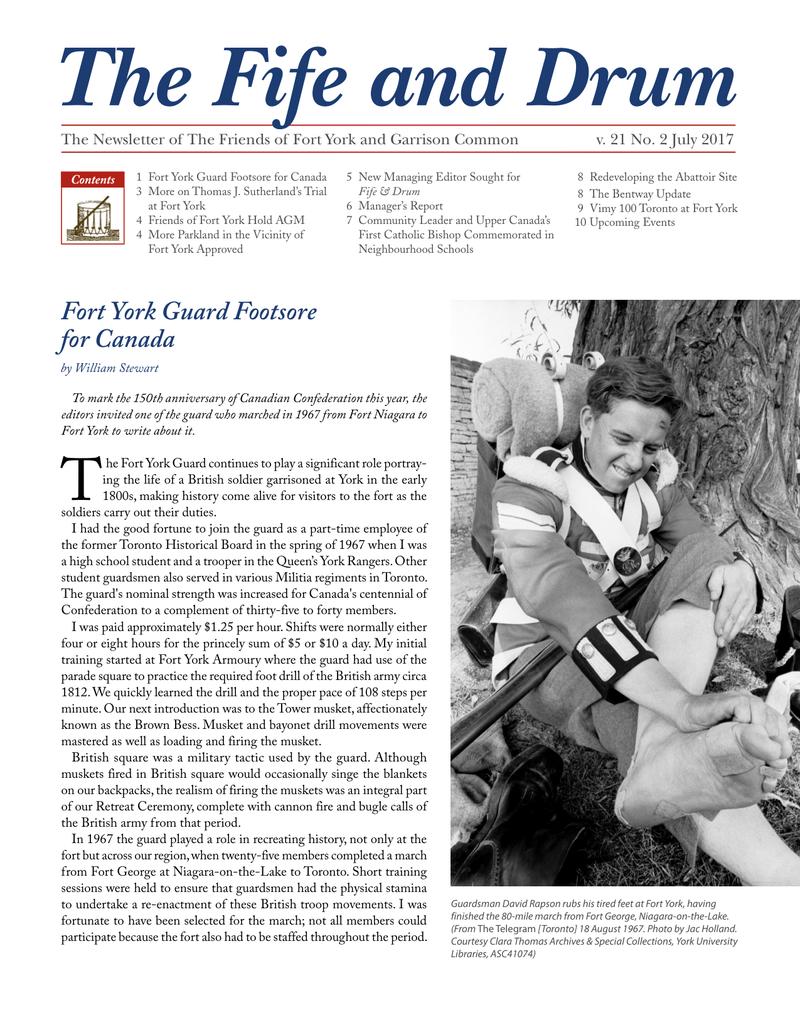
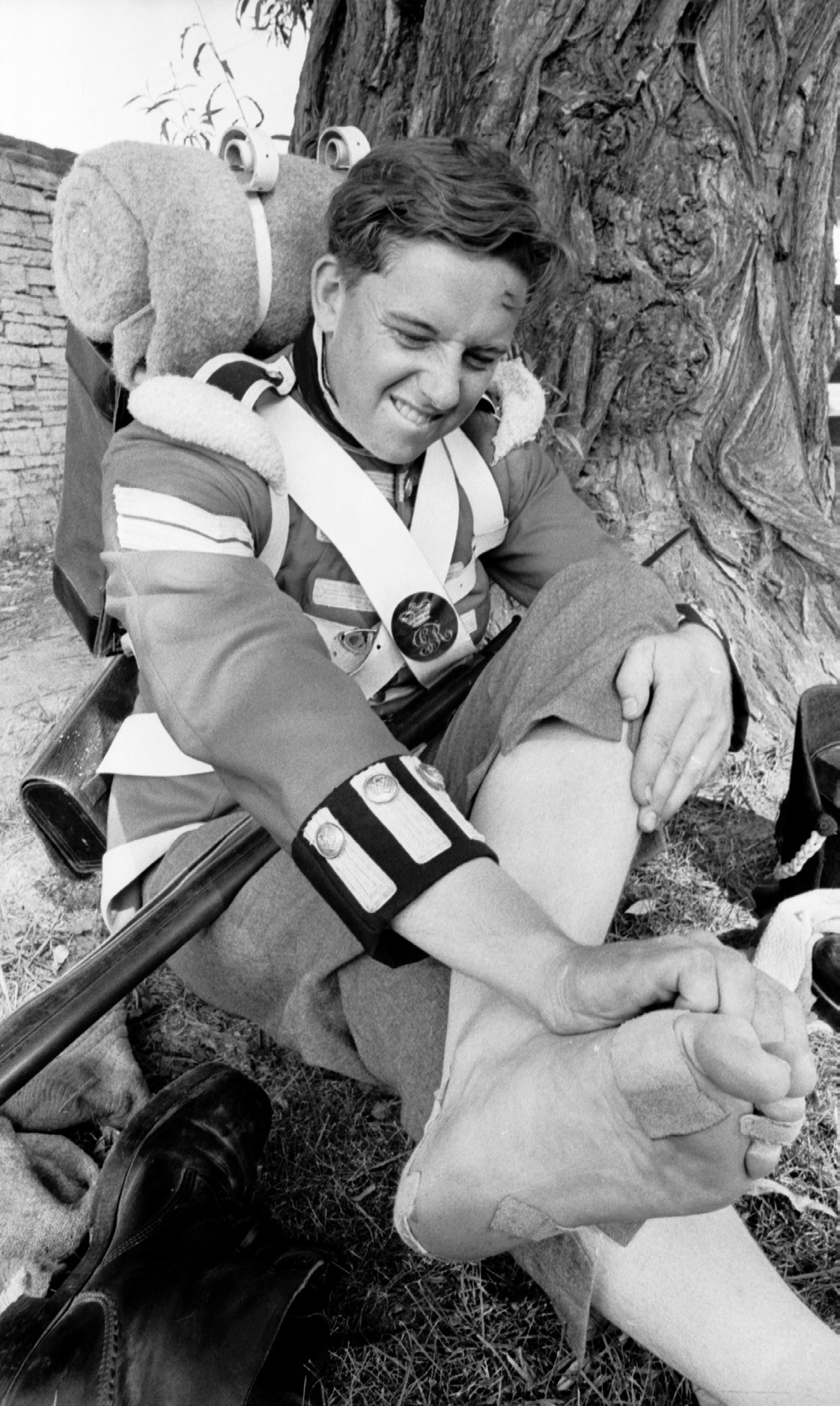
To mark the 150th anniversary of Canadian Confederation this year, the editors invited one of the guard who marched in 1967 from Fort Niagara to Fort York to write about it.
The Fort York Guard continues to play a significant role portraying the life of a British soldier garrisoned at York in the early 1800s, making history come alive for visitors to the fort as the soldiers carry out their duties.
I had the good fortune to join the guard as a part-time employee of the former Toronto Historical Board in the spring of 1967 when I was a high school student and a trooper in the Queen’s York Rangers. Other student guardsmen also served in various Militia regiments in Toronto. The guard’s nominal strength was increased for Canada’s centennial of Confederation to a complement of thirty-five to forty members.
I was paid approximately $1.25 per hour. Shifts were normally either four or eight hours for the princely sum of $5 or $10 a day. My initial training started at Fort York Armoury where the guard had use of the parade square to practice the required foot drill of the British army circa 1812. We quickly learned the drill and the proper pace of 108 steps per minute. Our next introduction was to the Tower musket, affectionately known as the Brown Bess. Musket and bayonet drill movements were mastered as well as loading and firing the musket.
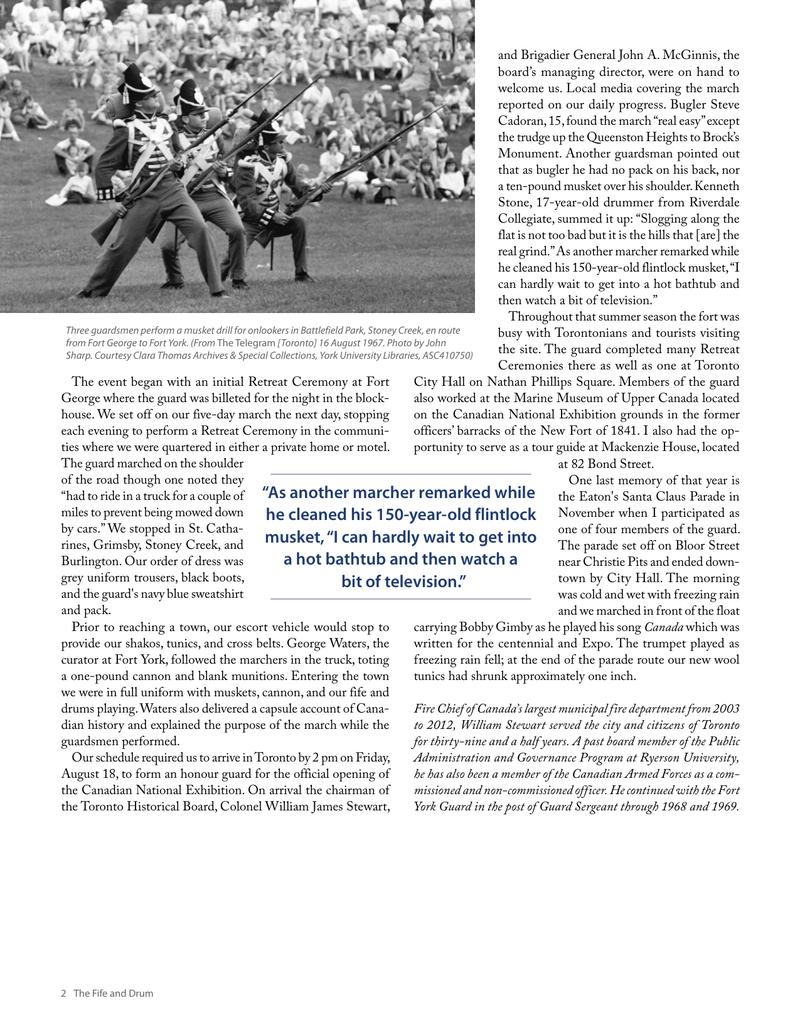
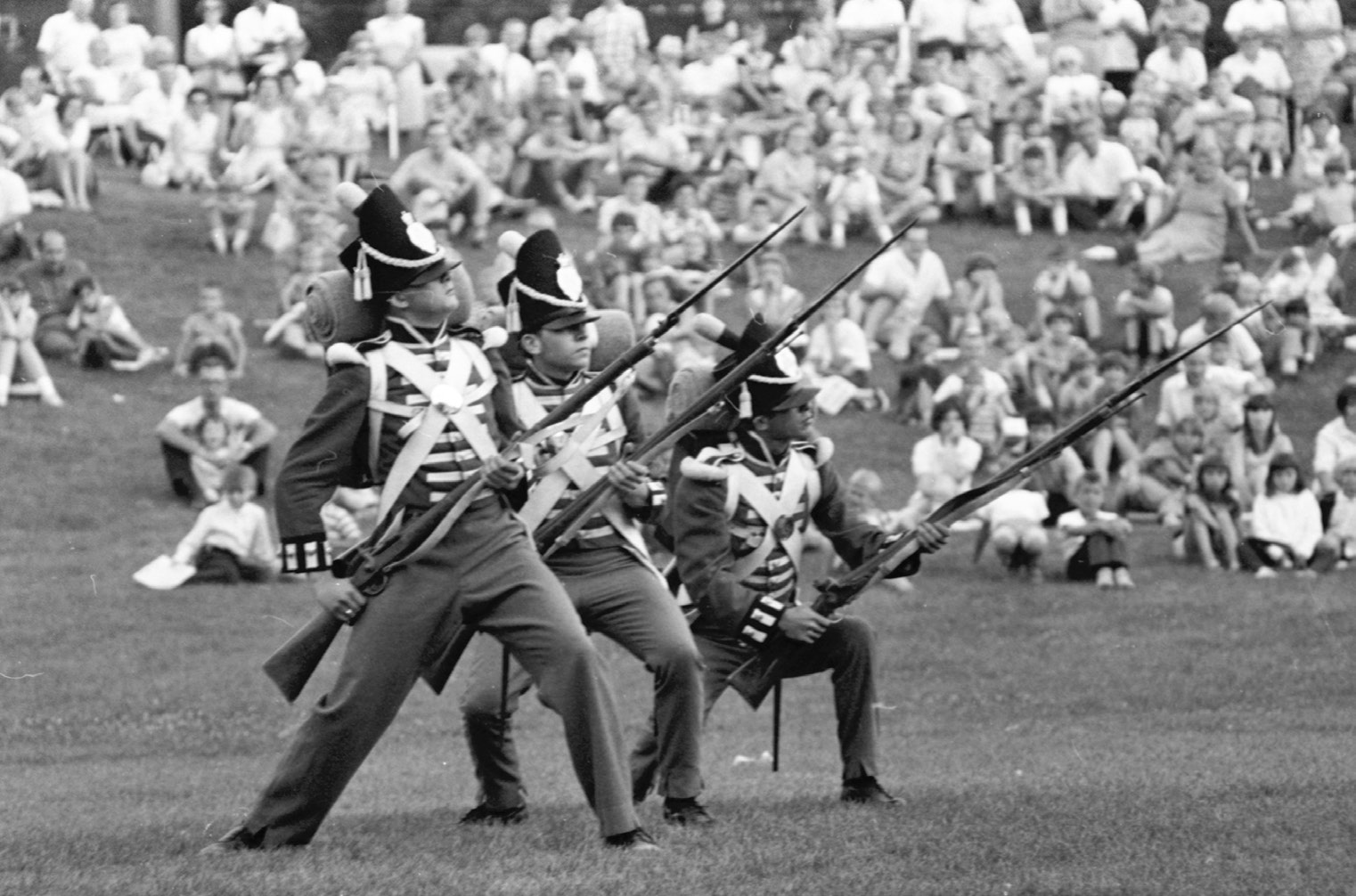
British square was a military tactic used by the guard. Although muskets fired in British square would occasionally singe the blankets on our backpacks, the realism of firing the muskets was an integral part of our Retreat Ceremony, complete with cannon fire and bugle calls of the British army from that period.
In 1967 the guard played a role in recreating history, not only at the fort but across our region, when twenty-five members completed a march from Fort George at Niagara-on-the-Lake to Toronto. Short training sessions were held to ensure that guardsmen had the physical stamina to undertake a re-enactment of these British troop movements. I was fortunate to have been selected for the march; not all members could participate because the fort also had to be staffed throughout the period.
The event began with an initial Retreat Ceremony at Fort George where the guard was billeted for the night in the blockhouse. We set off on our five-day march the next day, stopping each evening to perform a Retreat Ceremony in the communities where we were quartered in either a private home or motel. The guard marched on the shoulder of the road though one noted they “had to ride in a truck for a couple of miles to prevent being mowed down by cars.” We stopped in St. Catharines, Grimsby, Stoney Creek, and Burlington. Our order of dress was grey uniform trousers, black boots, and the guard’s navy blue sweatshirt and pack.
“As another marcher remarked while he cleaned his 150-year-old flintlock musket, “I can hardly wait to get into a hot bathtub and then watch a bit of television.”
Prior to reaching a town, our escort vehicle would stop to provide our shakos, tunics, and cross belts. George Waters, the curator at Fort York, followed the marchers in the truck, toting a one-pound cannon and blank munitions. Entering the town we were in full uniform with muskets, cannon, and our fife and drums playing. Waters also delivered a capsule account of Canadian history and explained the purpose of the march while the guardsmen performed.
Our schedule required us to arrive in Toronto by 2 pm on Friday, August 18, to form an honour guard for the official opening of the Canadian National Exhibition. On arrival the chairman of the Toronto Historical Board, Colonel William James Stewart, and Brigadier General John A. McGinnis, the board’s managing director, were on hand to welcome us. Local media covering the march reported on our daily progress. Bugler Steve Cadoran, 15, found the march “real easy” except the trudge up the Queenston Heights to Brock’s Monument. Another guardsman pointed out that as bugler he had no pack on his back, nor a ten-pound musket over his shoulder. Kenneth Stone, 17-year-old drummer from Riverdale Collegiate, summed it up: “Slogging along the flat is not too bad but it is the hills that [are] the real grind.” As another marcher remarked while he cleaned his 150-year-old flintlock musket, “I can hardly wait to get into a hot bathtub and then watch a bit of television.”
Throughout that summer season the fort was busy with Torontonians and tourists visiting the site. The guard completed many Retreat Ceremonies there as well as one at Toronto City Hall on Nathan Philips Square. Members of the guard also worked at the Marine Museum of Upper Canada located on the Canadian National Exhibition grounds in the former officers’ barracks of the New Fort of 1841. I also had the opportunity to serve as a tour guide at Mackenzie House, located at 82 Bond Street.
One last memory of that year is the Eaton’s Santa Claus Parade in November when I participated as one of four members of the guard. The parade set off on Bloor Street near Christie Pits and ended downtown by City Hall. The morning was cold and wet with freezing rain and we marched in front of the float carrying Bobby Gimby as he played his song Canada which was written for the centennial and Expo. The trumpet played as freezing rain fell; at the end of the parade route our new wool tunics had shrunk approximately one inch.
Original printed pages