

In the last issue of Fife and Drum it was said that Henry Ross was born on his father’s 200-acre farm in Lot 3, Second Concession west of Yonge Street, York Township, now part of midtown Toronto. It appears now this was not strictly correct. His birthplace was a house on a five-acre parcel in Lot 2 attached like a chad to the southeast corner of Lot 3. It was a newly-built squared-timber structure when Henry’s father bought it in 1821 from his brother-in-law Robert Wells. Numbered as 2600 Bathurst Street until the 1950s, it then became 8 Ridelle Avenue.
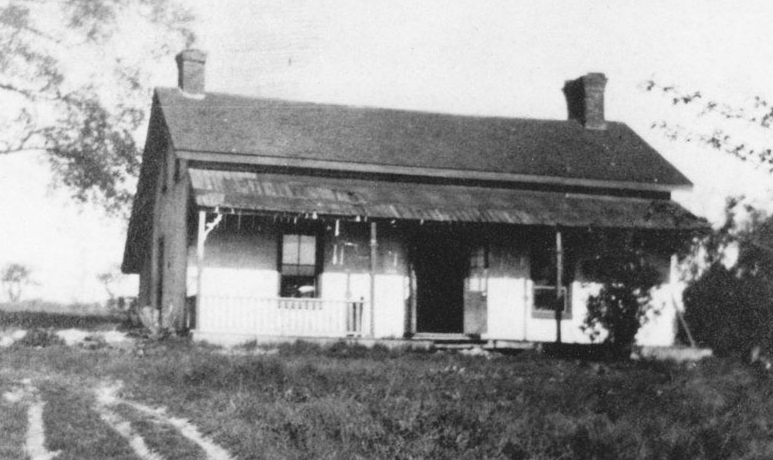
In 1858, four years after Ross’s death in Australia, his parents moved from Bathurst Street and divided the farm between two of his brothers; Joseph got the house. Among its later owners were William and Minnie Gemmell who bought it in 1920. It was also the home of Dora Mavor Moore, a noted actor, teacher, and stage-director who purchased it from the Gemmells in 1938. In a barn on the property the Village Players, a company she co-founded, performed plays by Federico García Lorca and Bertolt Brecht when it was not touring Shakespeare in the high schools.
The charm and history of the home inspired the Gemmell’s daughter, Jeanne Minhinnick, author of the much respected At Home in Upper Canada (1970), in her work as a consultant on Upper Canada Village, the restoration of The Grange at Toronto, and Hamilton’s Dundurn Castle. In the 1990s Minhinnick’s sister, Mary Denoon, led a spirited campaign to prevent the house from being torn down, but without success. Said then to be the longest-inhabited dwelling in the City of Toronto, this failed to sway Council to prevent demolition.
Apart from stucco applied to the exterior for practical and cosmetic reasons in the 19th century, the house changed very little in appearance or function in its first century. In 1920 as in 1820, it still lacked running water, central heating, and indoor plumbing. When the Gemmells became the owners they made several improvements. A trio of dormers with casement windows was opened on the second floor, bringing welcome light to the upper hall and two front bedrooms. The verandah was rebuilt to a deeper configuration and given heavier columns. Hydro service would wait until 1941.
By 1954 when the house was boxed in by a large apartment building on Bathurst Street it lost much of its setting. By the 1990s Dora Mavor Moore’s children were joint owners and could not agree on a course leading to preservation. In spite of real public interest in this option, when it was clear that demolition was impending the structure was given to Habitat for Humanity to auction the materials. They were bought for $29,000 by a young couple who after some delay were able to re-erect the building on Allbright Road in Uxbridge, a small town 65 km northeast of Toronto.
Original printed pages


