For the city of Toronto, as for the rest of the country, 1914 to 1918 had been four long and hard years. From a population estimated to be just under 400,000 in 1914, 50,000 men from Toronto and surrounding area had enlisted in the Canadian Expeditionary Force for overseas service – and 10,000 did not return. Their families and loved ones at home eagerly awaited the arrival of the mailman, hopefully carrying a letter or postcard from overseas. But they did not want to see telegram boys coming down the street because telegrams were bad news, particularly the ones that began with the phrase “Deeply regret to inform you that …” a loved one was dead, wounded or missing in action.
Life on the home front was not easy. Although there were more jobs and higher wages, the cost of living nearly doubled and there were shortages of milk, bread and eggs. During the last year of the war, Torontonians also experienced fuel shortages that resulted in frequent blackouts or brown-outs. In February 1918 all public buildings in the city, including schools, as well as many businesses were closed for three days to conserve fuel. In the late summer of 1918 news of substantial Allied advances on the Western Front cheered everyone up. Then, a new and terrible enemy appeared.
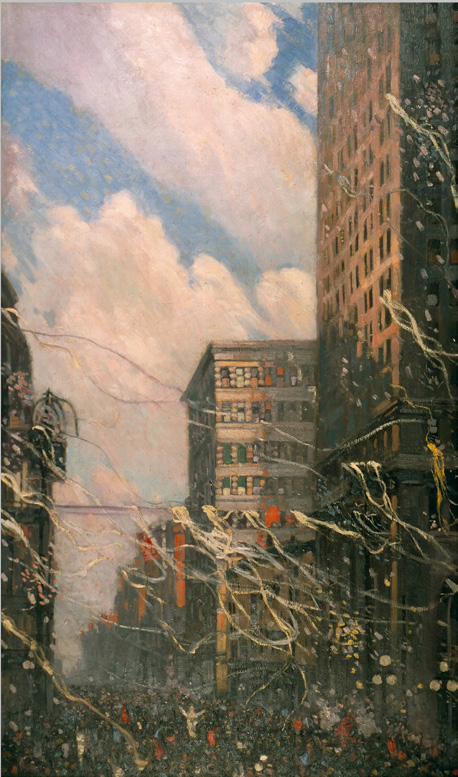
Popularly known as the Spanish flu – which it was not – this was an H1N1 virus that had appeared in Europe that summer. It grew so rapidly that it became a full-fledged pandemic. By October it had reached Toronto and spread through the school system; by mid-month 50 people a day were dying in the city. By November, when the pandemic seems to have run its course, 200,000 Torontonians – almost half the city’s population – had contracted the virus and 1,300 people had perished. Globally, the pandemic is thought to have killed between 25 and 50 million people. It is small wonder that when news of the Armistice of November 11 reached the city, Torontonians went wild with excitement.
By the following summer of 1919, people were in the mood to celebrate. The management of the Canadian National Exhibition, sensing that spirit, declared the Ex that year to be “Canada’s Victory Celebration” – an “Incomparable Programme Eclipsing All Former Triumphs.” It was the hope of the management that attendance in 1919 would reach 1,250,000 visitors, surpassing the million-ticket total of the 1913 Ex, the last year the fair was held in its entirety.
They therefore put a lot of effort into advertising the “Victory Celebrations,” commissioning a very fine poster from J.E.H. MacDonald, originally a Toronto graphic designer and soon to be one of the founders of the Group of Seven painters. His mission was to illuminate the military themes of that year’s fair. His poster (on our front page) features a woman as an image of Canada, wearing the breast plate of the Dominion, carrying the Union Jack and riding a mount draped with maple leaves and the laurels of victory. Escorted by a soldier of the 3rd Battalion CEF (The Toronto Regiment), who is wearing a wound stripe, she is about to trample a German helmet of the ostentatious type favoured by Kaiser Wilhelm.
Listed below this patriotic Amazon are the highlights of the Victory Year CNE. The featured displays were all related to the world war that had officially ended on June 28 – five years to the day after the assassination of Arch-Duke Francis Ferdinand that began it all – when the Treaty of Versailles was signed. They include a surrendered German U-boat, a display of Canada’s war trophies, paintings of the war (“hundreds of masterpieces”), daily concerts by the band of the Grenadier Guards of the British Army, and the “Enormous Spectacle” of the grandstand show – called The Festival of Triumph – guaranteed to be “Uncommonly Picturesque, Inspiring and Colorful.” In even larger type is the promise that Edward, Prince of Wales, would officially open the exhibition.
On the first day of the Ex, August 23, it was soon apparent the war trophies were the most popular attraction. “All roads of the C.N.E.” led to the exhibit, one reporter declared, and it was “the one place you have to go.” This collection was largely the work of Arthur Doughty, the Dominion Archivist, who had been appointed Director of War Trophies in 1916. After three years of hard work Doughty had amassed an amazing accumulation of 800 artillery pieces, 4,000 heavy and light machine guns, 10,000 rifles and a multitude of other items.
On display, according to The Toronto Daily Star, were “field guns, surrendered and captured; planes, flags, uniforms, helmets, sundry posters, proclamations, photographs, and every conceivable item connected with the science of war.” Unable to contain himself, the Star‘s man risked repetition by describing the “uniforms, machineguns of all descriptions, swords, decorations, and British publications and proclamations from enemy countries; rifles of all kinds, big guns, revolvers of every description, water torpedoes, air torpedoes, mines, ammunition and all kinds of equipment.”
The field telephone supposedly used by General Ludendorff to conduct the massive German offensives of the spring of 1918 was also on display. Of great interest to visitors was the cockpit section of a Sopwith Spitfire fighter aircraft: it was the one flown by Canadian Major William G. Barker of the Royal Flying Corps when he fought an epic battle against enemy aircraft the previous October. Barker shot down at least two of his opponents but was himself badly wounded and forced to crash land. For this epic aerial duel, Barker received the Victoria Cross which, added to the impressive number of medals he had already won, made him the most decorated soldiers of the British Empire.
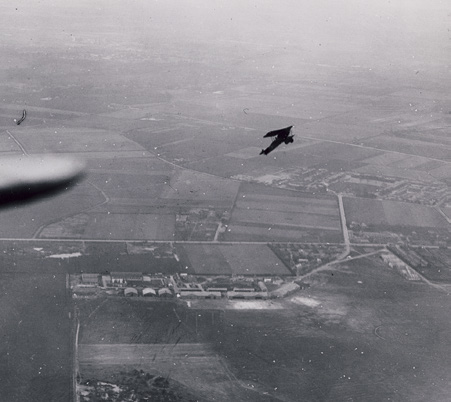
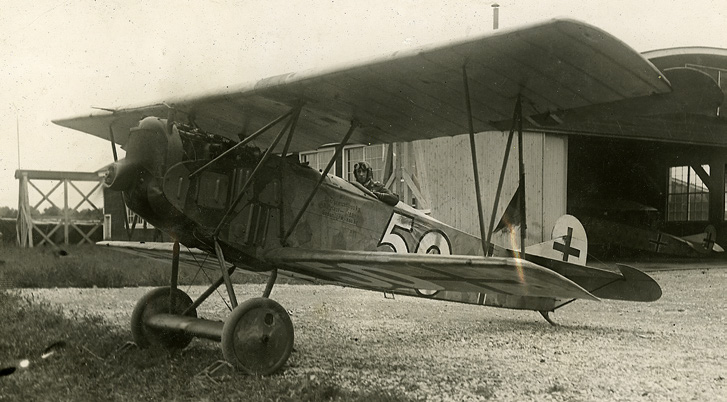
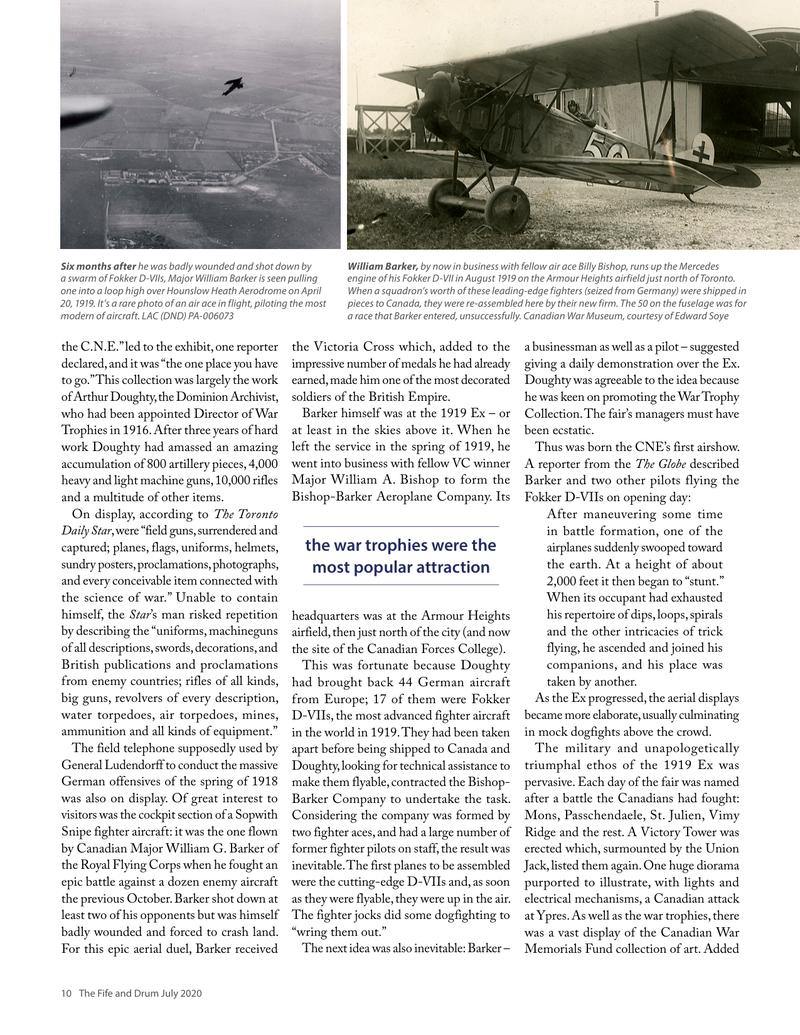
Barker launched was at the 1919 Ex – or at least in the skies above it. When he left the service in the spring of 1919, he went into business with fellow VC winner Major William A. Bishop to form the Bishop-Barker Aeroplane Company. It’s a businessman as well as a pilot – suggested giving a daily demonstration over the Ex. Doughty was agreeable to the idea because he was keen on promoting the War Trophy Collection. The fair’s managers must have been ecstatic.
Thus was born the CNE’s first airshow. A reporter from the The Globe described Barker and two other pilots flying the Fokker D-VIIs on opening day:
the war trophies were the most popular attraction
After maneuvering some time in battle formation, one of the airplanes suddenly swooped toward the earth. At a height of about 2,000 feet it then began to “stunt.” When its occupant had exhausted his repertoire of dips, loops, spirals and the other intricacies of trick flying, he ascended and joined his companions, and his place was taken by another.
As the Ex progressed, the aerial displays became more elaborate, usually culminating in mock dogfights above the crowd.
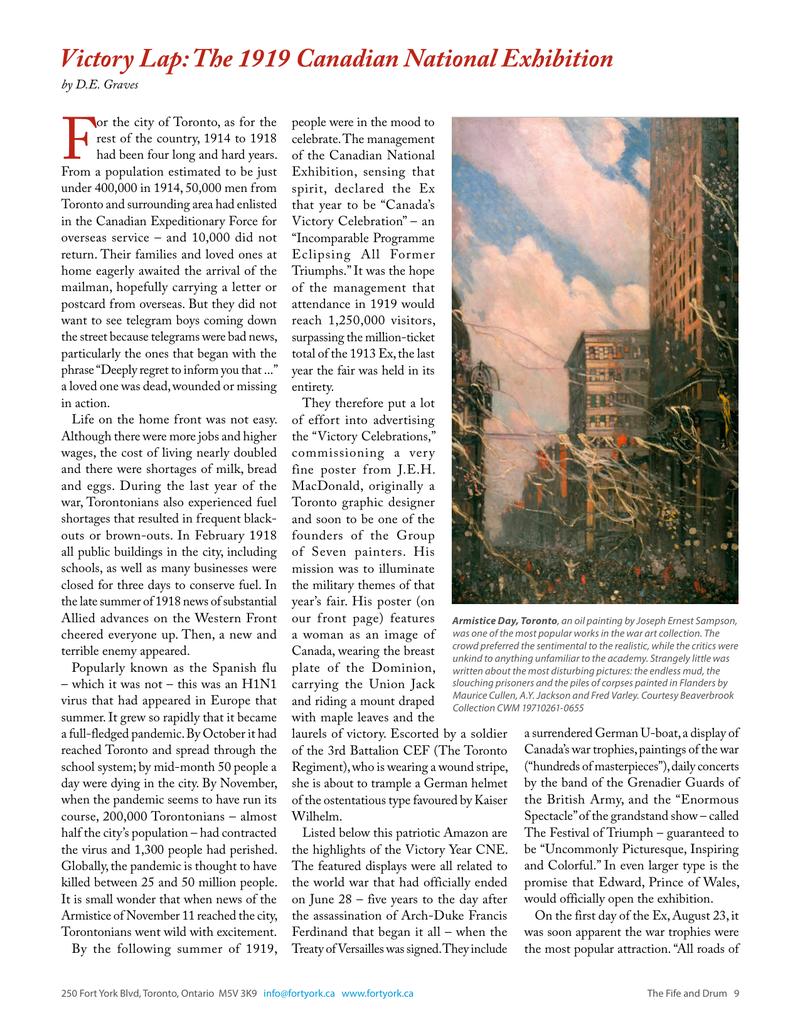
The military and unapologetically triumphal ethos of the 1919 Ex was pervasive. Each day of the fair was named after a battle the Canadians had fought: Mons, Passchendaele, St. Julien, Vimy Ridge and the rest. A Victory Tower was erected which, surmounted by the Union Jack, listed them again. One huge diorama purported to illustrate, with lights and electrical mechanisms, a Canadian attack at Ypres. As well as the war trophies, there was a vast display of the Canadian War Memorials Fund collection of art. Added to the CNE’s annual display of Canadian paintings (a major event in itself) were no fewer than 447 works of war art, making an exhibition of nearly a thousand works by a hundred artists. Among them were soon-to-be famous Canadians at the start of their careers (such as A.Y. Jackson and Fred Varley) while others were among the most prominent names in British art circles (such as Augustus Johns and Paul Nash). The Grenadier Guards Band played each afternoon. The Royal Canadian Dragoons, a unit of the regular army still stationed at the Stanley Barracks, performed the first postwar musical ride, that intricate equine ballet now assumed by the RCMP.
Of course, there were still the normal attractions, including the Food Hall and the Midway. There were displays of livestock, government exhibits, “acres of manufactures” and the animal competitions for dogs, cats and poultry. There was a large and popular exhibit of international photography. Another modern event attracting big crowds was the motor speed tests done on the horse-racing track. Spectators were thrilled by the appearance of Ralph DePalma, the winner of the 1915 Indianapolis 500, who drove his V-12 Packard to nearly 100 miles per hour.

After visitors had had their fill of war trophies and art, of aircraft wheeling in the sky above, and band concerts, and rides on the midway and endless temptations in the Food Hall, there was still the grand finale: the “Gorgeous Spectacle” of a grandstand show titled Festival of Triumph. This Festival featured massed bands, representative military units from allied nations, and the figures of Britannia, Columbia, John Bull and Uncle Sam. There was a Victory Ballet: a hundred girls “in robes of white with headpieces of electric lights.” The grand finale featured “the white-robed Choir of Jerusalem on St. David’s steps with golden horns” leading the singing of God Save the King backed by the inevitable massed bands. This was a hard act to follow but the fireworks display, which closed every day, did its best. There was certainly no shortage of explosives or expertise in the Toronto of 1919.
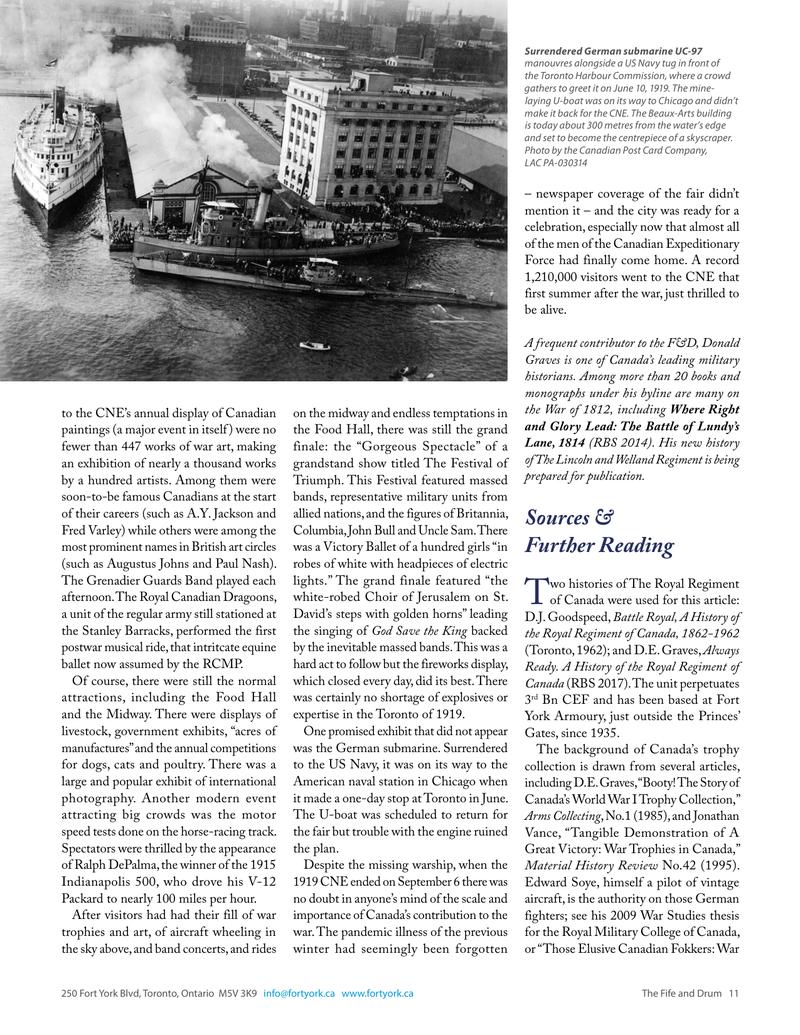
One promised exhibit that did not appear was the German submarine. Surrendered to the US Navy, it was on its way to the American naval station in Chicago when it made a one-day stop at Toronto in June. The U-boat was scheduled to return for the fair but trouble with the engine offset the plan.
Despite the missing warship, when the 1919 CNE ended on September 6 there was no doubt in anyone’s mind of the scale and importance of Canada’s contribution to the war. The pandemic illness of the previous winter had seemingly been forgotten – newspaper coverage of the fair didn’t mention it – and the city was ready for a celebration, especially now that almost all of the men of the Canadian Expeditionary Force had finally come home. A record 1,210,000 visitors went to the CNE that first summer after the war, just thrilled to be alive.
Sources & Further Reading
Two histories of The Royal Regiment of Canada were used for this article: D.J. Goodspeed, Battle Royal, A History of the Royal Regiment of Canada, 1862–1962 (Toronto, 1962); and D.E. Graves, Always Ready, A History of the Royal Regiment of Canada (RBS 2017). The unit perpetuates 3rd Bn CEF and has been based at Fort York Armoury, just outside the Princes’ Gates, since 1935.
The background of Canada’s trophy collection is drawn from several articles, including D.E. Graves, “Booty! The Story of Canada’s World War I Trophy Collection,” Arms Collecting, No.1 (1985), and Jonathan Vance, “Tangible Demonstration of A Great Victory: War Trophies in Canada,” Material History Review No.42 (1995). Edward Soye, himself a pilot of vintage aircraft, is the authority on those German fighters; see his 2009 War Studies thesis for the Royal Military College of Canada, or “Those Elusive Canadian Fokkers: War Trophies in the Nascent Canadian Air Force” on the Vintage Wings of Canada web site.
The fair was well covered by The Toronto Daily Star (notably on August 23 and September 6) and The Globe (especially August 23, 25 and 26).
Ian Miller’s book Our Day of Glory and Grief: Torontonians and the Great War (UTP 2000) ends abruptly with the Armistice but comprehensively describes the society of Toronto at the end of the war. Alan Bowker’s A Time Such as There Never Was Before: Canada After the Great War (Dundurn 2014) picks up the story for the country as a whole. Tim Cook and Jack Granatstein have just released a collection of 19 essays and WW1: A Nation Shaped by War (UBC 2020). Practically every scholar active in the field is represented and the topics range from reintegration to politics, paintings, venereal disease and the Spanish Influenza.
For an insightful look at the pandemic of 1918, see Vivian McAlister’s earlier echoes: the 1918 pandemic and today,” in SITREP (May–June 2020), the journal of the Royal Canadian Military Institute. It can be found here.
Jonathan Vance’s magnificent Death So Noble: Memory, Meaning and the First World War (UBC 1997) explores Canada’s evolution away from the triumphalist milieu of 1919. The story of the art in the extraordinary Canadian War Memorials Fund collection, including public reaction to the show at the CNE, is told by Maria Tippett in Art at the Service of War: Canada, Art, and the Great War (UTP 1984).
Original printed pages