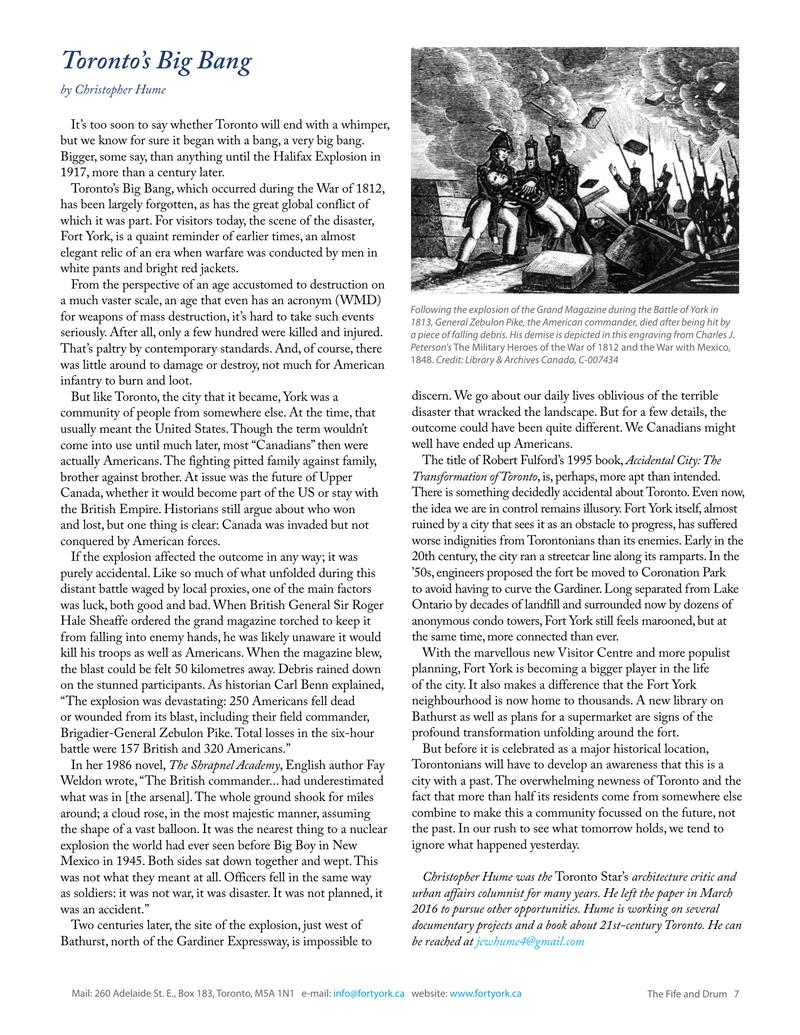
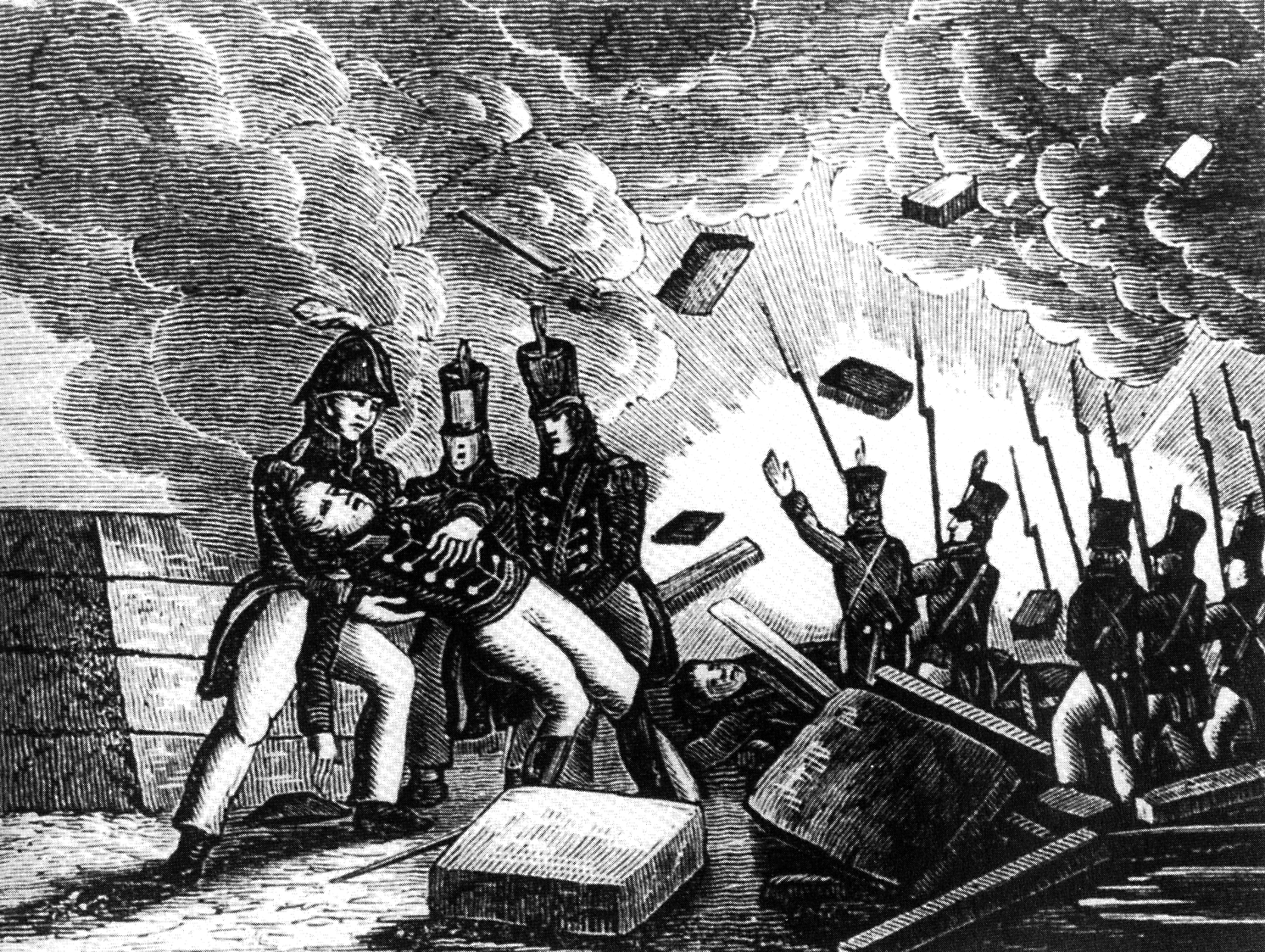
It’s too soon to say whether Toronto will end with a whimper, but we know for sure it began with a bang, a very big bang. Bigger, some say, than anything until the Halifax Explosion in 1917, more than a century later.
Toronto’s Big Bang, which occurred during the War of 1812, has been largely forgotten, as has the great global conflict of which it was part. For visitors today, the scene of the disaster, Fort York, is a quaint reminder of earlier times, an almost elegant relic of an era when warfare was conducted by men in white pants and bright red jackets.
From the perspective of an age accustomed to destruction on a much vaster scale, an age that even has an acronym (WMD) for weapons of mass destruction, it’s hard to take such events seriously. After all, only a few hundred were killed and injured. That’s paltry by contemporary standards. And, of course, there was little around to damage or destroy, not much for American infantry to burn and loot.
But like Toronto, the city that it became, York was a community of people from somewhere else. At the time, that usually meant the United States. Though the term wouldn’t come into use until much later, most “Canadians” then were actually Americans. The fighting pitted family against family, brother against brother. At issue was the future of Upper Canada, whether it would become part of the US or stay with the British Empire. Historians still argue about who won and lost, but one thing is clear: Canada was invaded but not conquered by American forces.
If the explosion affected the outcome in any way; it was purely accidental. Like so much of what unfolded during this distant battle waged by local proxies, one of the main factors was luck, both good and bad. When British General Sir Roger Hale Sheaffe ordered the grand magazine torched to keep it from falling into enemy hands, he was likely unaware it would kill his troops as well as Americans. When the magazine blew, the blast could be felt 50 kilometres away. Debris rained down on the stunned participants. As historian Carl Benn explained, “The explosion was devastating: 250 Americans fell dead or wounded from its blast, including their field commander, Brigadier-General Zebulon Pike. Total losses in the six-hour battle were 157 British and 320 Americans.”
In her 1986 novel, The Shrapnel Academy, English author Fay Weldon wrote, “The British commander… had underestimated what was in [the arsenal].’ The whole ground shook for miles around; a cloud rose, in the most majestic manner, assuming the shape of a vast balloon. It was the nearest thing to a nuclear explosion the world had ever seen before Big Boy in New Mexico in 1945. Both sides sat down together and wept. This was not what they meant at all. Officers fell in the same way as soldiers: it was not war, it was disaster. It was not planned, it was an accident.”
Two centuries later, the site of the explosion, just west of Bathurst, north of the Gardiner Expressway, is impossible to discern. We go about our daily lives oblivious of the terrible disaster that wracked the landscape. But for a few details, the outcome could have been quite different. We Canadians might well have ended up Americans.
The title of Robert Fulford’s 1995 book, Accidental City: The Transformation of Toronto, is, perhaps, more apt than intended. There is something decidedly accidental about Toronto. Even now, the idea we are in control remains illusory. Fort York itself, almost ruined by a city that sees it as an obstacle to progress, has suffered worse indignities from Torontonians than its enemies. Early in the 20th century, the city ran a streetcar line along its ramparts. In the ’50s, engineers proposed the fort be moved to Coronation Park to avoid having to curve the Gardiner. Long separated from Lake Ontario by decades of landfill and surrounded now by dozens of anonymous condo towers, Fort York still feels marooned, but at the same time, more connected than ever.
With the marvellous new Visitor Centre and more populist planning, Fort York is becoming a bigger player in the life of the city. It also makes a difference that the Fort York neighbourhood is now home to thousands. A new library on Bathurst as well as plans for a supermarket are signs of the profound transformation unfolding around the fort.
But before it is celebrated as a major historical location, Torontonians will have to develop an awareness that this is a city with a past. The overwhelming newness of Toronto and the fact that more than half its residents come from somewhere else combine to make this a community focussed on the future, not the past. In our rush to see what tomorrow holds, we tend to ignore what happened yesterday.
Original printed pages