More than four years ago Chris Laverton wrote a short biography of Captain Henry Evatt for The Fife and Drum (July 2012). Born into a military family in Ireland in 1774, Evatt came to Canada in 1817. Within two years, he was appointed assistant barrack master at Côteau-du-Lac in Lower Canada, rising to barrack master by 1832. Evatt served as barrack master in Toronto during 1835-41, then held the same position in Hamilton, where he died in 1857.
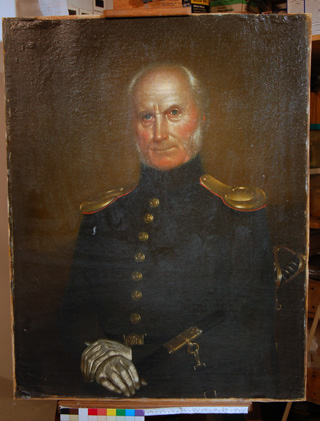
Accompanying Laverton’s article was an oil on canvas portrait owned by Parks Canada. In it, Evatt wears the blue uniform of an officer of the Ordnance Department, with epaulettes denoting the equivalency of a barrack master to the rank of major. Neither the date of the painting nor the artist is known.
Parks Canada has since loaned the Evatt portrait to City of Toronto Museums & Heritage Services for a ten-year period. We agreed to undertake a condition assessment and then proceed with conservation treatment before exhibiting the portrait. The Fort York Foundation provided funding through its Fort York Acquisitions Fund.
Evatt came to us in poor and unstable condition. Previous attempts at restoration had resulted in the partial removal of varnish, minor overcleaning, and the application of overpaint and replacement varnish. More critically, the canvas had been cut away from the original stretcher frame and then glued to semi-rigid cardboard. Warping of this auxiliary support resulted in paint/ground losses and planar distortions. Materials in the glue and the cardboard had accelerated the chemical deterioration of the canvas. The glue’s high temperature and moisture content had also caused heat blisters in the oil paint.
The painting presents a remarkable example of a relatively recent phenomenon identified in oil paintings: the formation of tiny, round, white protrusions consisting of metallic soaps. Fortunately, the protrusions on the Evatt portrait had not broken off, which would have created visually distracting crater-like structures in the paint layers.
The present conservation treatment involved the application of a protective facing on the front of the painting, followed by removal of the cardboard and heavy, too-thick glue residues from the back. The heat blisters were secured and stabilized; in some cases, the degree of blistering was reduced with controlled applications of moisture and heat and pressure.
After the structural restoration work was completed, the painting was cleaned. Two layers of discoloured resin varnish were removed, eliminating the hazy grey film that had diffused and desaturated the paint colours. A new, non-yellowing coating of varnish was added, bringing out the colour and modelling of the figure.
Remarkably, for a painting of this age, very little paint loss has occurred to the original design layers except along the cut edges. Only minor inpainting was required during the present treatment.
Once the original canvas has been mounted on a new lining and attached to a new custom-built stretcher frame, the portrait will go on display in the Officers’ Mess Dining Room at Fort York. It is a fitting place for this painting. The room has been restored to its 1830s appearance, and Evatt would have spent considerable time there during his tenure in Toronto.
I would like to thank the Fort York Foundation, and especially Steve Otto, for supporting this project in so many ways. Credit must also go to: Therese Charboneau, for her condition assessment and treatment recommendations; Barry Briggs, for performing the treatment; and Joan Fussell, the city’s artifacts conservator, for coordinating the restoration of Henry Evatt.


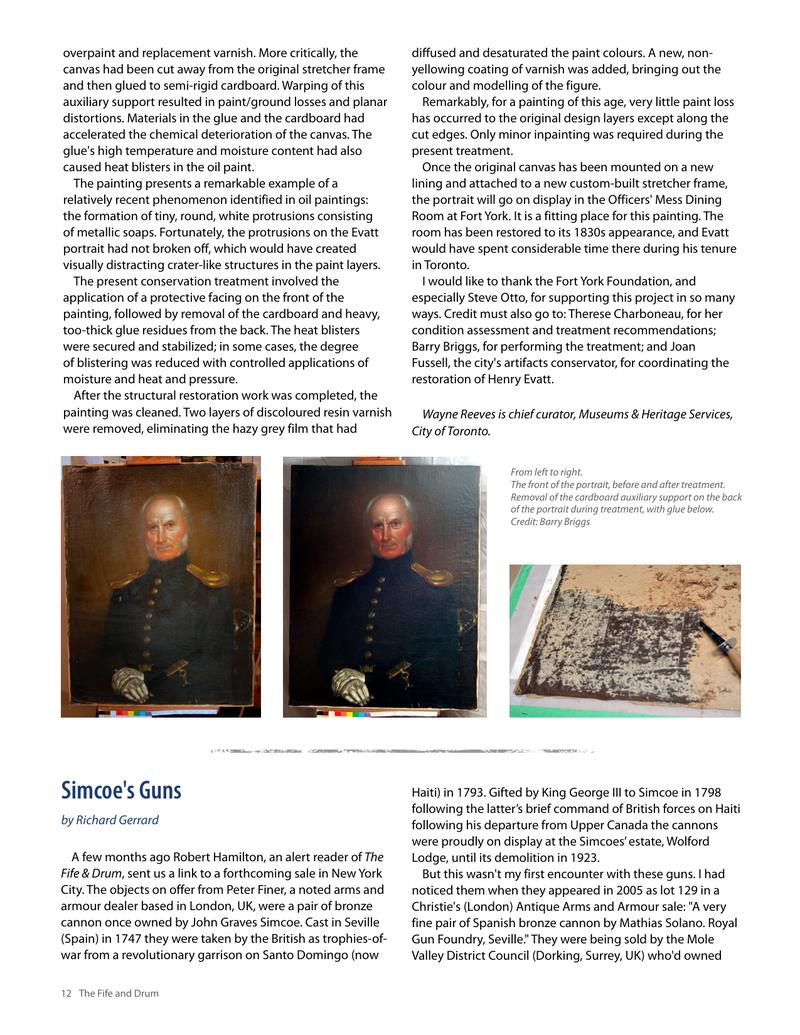
Original printed pages