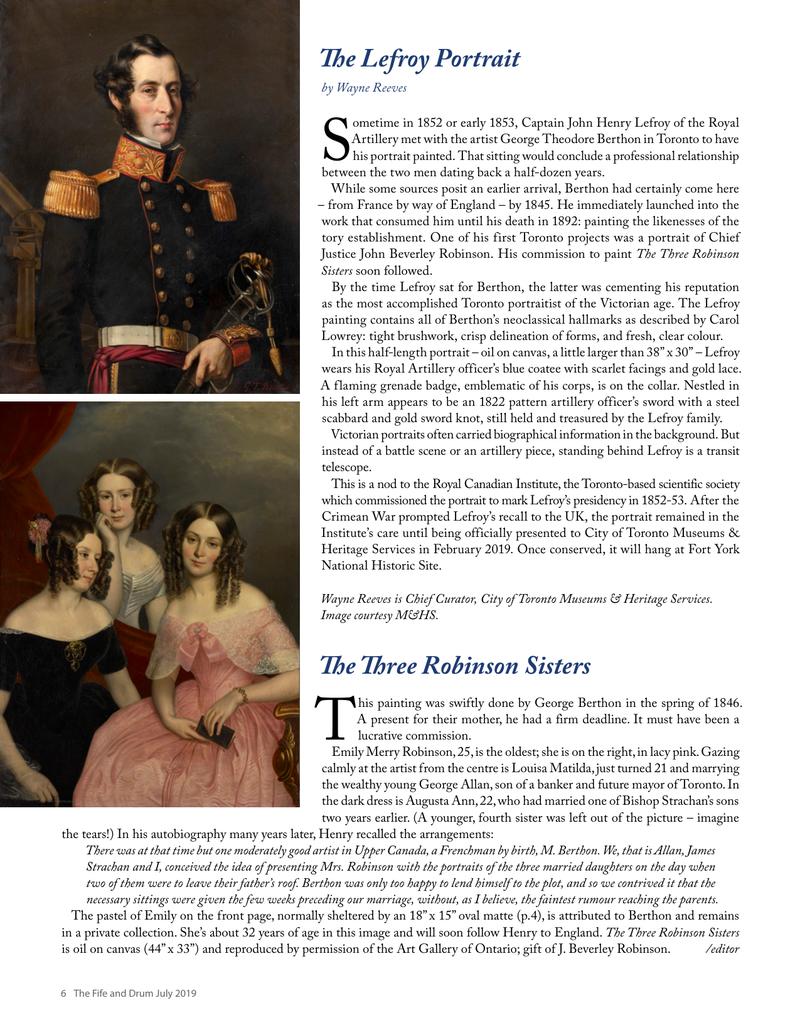
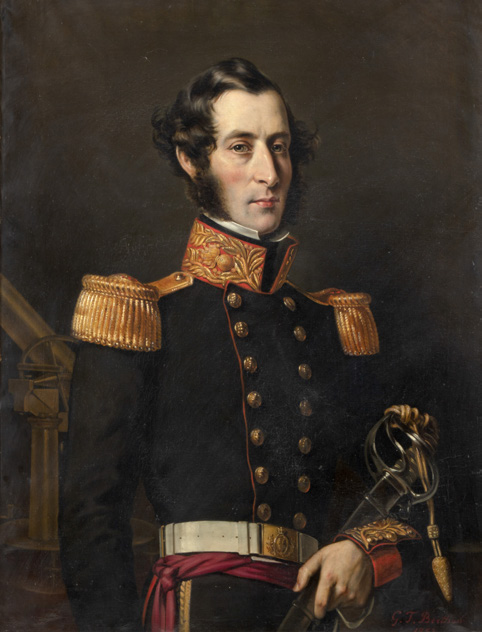
Sometime in 1852 or early 1853, Captain John Henry Lefroy of the Royal Artillery met with the artist George Theodore Berthon in Toronto to have his portrait painted. That sitting would conclude a professional relationship between the two men dating back a half-dozen years.
While some sources posit an earlier arrival, Berthon had certainly come here – from France by way of England – by 1845. He immediately launched into the work that consumed him until his death in 1892: painting the likenesses of the tory establishment. One of his first Toronto projects was a portrait of Chief Justice John Beverley Robinson. His commission to paint The Three Robinson Sisters soon followed.
By the time Lefroy sat for Berthon, the latter was cementing his reputation as the most accomplished Toronto portraitist of the Victorian age. The Lefroy painting contains all of Berthon’s neoclassical hallmarks as described by Carol Lowrey: tight brushwork, crisp delineation of forms, and fresh, clear colour.
In this half-length portrait – oil on canvas, a little larger than 38″ × 30″ – Lefroy wears his Royal Artillery officer’s blue coatee with scarlet facings and gold lace. A flaming grenade badge, emblematic of his corps, is on the collar. Nestled in his left arm appears to be an 1822 pattern artillery officer’s sword with a steel scabbard and gold sword knot, still held and treasured by the Lefroy family.
Victorian portraits often carried biographical information in the background. But instead of a battle scene or an artillery piece, standing behind Lefroy is a transit telescope.
This is a nod to the Royal Canadian Institute, the Toronto-based scientific society which commissioned the portrait to mark Lefroy’s presidency in 1852-53. After the Crimean War prompted Lefroy’s recall to the UK, the portrait remained in the Institute’s care until being officially presented to City of Toronto Museums & Heritage Services in February 2019. Once conserved, it will hang at Fort York National Historic Site.
The Three Robinson Sisters
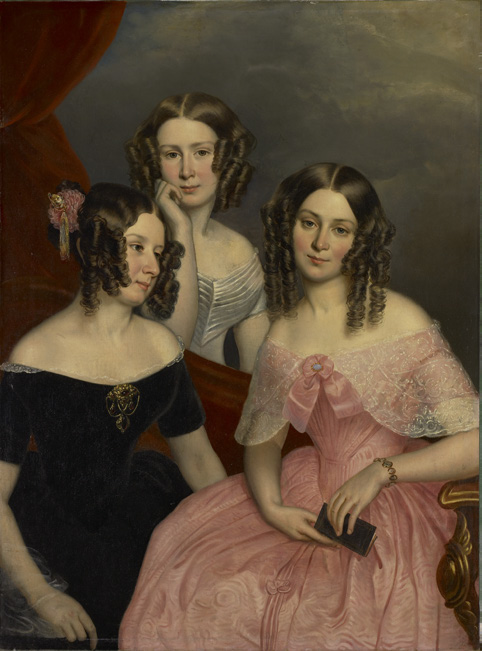
This painting was swiftly done by George Berthon in the spring of 1846. A present for their mother, he had a firm deadline. It must have been a lucrative commission.
Emily Merry Robinson, 25, is the oldest; she is on the right, in lacy pink. Gazing calmly at the artist from the centre is Louisa Matilda, just turned 21 and marrying the wealthy young George Allan, son of a banker and future mayor of Toronto. In the dark dress is Augusta Ann, 22, who had married one of Bishop Strachan’s sons two years earlier. (A younger, fourth sister was left out of the picture – imagine the tears!) In his autobiography many years later, Henry recalled the arrangements:
There was at that time but one moderately good artist in Upper Canada, a Frenchman by birth, M. Berthon. We, that is Allan, James Strachan and I, conceived the idea of presenting Mrs. Robinson with the portraits of the three married daughters on the day when they all came to leave their father’s roof. Berthon was only too happy to lend himself to the plot, and so we contrived it that the necessary sittings were given the few weeks preceding our marriage, without, as I believe, the faintest rumour reaching the parents.
The pastel of Emily on the front page, normally sheltered by an 18″ × 15″ oval matte (p.4), is attributed to Berthon and remains in a private collection. She’s about 32 years of age in this image and will soon follow Henry to England. The Three Robinson Sisters is oil on canvas (44″ × 33″) and reproduced by permission of the Art Gallery of Ontario, gift of J. Beverley Robinson.
Original printed pages