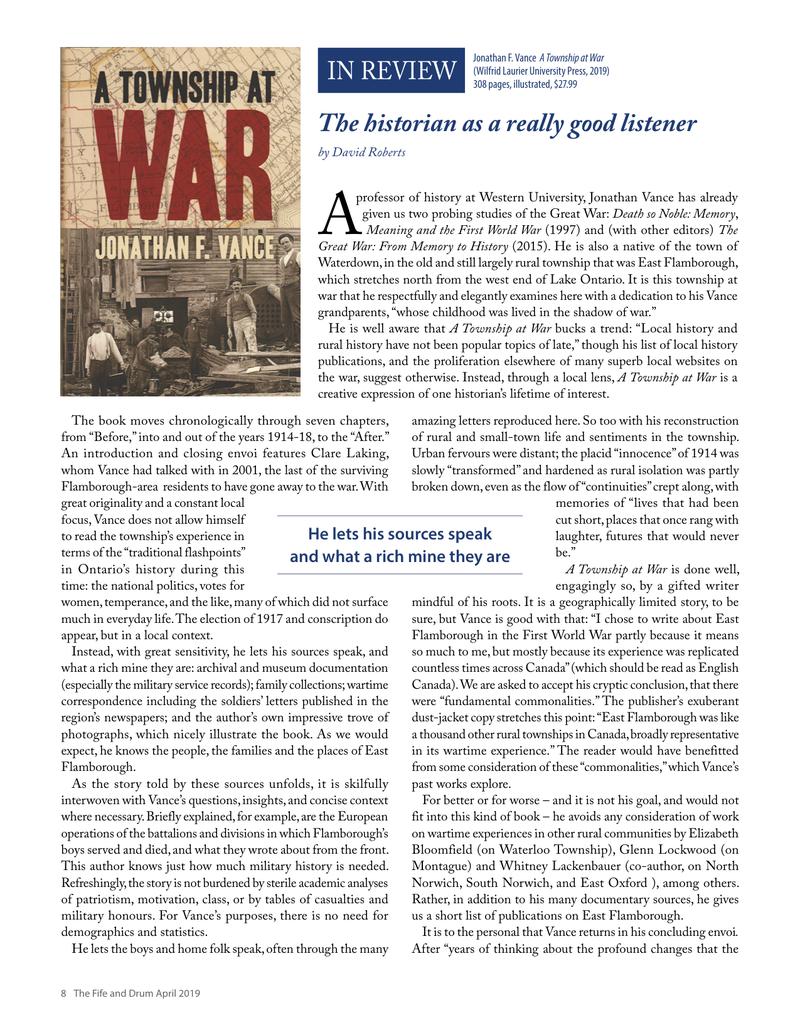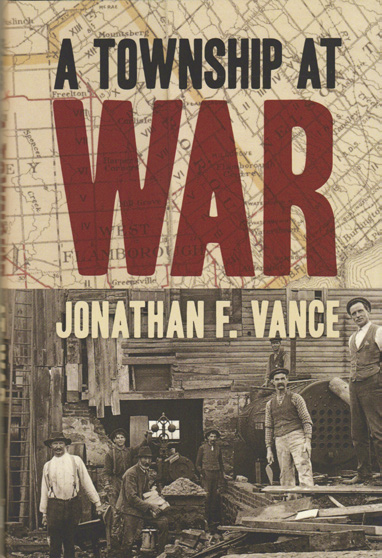
A professor of history at Western University, Jonathan Vance has already given us two probing studies of the Great War: Death so Noble: Memory, Meaning and the First World War (1997) and (with other editors) The Great War: From Memory to History (2015). He is also a native of the town of Waterdown, in the old and still largely rural township that was East Flamborough, which stretches north from the west end of Lake Ontario. It is this township at war that he respectfully and elegantly examines here with a dedication to his grandparents, “whose childhood was lived in the shadow of war.”
He is well aware that A Township at War bucks a trend: “Local history and rural history have not been popular topics of late,” though his list of local history publications, and the proliferation elsewhere of many superb local websites on the war, suggest otherwise. Instead, through a local lens, A Township at War is a creative expression of one historian’s lifetime of interest.
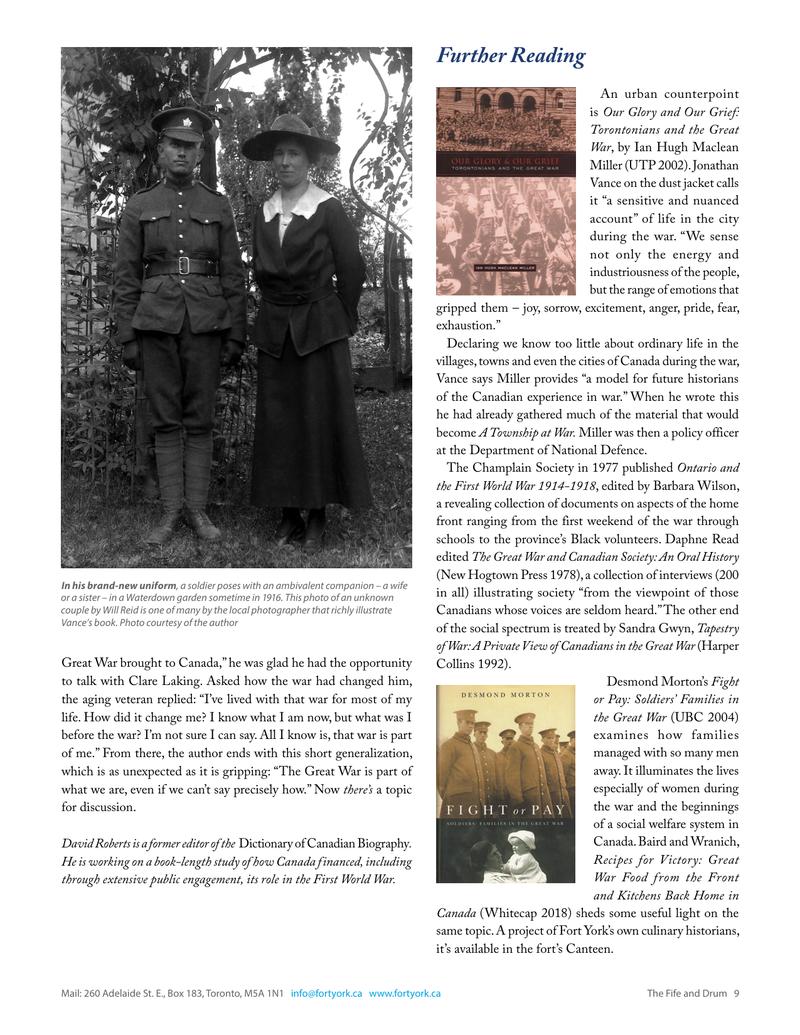
The book moves chronologically through seven chapters, from “Before,” into and out of the years 1914-18, to the “After.” An introduction and closing envoi features Clare Laking, whom Vance had talked with in 2001, the last of the surviving Flamborough-area residents to have gone away to the war. With great originality and a constant local focus, Vance does not allow himself to read the township’s experience in terms of the “traditional flashpoints” in Ontario’s history during this time: the national politics, votes for women, temperance, and the like, many of which did not surface much in everyday life. The election of 1917 and conscription do appear, but in a local context.
Instead, with great sensitivity, he lets his sources speak, and what a rich mine they are: archival and museum documentation (especially the military service records); family collections; wartime correspondence including the soldiers’ letters published in the region’s newspapers; and the author’s own impressive trove of photographs, which nicely illustrate the book. As we would expect, he knows the people, the families and the places of East Flamborough.
As the story told by these sources unfolds, it is skilfully interwoven with Vance’s questions, insights, and concise context where necessary. Briefly explained, for example, are the European operations of the battalions and divisions in which Flamborough’s boys served and died, and what they wrote about from the front. This author knows just how much military history is needed. Refreshingly, the story is not burdened by sterile academic analyses of patriotism, motivation, class, or by tables of casualties and military honours. For Vance’s purposes, there is no need for demographics and statistics.
He lets his sources speak and what a rich mine they are
He lets the boys and home folk speak, often through the many amazing letters reproduced here. So too with his reconstruction of rural and small-town life and sentiments in the township. Urban fervours were distant; the placid “innocence” of 1914 was slowly “transformed” and hardened as rural isolation was partly broken down, even as the flow of “continuities” crept along, with memories of “lives that had been cut short, places that once rang with laughter, futures that would never be.”
A Township at War is done well, engagingly so, by a gifted writer mindful of his roots. It is a geographically limited story, to be sure, but Vance is good with that: “I chose to write about East Flamborough in the First World War partly because it means so much to me, but mostly because its experience was replicated countless times across Canada” (which should be read as English Canada). We are asked to accept his cryptic conclusion, that there were “fundamental commonalities.” The publisher’s exuberant dust-jacket copy stretches this point: “East Flamborough was like a thousand other rural townships in Canada, broadly representative in its wartime experience.” The reader would have benefitted from some consideration of these “commonalities,” which Vance’s past works explore.
For better or for worse – and it is not his goal, and would not fit into this kind of book – he avoids any consideration of work on wartime experiences in other rural communities by Elizabeth Bloomfield (on Waterloo Township), Glenn Lockwood (on Montague) and Whitney Lackenbauer (co-author, on North Norwich, South Norwich, and East Oxford), among others. Rather, in addition to his many documentary sources, he gives us a short list of publications on East Flamborough.
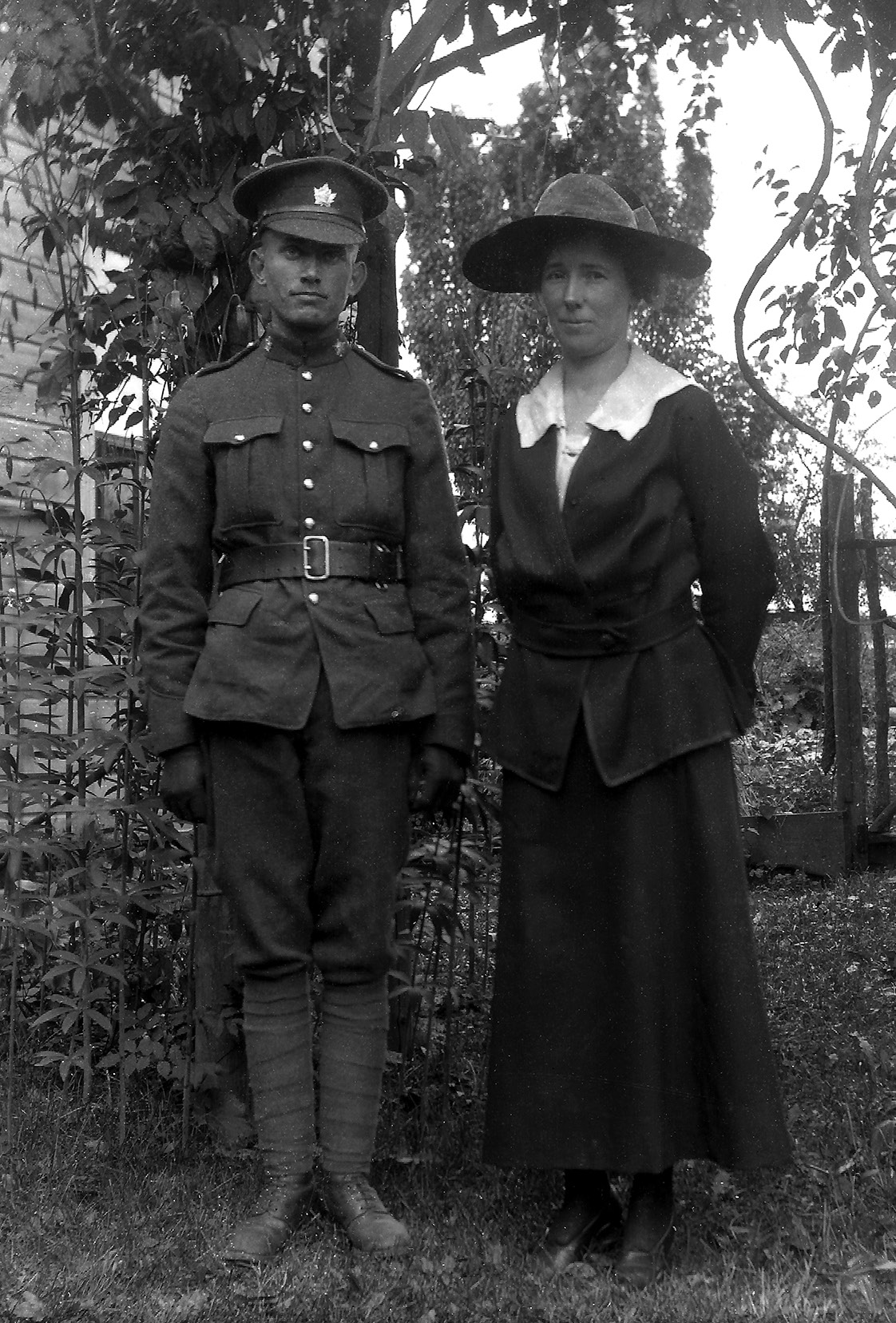
It is to the personal that Vance returns in his concluding envoi. After “years of thinking about the profound changes that the Great War brought to Canada,” he was glad he had the opportunity to talk with Clare Laking. Asked how the war had changed him, the aging veteran replied: “I’ve lived with that war for most of my life. How did it change me? I know what I am now, but what was I before the war? I’m not sure I can say. All I know is, that war is part of me.” From there, the author ends with this short generalization, which is as unexpected as it is gripping: “The Great War is part of what we are, even if we can’t say precisely how.” Now there’s a topic for discussion.
Further Reading
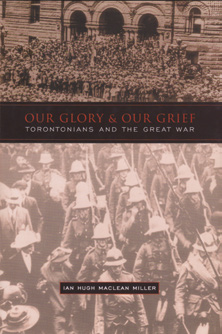
An urban counterpoint is Our Glory and Our Grief: Torontonians and the Great War, by Ian Hugh Maclean Miller (UTP 2002). Jonathan Vance on the dust jacket calls it “a sensitive and nuanced account” of life in the city during the war. “We sense not only the energy and industriousness of the people, but the range of emotions that gripped them – joy, sorrow, excitement, anger, pride, fear, exhaustion.”
Declaring we know too little about ordinary life in the villages, towns and even the cities of Canada during the war, Vance says Miller provides “a model for future historians of the Canadian experience in war.” When he wrote this he had already gathered much of the material that would become A Township at War. Miller was then a policy officer at the Department of National Defence.
The Champlain Society in 1977 published Ontario and the First World War 1914–1918, edited by Barbara Wilson, a revealing collection of documents on aspects of the home front ranging from the first weekend of the war through schools to the province’s Black volunteers. Daphne Read edited The Great War and Canadian Society: An Oral History (New Hogtown Press 1978), a collection of interviews (200 in all) illustrating society “from the viewpoint of those Canadians whose voices are seldom heard.” The other end of the social spectrum is treated by Sandra Gwyn, Tapestry of War: A Private View of Canadians in the Great War (Harper Collins 1992).
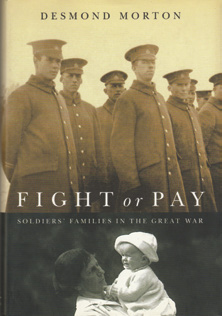
Desmond Morton’s Fight or Pay: Soldiers’ Families in the Great War (UBC 2004) examines how families managed with so many men away. It illuminates the lives especially of women during the war and the beginnings of a social welfare system in Canada. Baird and Wramich, Recipes for Victory: Great War Food from the Front and Kitchens Back Home in Canada (Whitecap 2018) sheds some useful light on the same topic. A project of Fort York’s own culinary historians, it’s available in the fort’s Canteen.
Original printed pages