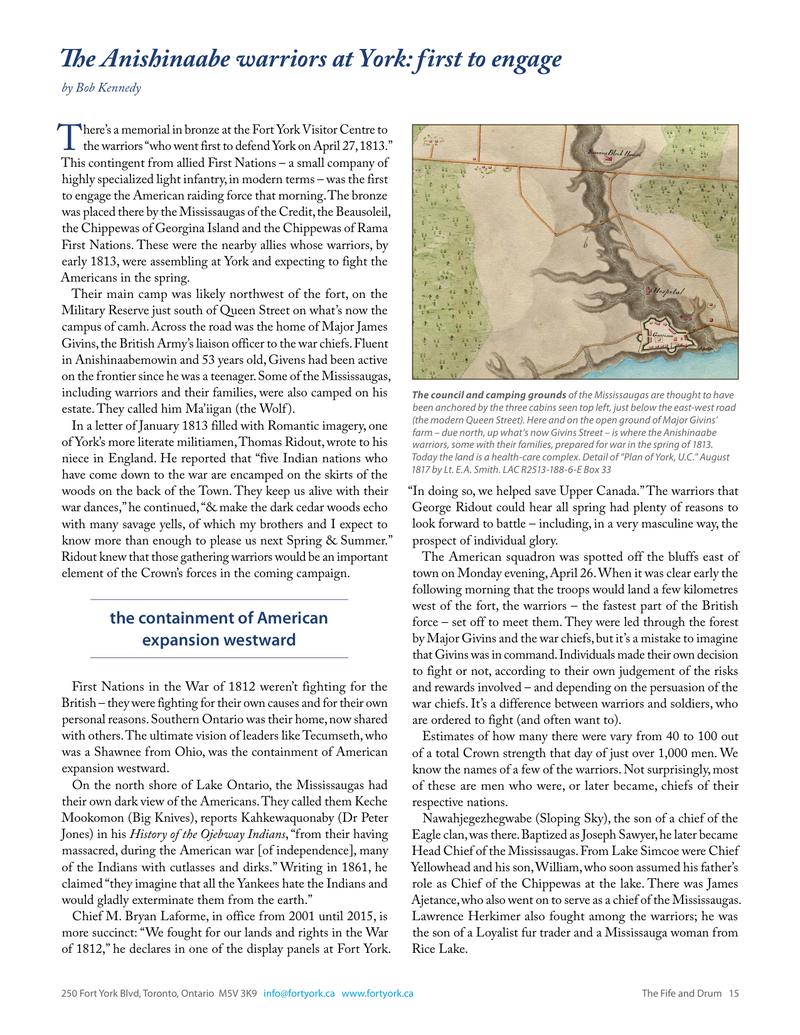
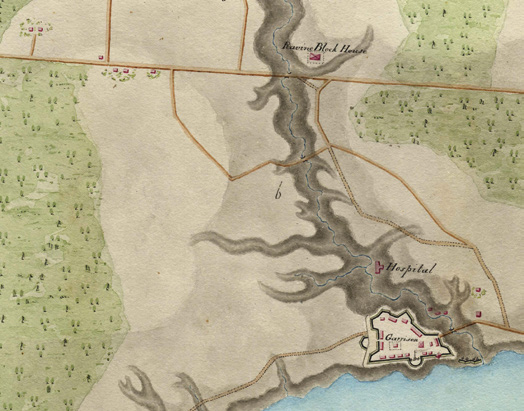
There’s a memorial in bronze at the Fort York Visitor Centre to the warriors “who went first to defend York on April 27, 1813.” This contingent from allied First Nations – a small company of highly specialized light infantry, in modern terms – was the first to engage the American raiding force that morning. The bronze was placed there by the Mississaugas of the Credit, the Beausoleil, the Chippewas of Georgina Island and the Chippewas of Rama First Nations. These were the nearby allies whose warriors, by early 1813, were assembling at York and expecting to fight the Americans in the spring.
Their main camp was likely northwest of the fort, on the Military Reserve just south of Queen Street on what’s now the campus of camh. Across the road was the home of Major James Givins, the British Army’s liaison officer to the war chiefs. Fluent in Anishinaabemowin and 53 years old, Givens had been active on the frontier since he was a teenager. Some of the Mississaugas, including warriors and their families, were also camped on his estate. They called him Ma’iigan (the Wolf).
In a letter of January 1813 filled with Romantic imagery, one of York’s more literate militiamen, Thomas Ridout, wrote to his niece in England. He reported that “five Indian nations who have come down to the war are encamped on the skirts of the woods on the back of the Town. They keep us alive with their war dances,” he continued, “& make the dark cedar woods echo with many savage yells, of which my brothers and I expect to know more than enough to please us next Spring & Summer.” Ridout knew that those gathering warriors would be an important element of the Crown’s forces in the coming campaign.
the containment of American expansion westward
First Nations in the War of 1812 weren’t fighting for the British – they were fighting for their own causes and for their own personal reasons. Southern Ontario was their home, now shared with others. The ultimate vision of leaders like Tecumseth, who was a Shawnee from Ohio, was the containment of American expansion westward.
On the north shore of Lake Ontario, the Mississaugas had their own dark view of the Americans. They called them Keche Mookomon (Big Knives), reports Kahkewaquonaby (Dr Peter Jones) in his History of the Ojebway Indians, “from their having massacred, during the American war [of independence], many of the Indians with cutlasses and dirks.” Writing in 1861, he claimed “they imagine that all the Yankees hate the Indians and would gladly exterminate them from the earth.”
Chief M. Bryan Laforme, in office from 2001 until 2015, is more succinct: “We fought for our lands and rights in the War of 1812,” he declares in one of the display panels at Fort York. “In doing so, we helped save Upper Canada.” The warriors that George Ridout could hear all spring had plenty of reasons to look forward to battle – including, in a very masculine way, the prospect of individual glory.
The American squadron was spotted off the bluffs east of town on Monday evening, April 26. When it was clear early the following morning that the troops would land a few kilometres west of the fort, the warriors – the fastest part of the British force – set off to meet them. They were led through the forest by Major Givins and the war chiefs, but it’s a mistake to imagine that Givins was in command. Individuals made their own decision to fight or not, according to their own judgement of the risks and rewards involved – and depending on the persuasion of the war chiefs. It’s a difference between warriors and soldiers, who are ordered to fight (and often want to).
Estimates of how many there were vary from 40 to 100 out of a total Crown strength that day of just over 1,000 men. We know the names of a few of the warriors. Not surprisingly, most of these are men who were, or later became, chiefs of their respective nations.
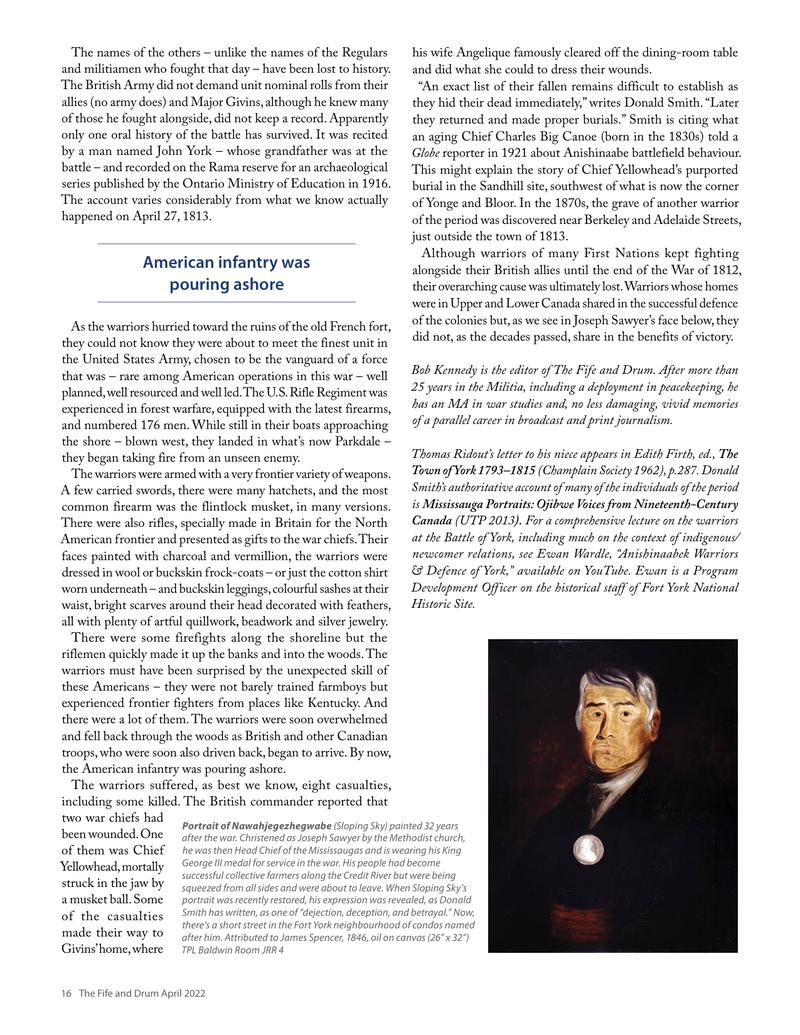
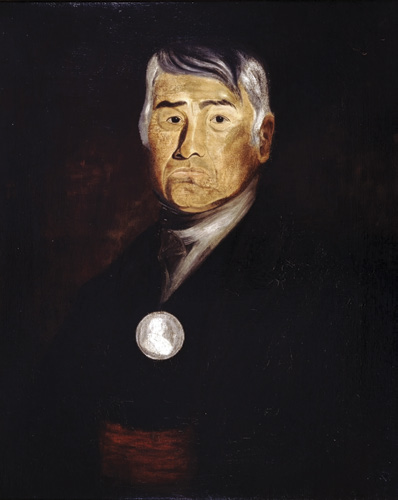
Nawahjegezhegwabe (Sloping Sky), the son of a chief of the Eagle clan, was there. Baptized as Joseph Sawyer, he later became Head Chief of the Mississaugas. From Lake Simcoe were Chief Yellowhead and his son, William, who soon assumed his father’s role as Chief of the Chippewas at the lake. There was James Ajetance, who also went on to serve as a chief of the Mississaugas. Lawrence Herkimer also fought among the warriors; he was the son of a Loyalist fur trader and a Mississauga woman from Rice Lake.
The names of the others – unlike the names of the Regulars and militiamen who fought that day – have been lost to history. The British Army did not demand unit nominal rolls from their allies (no army does) and Major Givins, although he knew many of those he fought alongside, did not keep a record. Apparently only one oral history of the battle has survived. It was recited by a man named John York – whose grandfather was at the battle – and recorded on the Rama reserve for an archaeological series published by the Ontario Ministry of Education in 1916. The account varies considerably from what we know actually happened on April 27, 1813.
American infantry was pouring ashore
As the warriors hurried toward the ruins of the old French fort, they could not know they were about to meet the finest unit in the United States Army, chosen to be the vanguard of a force that was – rare among American operations in this war – well planned, well resourced and well led. The U.S. Rifle Regiment was experienced in forest warfare, equipped with the latest firearms, and numbered 176 men. While still in their boats approaching the shore – blown west, they landed in what’s now Parkdale – they began taking fire from an unseen enemy.
The warriors were armed with a very frontier variety of weapons. A few carried swords, there were many hatchets, and the most common firearm was the flintlock musket, in many versions. There were also rifles, specially made in Britain for the North American frontier and presented as gifts to the war chiefs. Their faces painted with charcoal and vermillion, the warriors were dressed in wool or buckskin frock-coats – or just the cotton shirt worn underneath – and buckskin leggings, colourful sashes at their waist, bright scarves around their head decorated with feathers, all with plenty of artful quillwork, beadwork and silver jewelry.
There were some firefights along the shoreline but the riflemen quickly made it up the banks and into the woods. The warriors must have been surprised by the unexpected skill of these Americans – they were not barely trained farmboys but experienced frontier fighters from places like Kentucky. And there were a lot of them. The warriors were soon overwhelmed and fell back through the woods as British and other Canadian troops, who were soon also driven back, began to arrive. By now, the American infantry was pouring ashore.
The warriors suffered, as best we know, eight casualties, including some killed. The British commander reported that two war chiefs had been wounded. One of them was Chief Yellowhead, mortally struck in the jaw by a musket ball. Some of the casualties made their way to Givins’ home, where his wife Angelique famously cleared off the dining-room table and did what she could to dress their wounds.
“An exact list of their fallen remains difficult to establish as they had their dead immediately,” writes Donald Smith. “Later they returned and made proper burials.” Smith is citing what was written by Chief Charles Big Canoe (born in the 1830s) told a Globe reporter in 1921 about Anishinaabe battlefield behaviour. This might explain the story of Chief Yellowhead’s purported burial in the Sandhill site, southwest of what is now the corner of Yonge and Bloor. In the 1870s, the grave of another warrior of the period was discovered near Berkeley and Adelaide Streets, just outside the town of 1813.
Although warriors of many First Nations kept fighting alongside their British allies until the end of the War of 1812, their overarching cause was ultimately lost. Warriors whose homes were in Upper and Lower Canada shared in the successful defence of the colonies but, as we see in Joseph Sawyer’s face below, they did not, as the decades passed, share in the benefits of victory.
Sources & Further Reading
Thomas Ridout’s letter to his niece appears in Edith Firth, ed., The Town of York 1793–1815 (Champlain Society 1962), p.287. Donald Smith’s authoritative account of many of the individuals of the period is Mississauga Portraits: Ojibwe Voices from Nineteenth-Century Canada (UTP 2013). For a comprehensive lecture on the warriors present at the Battle of York, including much on the context of indigenous/ incessant relations, see Ewan Wardle, “Anishinaabek Warriors & Defence of York,” available on YouTube. Ewan is a Program Development Officer on the historical staff of Fort York National Historic Site.
Original printed pages