

Anyone familiar with the War of 1812 will surely recognize the portrait below of Major-General Sir Isaac Brock (1769-1812). And given his association with Fort York, the “Hero of Upper Canada” certainly requires no introduction to readers of The Fife and Drum. Yet, these same readers might be surprised to learn that the portrait reproduced here is not that of Major-General Sir Isaac Brock. Rather, it is Brock in his earlier appointment as a brigadier-general and staff officer.
This is one of several new details to emerge from a close study of Brock’s portraits, which I undertook in conjunction with my on-going research into the life of the celebrated British commander. I had already decided that a likeness of Brock approaching middle age would be the most relevant, both in terms of Canadian history and also for my project. After careful investigation, I satisfied myself that the quintessential Brock is the one featured in this well-known profile portrait, which was done mainly in pastels. But I soon began to question the identity of the artist responsible for this image. Although it had long been touted as the work of William Berczy, the Bavarianborn artist and Upper Canadian land settlement agent, this attribution ultimately proved incorrect. Brock’s portrait was actually executed by Gerrit Schipper, a Dutch itinerant artist who never set foot in Upper Canada.
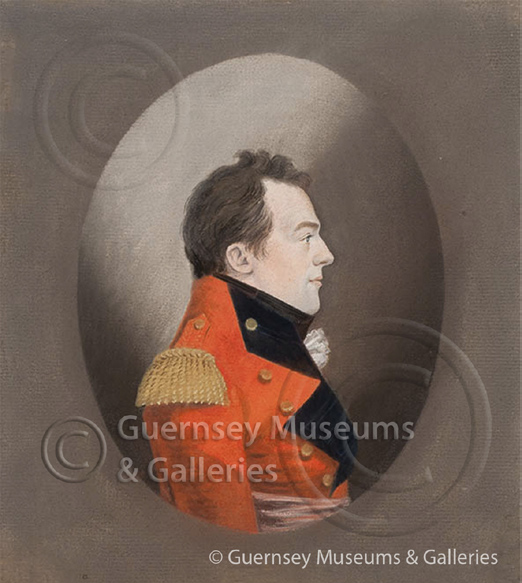
Schipper, however, did venture into Lower Canada, and it was while practising his art in Quebec City that he came into contact with Brigadier-General Isaac Brock sometime between late May of 1809 and mid-July of 1810. Although the sitting was brief (about three-quarters of an hour), this session resulted in a finely rendered portrait, the only one known of Brock from near the end of his life. It was likely produced with the aid of a physiognotrace, a mechanical drawing device used for delineating profiles.
During my scrutiny of Schipper’s portrait of Brock, I recognized the need to clarify details of his uniform. Everything about it pointed to the coatee of a brigadiergeneral and staff officer—except for the evenly spaced buttons, which should have been sewn in pairs. Fortunately, I was able to resolve the dilemma of these misplaced fasteners: Brock was portrayed wearing an outdated colonel’s uniform because he was still awaiting the delivery of his new regimentals. When Brock’s old uniform was modified in keeping with his new appointment the buttons, it would seem, were too difficult to move so they were left in their original placement. It was a minor departure from the dress regulations, or the rules which—to a degree—governed the attire of British military officers. Brock was clearly allowed some leeway in this regard, and the fact that his buttons were not properly placed was of no real consequence, not in a distant posting such as Quebec City. Brock was promoted to major-general in June of 1811, and once again his new outfit was delayed (which explains why he donned a brigadiergeneral’s uniform for the fatal Battle of Queenston Heights in October of 1812).
Another discrepancy, and one more troubling than all the non-regulation buttons put together, is Schipper’s portrayal of Brock’s physical appearance, which does not conform with surviving eyewitness accounts of the great man. One of these descriptions originated with Brock’s nephew, Ferdinand Brock Tupper, who observed that his uncle “was perhaps too portly” towards the end of his life. However, Schipper’s portrait of Brock gives no indication of a portly sitter, which has led some to question the officer’s very identity. Nor does it help that Brock himself acknowledged the “enormity” of his head, a characteristic not readily apparent in his portrait. Judging from the size of his cocked hat, which is preserved in the Niagara Historical Museum, Brock did have a large head—but it was obviously not out of proportion with the rest of his body. Instead of a portly sitter, the picture that emerges of Brock is one of a big man who carried his weight well.
Gerrit Schipper’s portrait of Brigadier-General Isaac Brock is currently on display at the RiverBrink Art Museum in Queenston, Ontario. It returns to Guernsey at the end of October.
Original printed pages


