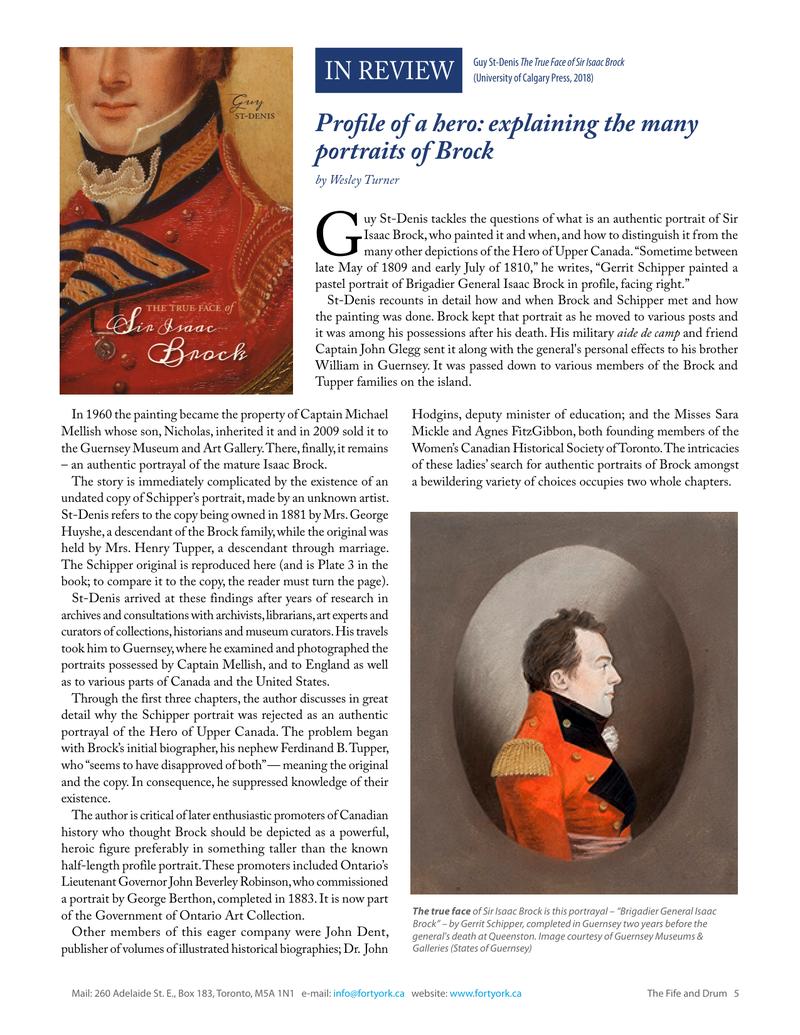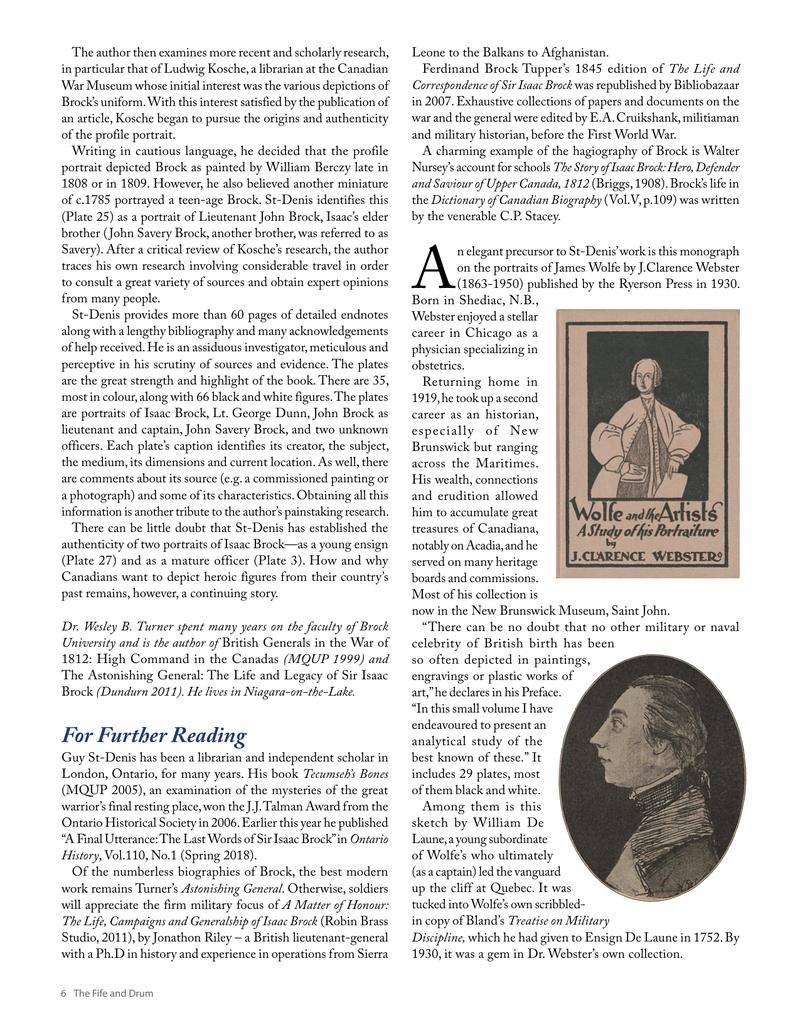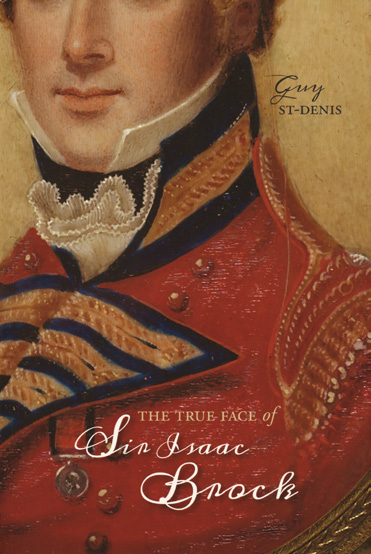
Guy St-Denis tackles the questions of what is an authentic portrait of Sir Isaac Brock, who painted it and when, and how to distinguish it from the many other depictions of the Hero of Upper Canada. “Sometime between late May of 1809 and early July of 1810,” he writes, “Gerrit Schipper painted a pastel portrait of Brigadier General Isaac Brock in profile, facing right.”
St-Denis recounts in detail how and when Brock and Schipper met and how the painting was done. Brock kept that portrait as he moved to various posts and it was among his possessions after his death. His military aide de camp and friend Captain John Glegg sent it along with the general’s personal effects to his brother William in Guernsey. It was passed down to various members of the Brock and Tupper families on the island.
In 1960 the painting became the property of Captain Michael Mellish whose son, Nicholas, inherited it and in 2009 sold it to the Guernsey Museum and Art Gallery. There, finally, it remains—an authentic portrayal of the mature Isaac Brock.
The story is immediately complicated by the existence of an undated copy of Schipper’s portrait, made by an unknown artist. St-Denis refers to the copy being owned in 1881 by Mrs. George Huyshe, a descendant of the Brock family, while the original was held by Mrs. Henry Tupper, a descendant through marriage. The Schipper original is reproduced here (and is Plate 3 in the book; to compare it to the copy, the reader must turn the page).
St-Denis arrived at these findings after years of research in archives and consultations with archivists, librarians, art experts and curators of collections, historians and museum curators. His travels took him to Guernsey, where he examined and photographed the portraits possessed by Captain Mellish, and to England as well as to various parts of Canada and the United States.
Through the first three chapters, the author discusses in great detail why the Schipper portrait was rejected as an authentic portrayal of the Hero of Upper Canada. The problem began with Brock’s initial biographer, his nephew Ferdinand B. Tupper, who “seems to have disapproved of both”—meaning the original and the copy. In consequence, he suppressed knowledge of their existence.
The author is critical of later enthusiastic promoters of Canadian history who thought Brock should be depicted as a powerful, heroic figure preferably in something taller than the known half-length profile portrait. These promoters included Ontario’s Lieutenant Governor John Beverley Robinson, who commissioned a portrait by George Berthon, completed in 1883. It is now part of the Government of Ontario Art Collection.
Other members of this eager company were John Dent, publisher of volumes of illustrated historical biographies; Dr. John Hodgins, deputy minister of education; and the Misses Sara Mickle and Agnes FitzGibbon, both founding members of the Women’s Canadian Historical Society of Toronto. The intricacies of these ladies’ search for authentic portraits of Brock amongst a bewildering variety of choices occupies two whole chapters.
The author then examines more recent and scholarly research, in particular that of Ludwig Kosche, a librarian at the Canadian War Museum whose initial interest was the various depictions of Brock’s uniform. With this interest satisfied by the publication of an article, Kosche began to pursue the origins and authenticity of the profile portrait.
Writing in cautious language, he decided that the profile portrait depicted Brock as painted by William Berczy late in 1808 or in 1809. However, he also believed another miniature of c.1785 portrayed a teen-age Brock. St-Denis identifies this (Plate 25) as a portrait of Lieutenant John Brock, Isaac’s elder brother (John Savery Brock, another brother, was referred to as Savery). After a critical review of Kosche’s research, the author traces his own research involving considerable travel in order to consult a great variety of sources and obtain expert opinions from many people.
St-Denis provides more than 60 pages of detailed endnotes along with a lengthy bibliography and many acknowledgements of help received. He is an assiduous investigator, meticulous and perceptive in his scrutiny of sources and evidence. The plates are the great strength and highlight of the book. There are 35, most in colour, along with 66 black and white figures. The plates are portraits of Isaac Brock, Lt. George Dunn, John Brock as lieutenant and captain, John Savery Brock, and two unknown officers. Each plate’s caption identifies its creator, the subject, the medium, its dimensions and current location. As well, there are comments about its source (e.g. a commissioned painting or a photograph) and some of its characteristics. Obtaining all this information is another tribute to the author’s painstaking research.
There can be little doubt that St-Denis has established the authenticity of two portraits of Isaac Brock—as a young ensign (Plate 27) and as a mature officer (Plate 3). How and why Canadians want to depict heroic figures from their country’s past remains, however, a continuing story.
For Further Reading
Guy St-Denis has been a librarian and independent scholar in London, Ontario, for many years. His book Tecumseh’s Bones (MQUP 2005), an examination of the mysteries of the great warrior’s final resting place, won the J.J. Talman Award from the Ontario Historical Society in 2006. Earlier this year he published “A Final Utterance: The Last Words of Sir Isaac Brock” in Ontario History, Vol.110, No.1 (Spring 2018).
Of the numberless biographies of Brock, the best modern work remains Turner’s Astonishing General. Otherwise, soldiers will appreciate the firm military focus of A Matter of Honour: The Life, Campaigns and Generalship of Isaac Brock (Robin Brass Studio, 2011), by Jonathon Riley – a British lieutenant-general with a Ph.D in history and experience in operations from Sierra Leone to the Balkans to Afghanistan.
Ferdinand Brock Tupper’s 1845 edition of The Life and Correspondence of Sir Isaac Brock was republished by Bibliobazaar in 2007. Exhaustive collections of papers and documents on the war and the general were edited by E.A. Cruikshank, militiaman and military historian, before the First World War.
A charming example of the hagiography of Brock is Walter Nursey’s account for schools The Story of Isaac Brock: Hero, Defender and Saviour of Upper Canada, 1812 (Briggs, 1908). Brock’s life in the Dictionary of Canadian Biography (Vol.V, p.109) was written by the venerable C.P. Stacey.
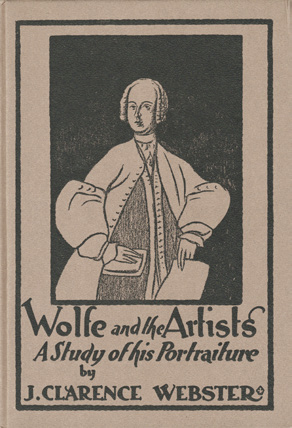
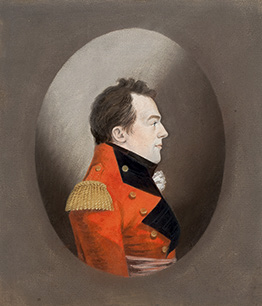
An elegant precursor to St-Denis’ work is this monograph on the portraits of James Wolfe by J. Clarence Webster (1863-1950) published by the Ryerson Press in 1930. Born in Shediac, N.B., Webster enjoyed a stellar career in Chicago as a physician specializing in obstetrics.
Returning home in 1919, he took up a second career as an historian, especially of New Brunswick but ranging across the Maritimes. His wealth, connections and erudition allowed him to accumulate great treasures of Canadiana, notably on Acadia, and he served on many heritage boards and commissions. Most of his collection is now in the New Brunswick Museum, Saint John.
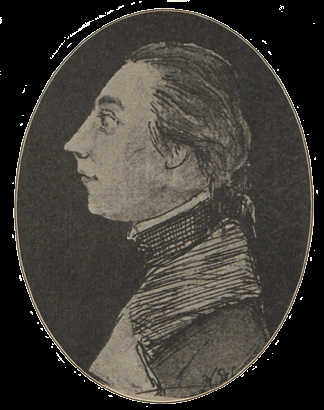
“There can be no doubt that no other military or naval celebrity of British birth has been so often depicted in paintings, engravings or plastic works of art,” he declares in his Preface. “In this small volume I have endeavoured to present an analytical study of the best known of these.” It includes 29 plates, most of them black and white. Among them is this sketch by William De Laune, a young subordinate of Wolfe’s who ultimately (as a captain) led the vanguard up the cliff at Quebec. It was tucked into Wolfe’s own scribbled-in copy of Bland’s Treatise on Military Discipline, which he had given to Ensign De Laune in 1752. By 1930, it was a gem in Dr. Webster’s own collection.
Original printed pages