

Visitors to Fort York usually focus on the surviving military buildings, the earthworks and other features of the landscape. But the fort is valued as well for its archaeological resources, which include millions of artifacts from every period and the well preserved architectural remains of buildings such as the Commandant’s House, Engineer’s Quarters, Splinterproof Barracks and the Guard House.
Other structures found at the fort include the more ordinary ones like privies, latrines and wells. Except for the well near the Stone Magazine, there is little visible evidence of them today. Their archival trace appears in requests for monies to maintain and improve the site, in reports from the Medical Department, and on maps and plans. Although few of these structure have been studied through archaeology as yet, they have been protected from disturbance and development so they may be investigated in the future.
Privies, the usual term in the military record for the latrines or outhouses, must have been among the earliest structures on the site. While the military correspondence for Fort York includes many references to them and complaints that they are poorly built or insufficient for the men’s needs, no plans or drawings and few clues as to their construction survive. Typically they were sited around the periphery of a fort, tucked in discreetly behind the barracks buildings. In the case of Fort York, this meant they drained into the ravine of the Garrison Creek or directly into Lake Ontario.
Before 1832 two privies were attached to the south wall of Blockhouse No. 1 and overhung the shore of the lake. In that year they were washed away when high water nearly undermined the Blockhouse and the south ramparts themselves. New privies were recommended by Dr. Shortt, surgeon of the 79th Regiment, for the preservation of the health of the troops, especially since cholera had broken out recently in the nearby Town of York. As a result, two were built at the ends of small wharves south of the central or flag Bastion. Access to them was through gates in the south ramparts. They were frame buildings on stone bases, and appear as small rectangles on maps as late as 1855, when the Grand Trunk Railway began filling the lake south of the fort.
On an 1851 Ordnance Department plan of the fort, privies are shown outside the ramparts south of Blockhouse No. 1, south of the Circular Bastion and in the Garrison Creek Ravine north of the fort. Urinals are indicated south of the “D” Barracks, north of the “C” Barracks, between the Blue and Artillery Barracks and near Blockhouse No. 1. By 1869 there were five latrines as well as several ablution houses where hot water was supplied for washing. One ablution house built in 1862 against the south wall west of Blockhouse No.1 survived until about 1932 and can be seen in several early photographs. Dry earth latrines existed at the fort from the mid-century. They were not flushed but had to be emptied by hand. In 1861 the Barracks Department put a notice in The Globe inviting tenders for removing the ‘night soil.’
The garrison, sometimes numbering several hundred, required large and dependable supplies of water for drinking, cooking and washing. Water was obtained from both the lake and Garrison Creek. Also, by the 1820s there was a well near the Stone Magazine, probably the successor to one sunk much earlier. A second well, built in 1837 in rear of the “D” Barracks, supplied a fair amount of water except in dry weather when it and the first well both failed. A third well, dug between 1862 and 1866 at a cost of £20, is shown on an the 1871 plan just west of Blockhouse No. 1. It is depicted with a deck and wooden shade or cover in a 1871 watercolour sketch by Joseph Fowler.
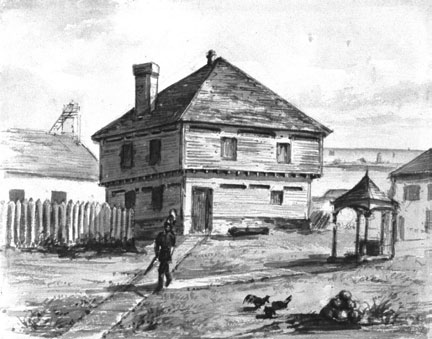
A report on the fort’s water supply in 1866 condemned as brackish the water in one of its three wells. Probably this was the well near the Stone Magazine described a few years earlier by the Royal Engineers’ Office as being near a large cess pit. The other two wells were said to afford a very small supply of good water ‘totally insufficient for the wants of the troops.’ Consequently, water for cooking and drinking had to be carted daily from the Stanley [New] Barracks. The report also recommended the installation of galvanized iron filters for the barracks, married quarters and cookhouses of the fort.
In 1894 the City began supplying water to the fort through a 4″ iron water main. Late in the 19th century the historic well located south of the Stone Magazine was covered by a deck and a pump. Early in the 20th century it was finally abandoned and filled in. Its location was forgotten until 1956 when, during a hot summer, a circular patch of yellow grass led to the its rediscovery and re-excavation. The top was enclosed by a stone parapet. This coming year, one of the fort’s capital projects will be the reconstruction of a more historically accurate well. The parapet will be removed, a deck of heavy timbers constructed, a stand, windlass and bucket added, and the whole covered by a shingled shade or canopy. The reconstruction will be based on photographs of the well, artistic depictions of a contemporary well and on historic military plans. The well will add character and focus to the parade ground of the fort and provide visible evidence of the important systems of water, storm and sanitary services that were so necessary.
Standing water and poor drainage have always been a problem in the central part of the fort, which is shaped like a shallow saucer. Archaeological excavations have found drains of many different types throughout the area. Some dating from the Rebellion Period of 1837-38 still pass large quantities of water. In the 1860s the drainage was improved by collecting rainwater and directing it through clay tile pipes to older, existing drains. These pipes still exist around several of the buildings as part of the extensive spider’s web of drains extending in every direction across much of the site.
In 1866 a large subterranean tank was constructed between the Officers’ Quarters and the North Soldiers’ Barracks in front of the “D” Barracks. This huge brick tank of several thousand gallons capacity was divided into several sections by arcaded brick walls and had a domed roof of yellow brick. Rain water from the eaves of the Officers’ Quarters and the “D” Barracks was collected in glazed tile pipes and carried underground to this reservoir. It provided a large store of water for the soldiers and families and a reliable source of water for flushing urinals. A pump on a wooden deck above the tank can be seen in several historic photographs of the fort. When the tank was full, the overflow was piped to the corner of the North Soldiers’ Barracks where it entered a large circular brick drain that was the fort’s main sewer. The drain extended south along the west wall of the barracks, then west through the West Gate, and then south again to empty into the lake. The reservoir, encountered intact during construction in the 1970s and again in 1989, is now filled with gravel.
Original printed pages


