

By 1979 – with the Guard dressed in its new finery – the question of what to do with the old, cast-off uniforms loomed. Guards Mike Wylie and Garth Armstrong proposed the creation of a site-based volunteer unit made up of students of military history and members of the Ontario Model Soldier Society. When the plan was approved an auxiliary unit of the Fort York Guard was born as the 1st Battalion Incorporated Militia of Upper Canada commanded by Wylie and Armstrong. This unit allowed ranks to swell for special event days at Fort York and acted as a point of entry for those interested in being hired as full or part-time members of the Guard. The unit eventually spun itself off as the Military Re-enactment Society of Canada and it is still in existence today.
The years 1980 to 1985 saw massive seasonal expansions of the Guard funded by Ontario Experience student work grants and the famous ‘Rent-A-Guard’ programme that made staff available for special events and international conventions at the Fort and around the city. Revenue generated this way augmented part-time salaries which in turn allowed the staff to grow each succeeding year. When Guard numbers exceeded the site’s ability to accommodate them trailers were brought in as staff rooms. Music programming expanded so that the Guard was able to parade with up to a dozen drums and fifes. A separate Royal Artillery section was formed. Seamstresses were hired and an on-site tailoring shop established to keep up with military staff needs for period clothing. Not since 1815 had Fort York been so populated with redcoats!
In 1982, the Guard was approached by the Queen’s (York) Rangers to form a commemorative section to support their special events and changes of command. New uniforms and muskets were ordered and the Guard paraded once again as Queen’s Rangers. A renewed relationship with the Department of National Defence was recognized when members of the QR commemorative section were granted ‘mess status’ for their superlative work.
Programming grew exponentially for the Guard, broadening to include visiting soldier programmes in schools; illustrated talks; successive promotional trips to New Orleans; daily summer appearances at Nathan Phillips Square and the Canadian National Exhibition; and special ‘Authenticity Weekends’ at the fort. Major events increased in status to include royal visits by H.M. the Queen and Queen Mother, for which the Guard served as a Royal Honour Guard. Daily routines back at Fort York included a wide range of ‘duties as assigned’ activities which even included cleaning, maintenance, and painting of the Fort’s artillery pieces – all done as an interpretive exercise!
When Toronto celebrated its sesquicentennial (150th anniversary) in 1984, the Fort York Guard figured prominently. Staff ranks swelled again to about forty as they strained to meet the demands of on- and offsite demonstrations. Since Rochester, New York, also celebrated its 150th that year, the Guard made frequent trips to promote Toronto and cross-border tourism. Also that year, the Fort York Guard was reviewed at the site by Colonel Sir Geoffrey Errington, Commanding Officer of the King’s Regiment, who being so impressed by the troops at Fort York, granted the Guard honorary regimental status proclaiming them “King’s Men” for life.
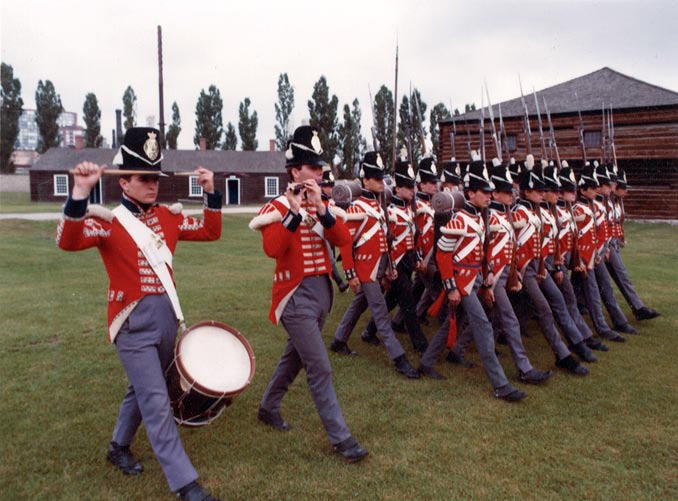
By 1985, the Guard contracted again to a complement of six full-time and about ten part-time staff. Administratively, the site refocused its efforts on capital improvement and museum education programmes. Summer animation by the Guard continued through the late 1980s into the ’90s, but on a smaller scale. In 1999 a revived animation/ demonstration squad, funded by the Friends of Fort York, heralded a different incarnation of the Fort York Guard with the new unit clothed and accoutred as the Canadian Regiment of Fencible Infantry c.1814-16. Today, the Fencibles continue to field at the Fort annually from July 1 through to Labour Day.
It should be noted that over its long history, the Guard has had the support of many ‘guest animators’ in period costume, particularly from special heritage sections provided by units of the Toronto Garrison Reserve. Noteworthy were the Queen’s Own Rifles of Canada with their Confederation-era unit; the Queen’s (York) Rangers; the Royal Regiment of Canada with their 10th Grenadiers Pioneer section; HMCS York with their naval field gun section; the Governor General’s Horse Guards mounted unit; Royal Canadian Artillery; the 48th Highlanders of Canada; and the Toronto Scottish Regiment. Also bringing the past to life on special event days was the recreated King’s Royal Regiment of New York c.1776-84; the recreated 1st Battalion Incorporated Militia of Upper Canada; the 78th Fraser’s Highlanders; the Dufferin Rifles; Upper Canada Rifles and animation staff from Fort George National Historic Site representing the 49th Foot; and staff from Fort Wellington National Historic site clothed as the Royal Canadian Rifle Regiment.

Original printed pages


