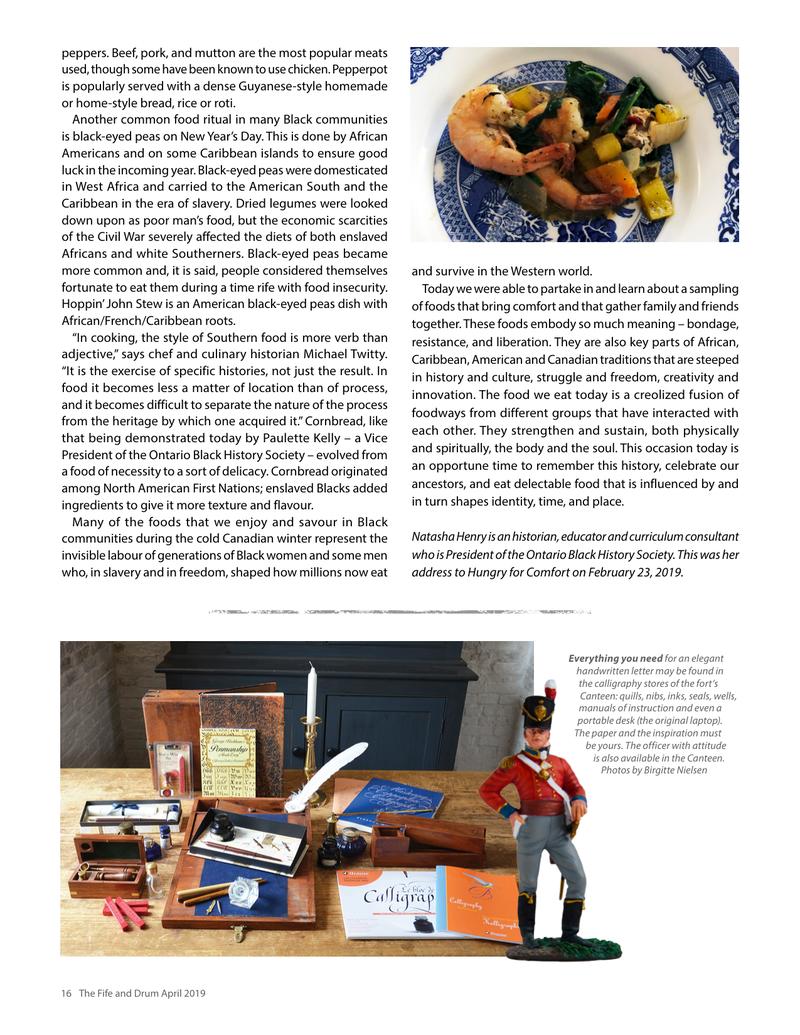
We are gathered today to experience, explore and discuss how African-Canadian communities continue to survive and thrive in Canada’s bitter winter with wintertime comfort foods. These diverse experiences are rooted in the history of African Diasporic foodways that have been transported and transplanted from other locations during different points in time in the various migration waves of African peoples, forced and by choice.
In surfing the web for some examples for today, I came across two interesting things. The Abyssinia Restaurant in Calgary, which is focused on Ethiopian and Eritrean cuisine, serves shiro wot and describes it as “comfort food for the crispy cold Canadian fall and winter days.” Shiro wot is a spicy stew that is made vegan with roasted chickpea flour and berbere (a spice mixture) or made with beef and is eaten with injera. And there is an Ethiopian restaurant in Yellowknife called Zehabesha that has received excellent reviews. In these examples we see newer African influences on Canadian winter eating.
One common winter meal that many cultural groups enjoy and eat to warm them up is soup. I am of Jamaican descent and one of my favourites is chicken-foot soup. My daughter also loves her grandmother’s (my mother’s) chicken-foot soup. This meal, like other common Jamaican dishes, was created during the days of slavery when plantation owners would take the best parts of cows, pigs, goats and chickens for themselves and leave the “fifth quarter” – the less desirable head, feet, tail, internal organs and skin – for the Africans they enslaved.
they took those scraps and turned them into the delicacies we now know as Soul Food
Yet they took those scraps and turned them into the delicacies we now know as Soul Food. For me, making soup and other winter comfort foods is about nurturing family and making memories. My husband makes the soup in our home and he has a routine that is practically a ritual. He always plays reggae music when he cooks and, when our daughter was younger, he would do this while sharing stories of his own father making soup, playing music and teaching him how to make it. As a little girl our daughter would stand on a stool beside her father, listening and watching him prepare the soup with so much care and love. And she would eagerly wait for him to make the dumplings, because he always gave her a few pieces to help roll the spinners.

Soup Joumou is made by Haitians in their native country as well as here in Canada during the middle of winter. It is a pumpkin-based soup prepared and shared on New Year’s Day to mark the moment when Haiti declared independence from France on January 1, 1804. On that day, Marie Claire Heureuse, the wife of the military leader of the Haitian Revolution, Jean-Jacques Dessalines, asked everyone to prepare the soup in celebration of their new-found freedom and independence – since it is believed that prior to this, enslaved Africans were forbidden from partaking in the soup that they had made for their enslavers. Other ingredients include beef, potato, plantains and vegetables such as parsley, carrots, green cabbage, celery and onions. Soup Joumou is traditionally made every year on January 1 to celebrate Haitian culture and to honour ancestors; it is a symbol of Haitian history, identity, resilience and freedom.
These soups include provisions that originated in West Africa and were transplanted to the Caribbean. The provisions – yam, dashene, and others – were used to stretch the food to feed the family. Soup is a common winter comfort food but is also eaten year-round in Jamaica and, of course, elsewhere.
Pepperpot is a South American meal that is a mainstay of Guyanese-Canadian homes and is eaten on Christmas Day in Guyana and on other special occasions. Pepperpot is an Amerindian/Creole meat stew. It is strongly flavoured with cinnamon, cassareep (a special sauce made from the cassava root) and other basic ingredients, including Caribbean hot peppers. Beef, pork, and mutton are the most popular meats used, though some have been known to use chicken. Pepperpot is popularly served with a dense Guyanese-style homemade or home-style bread, rice or roti.
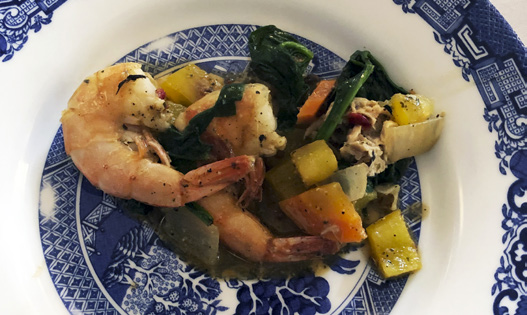
Another common food ritual in many Black communities is black-eyed peas on New Year’s Day. This is done by African Americans and on some Caribbean islands to ensure good luck in the incoming year. Black-eyed peas were domesticated in West Africa and carried to the American South and the Caribbean in the era of slavery. Dried legumes were looked down upon as poor man’s food, but the economic scarcities of the Civil War severely affected the diets of both enslaved Africans and white Southerners. Black-eyed peas became more common and, it is said, people considered themselves fortunate to eat them during a time rife with food insecurity. Hoppin’ John Stew is an American black-eyed peas dish with African/French/Caribbean roots.
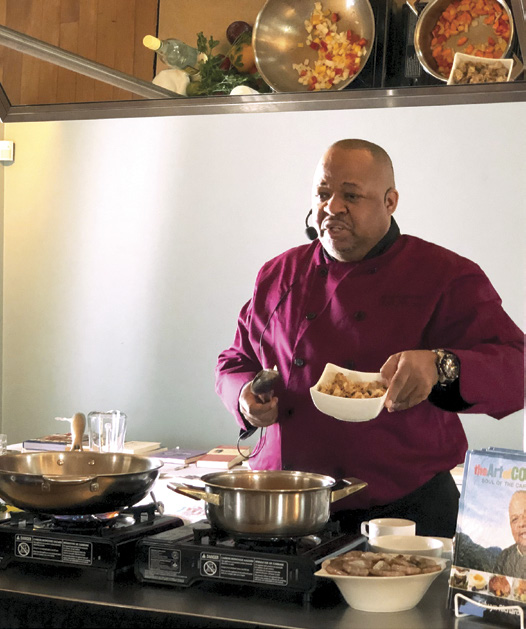
“In cooking, the style of Southern food is more verb than adjective,” says chef and culinary historian Michael Twitty. “It is the exercise of specific histories, not just the result. In food it becomes less a matter of location than of process, and it becomes difficult to separate the nature of the process from the heritage by which one acquired it.” Cornbread, like that being demonstrated today by Juliette Kelly – a Vice President of the Ontario Black History Society – evolved from a food of necessity to a sort of delicacy. Cornbread originated among North American First Nations; enslaved Blacks added ingredients to give it more texture and flavour.
Many of the foods that we enjoy and savour in Black communities during the cold Canadian winter represent the invisible labour of generations of Black women and some men who, in slavery and in freedom, shaped how millions now eat and survive in the Western world.
Today we were able to partake in and learn about a sampling of foods that bring comfort and that gather family and friends together. These foods embody so much meaning – bondage, resistance, and liberation. They are also key parts of African, Caribbean, American and Canadian traditions that are steeped in history and culture, struggle and freedom, creativity and innovation. The food we eat today is a creolized fusion of foodways from different groups that have interacted with each other. They strengthen and sustain, both physically and spiritually, the body and the soul. This occasion today is an opportune time to remember this history, celebrate our ancestors, and eat delectable food that is influenced by and in turn shapes identity, time, and place.
Original printed pages