Soon after moving from America to Toronto, fifty years ago, I discovered the Fort York neighbourhood. It then possessed certain undomesticated qualities I did and do seek out in every city: an atmosphere of industrial-strength urban melancholy, a material palette of concrete and asphalt and steel, lonesomeness, the monumental quiet that gathers, despite the clatter of traffic, under massive bridges and elevated expressways. Gentrification and the business interests of developers would soon tame such places in Toronto and other great cities. But for the moment, these seemingly desolate spots endured as refuges from the rush of metropolitan life.
I didn’t want to dwell there all the time, of course, or much of it. But, every now and then, usually around midnight, I would take off on foot from my mid-town digs toward the intersection of Bathurst and Lake Shore Boulevard, and stroll through what was then the zone of factories, warehouses, railway tracks, and emptiness in which Fort York found itself.
Prompted by The Friends’ recent invitation to comment on something I wrote about the fort and its supporters in 1994, I decided to return to my old haunt late one night in February, 2016, more than two decades after the real-estate boom had begun to transfigure the district. Over this place, after all, was joined the battle from which I absented myself in an open letter to former mayor John Sewell. http://www.fortyork.ca/images/historical-essays/fort-will-endure-1994.pdf The issue was then, as it has been down to the present day, residential and commercial intensification in the fort’s vicinity–how much of it should be allowed (if allowed at all), how tall, how dense.
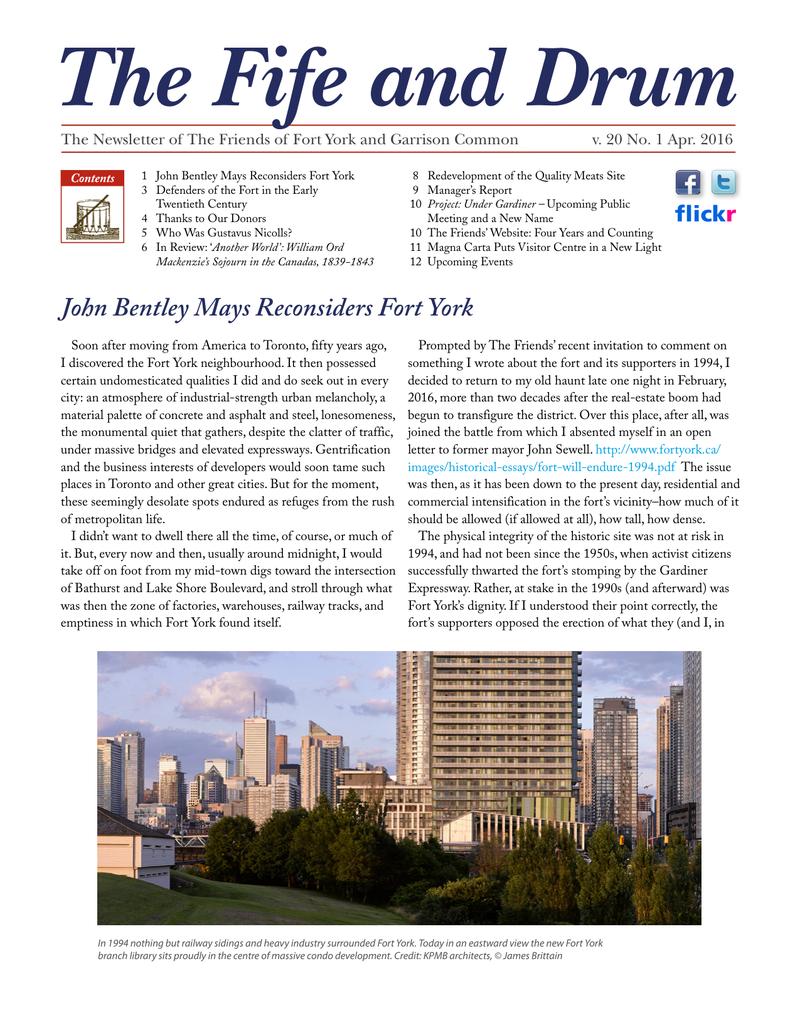
The physical integrity of the historic site was not at risk in 1994, and had not been since the 1950s, when activist citizens successfully thwarted the fort’s stomping by the Gardiner Expressway. Rather, at stake in the 1990s (and afterward) was Fort York’s dignity. If I understood their point correctly, the fort’s supporters opposed the erection of what they (and I, in my letter) called a “wall” of high-rise condominium blocks between the fortification and the present-day shoreline of Lake Ontario. The site had been separated from the water long before by a kilometre-wide apron of landfill, and by industrial and transportation projects. Raising towers south of the fort, it was believed, would be yet another insult, and a grievous one.

These apprehensions were grounded in painful recent experience. Fresh in urban memory, for example, was the helter-skelter high-rise exploitation of the inner harbour west of Yonge Street. It could easily have seemed that all the port lands and related properties south of Front Street were doomed to undergo similarly thoughtless treatment.
Looking back over a distance of twenty-two years at the letter I wrote to John Sewell, I was struck by how airily I dismissed the largely justified (or at least justifiable) concerns he and others had. I was, and am, inclined to be prodevelopment and pro-high-rise. But I was naïve (if not worse) to assume that the fort’s site, or any other treasured spot in the downtown fabric, would somehow take care of itself merely because many people treasured it. It’s clear to me now that, in 1994, when cultural conservationists founded The Friends of Fort York, the site and the inner city beyond surely needed all the friends they could get.
How has the city benefited from this friendship? Disentangling and evaluating the contributions to the contemporary cityscape around Fort York by advocacy groups, developers, and by professional urban designers and planners are interesting tasks that lie beyond the scope of this short article. But, as I found on my most recent walkabout of the neighbourhood, certain things have worked out less well than one might have hoped in 1994–and some better than anyone could have predicted.
I set out late one windy, mild weekday evening, and reached the area south of the fort around midnight. Apart from the odd dog-walker, the streets were empty. Few cars coursed along curving Fort York Boulevard. Though thousands of people now inhabit the tall buildings and townhomes in the district, the sense of it was as lonesome as it had been when I walked there a half-century before.
In most other respects, the place has changed utterly. But the condo towers, dreaded in 1994, do not loom like a wall between the fort and the water. Broad esplanades and streets, opening sightlines from the earthen ramparts toward the water, mercifully penetrate the residential blocks. The names of these passageways, which recall people whose lives were linked to the fort, or architectural features of it, further bind the new human settlement to this frontier outpost of the British Empire.
In fact, the Fort York neighbourhood, urban as it is, has something of the frontier about it. There is a bank and a tax-preparation office, but too few civilized hangouts–pubs, coffee shops, restaurants or such. Yet civilization is on the way. The graceful, sharply designed Toronto Public Library’s ninety-ninth branch has opened across the street from the fort. The transformation of the long-derelict Loblaw Groceterias building into a store is under way. Plans to connect the fort to the denser downtown areas via a pedestrian and cycle bridge have been unveiled, and the sweeping renovation of the expressway’s underside into a cultural and recreational corridor will strengthen the fort’s bond to the new pieces of city emerging along the lakeshore.
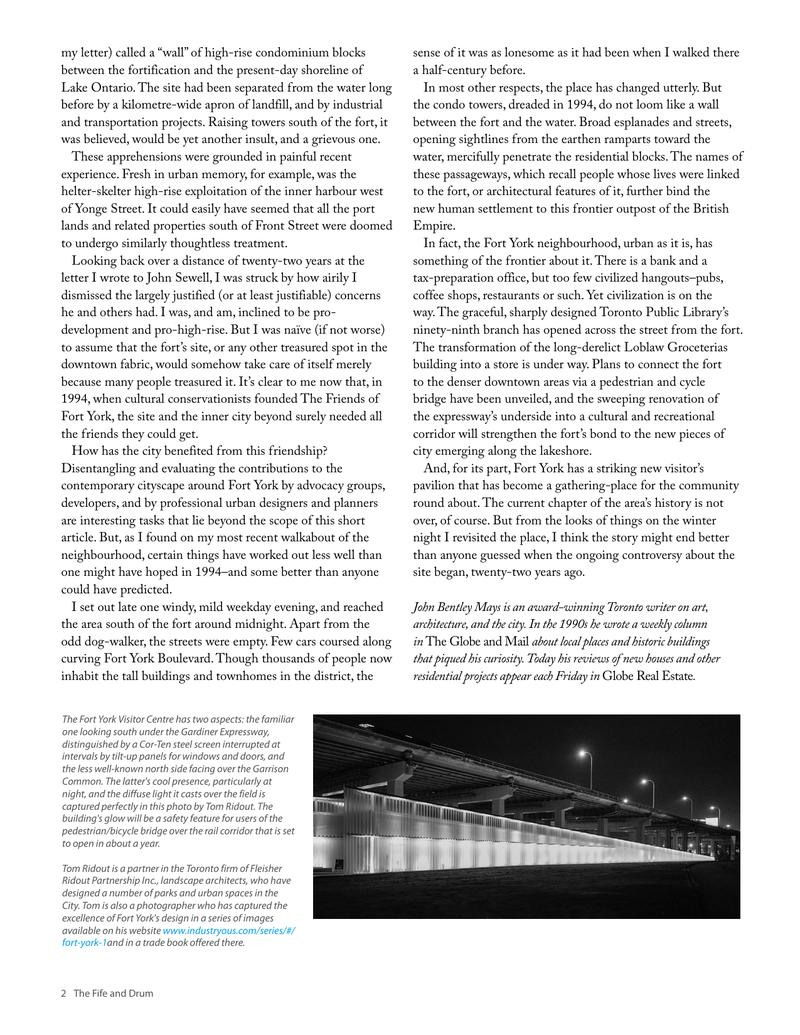
And, for its part, Fort York has a striking new visitor’s pavilion that has become a gathering-place for the community round about. The current chapter of the area’s history is not over, of course. But from the looks of things on the winter night I revisited the place, I think the story might end better than anyone guessed when the ongoing controversy about the site began, twenty-two years ago.

Tom Ridout is a partner in the Toronto firm of Fleisher Ridout Partnership Inc., landscape architects, who have designed a number of parks and urban spaces in the City. Tom is also a photographer who has captured the excellence of Fort York’s design in a series of images available on his website www.industryous.com/series/#/fort-york-1 and in a trade book offered there.
Original printed pages