In Stanley Barracks: Toronto’s Military Legacy, author Aldona Sendzikas chronicles the establishment and demise of one of Toronto’s important, early military institutions – “The New Fort” (1841), later given the title Stanley Barracks (1893), on what is today the grounds of the Canadian National Exhibition. Readers are to be forgiven if they know little or nothing about the robust, masonry garrison that was built to replace the near derelict “Old Fort” (Fort York) in the aftermath of the Rebellion of 1837, since all of the buildings of that impressive establishment – save one – were demolished in the early 1950s to provide additional parking for the site’s annual fair. Through Stanley Barracks, Sendzikas captures the significance of a pivotal chapter in the development of Canada’s fledgling militia and regular army; the fascinating ways in which the civil and military worlds were inextricably linked in 19th century Toronto; and the crucial role played by Stanley Barracks as a Canadian army administrative, recruiting and training centre during the First and Second World Wars. She also reminds us that it was at Stanley Barracks that elements of the antecedent unit of the Royal Canadian Mounted Police (North-West Mounted Police) were gathered and trained in 1873 before heading to Canada’s west and that it also saw a darker use in 1914 as a receiving centre or transit camp for so-called “enemy aliens” destined for Canadian internment camps during the Great War.
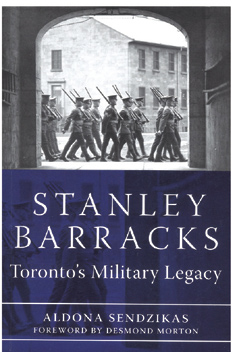
Most importantly, Sendzikas covers the historic relevance of the Toronto Garrison in the life of the city. She reminds us of Toronto’s original military role and the ways in which it evolved out of the British founding period of the 1790s to include the whole of the 19th century and first half of the 20th century. The author also documents the occasionally strained relations between Toronto’s civil and military authorities in the operations at Stanley Barracks and the land use issues connected to it.
Much of what Sendzikas presents can be found in other texts, however she is to be congratulated for distilling key material and presenting it a concise manner. Her direct interpretive approach teases out the salient points in the Stanley Barracks story in a rational chronology. Four distinct chapters trace the critical periods of development and change: The British Period (1840-1870); The Canadian Period (1870-1914); The World Wars (1914-1945); and The Post-War Years (1945 to Today). The British Period (1840-1870) tracks the origins of the British military presence in Toronto and the tensions of 1837 which ultimately hastened the construction of a more permanent and imposing military establishment. From there, the Canadian period that followed the handover of national defence from the British to Dominion Government is documented. Of particular note for that era was the founding at Stanley Barracks of the infantry and cavalry schools that gave rise to the Royal Canadian Dragoons and Royal Canadian Regiment, both celebrated units on the Canadian establishment historically and today. The World Wars (1914-1945) chapter will be of particular interest to Torontonians as it was, in the not-too-distant past, that Stanley Barracks was still in the public consciousness of many local residents. Thousands of men and women serving in Canada’s military passed in and out of the city and through its gates, as part of the larger military centre dubbed “Exhibition Camp” during both world wars.
In the closing chapter, The Post-War Years (1945 to Today), the author details the final days of Stanley Barracks as a national defence facility; its near total demolition; and the rehabilitation of the sole, surviving building, the Officers’ Quarters, as the Marine Museum of Upper Canada – a Toronto Historical Board cultural facility that served the public from 1959 until 1998.
The book is amply illustrated with a selection of archival photographs, documentary art, and plans. Of special note are two previously unpublished sketches dating from the summer of 1848 depicting the barracks at “The New Fort” and “Old Fort from Common.” The latter is of particular importance because Garrison Common was part of the original military reserve that ultimately linked the Georgian-era Fort York with its Victorian replacement. The Common was not only the “connecting tissue” between both British forts, but also the site of numerous military and civilian events. While space constraints no doubt dictated the number of original plans that could be published in this work, the first chapter could have benefitted from the reproduction of some of the earlier design proposals for “The New Fort” that were not brought to fruition.
Doubtless, Professor Sendzikas’s book will not be the final word on Stanley Barracks, in light of the approaching centennial of the Great War (2014-18) and sesquicentennial of Canadian Confederation in 2017, but it is a very good primer that most will find informative and enlightening.
Doubtless, Professor Sendzikas’s book will not be the final word on Stanley Barracks, in light of the approaching centennial of the Great War (2014-18) and sesquicentennial of Canadian Confederation in 2017, but it is a very good primer that most will find informative and enlightening. A relatively short read, it provides an essential jumping-off point for those interested in the origins of Canada’s army and the role played by forts as foundations for urban development. This is a book that should find space on the shelves of both professional and amateur historians as well laypersons interested in general Toronto history.
Original printed pages