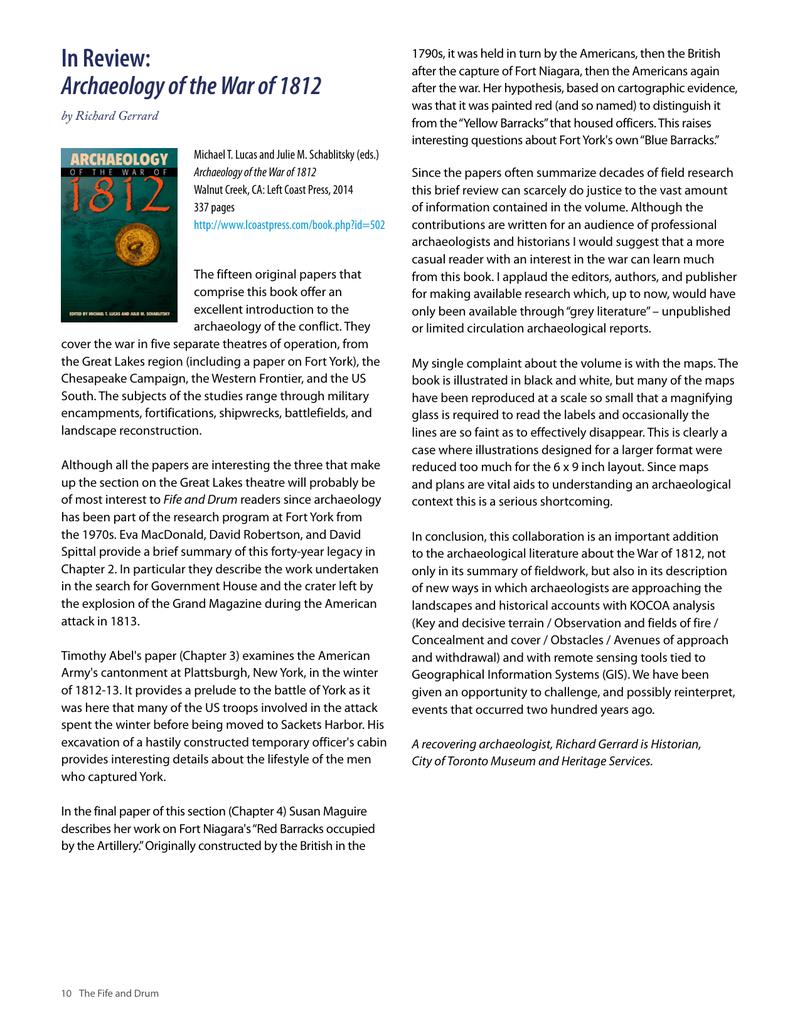
The fifteen original papers that comprise this book offer an excellent introduction to the archaeology of the conflict. They cover the war in five separate theatres of operation, from the Great Lakes region (including a paper on Fort York), the Chesapeake Campaign, the Western Frontier, and the US South. The subjects of the studies range through military encampments, fortifications, shipwrecks, battlefields, and landscape reconstruction.
Although all the papers are interesting the three that make up the section on the Great Lakes theatre will probably be of most interest to Fife and Drum readers since archaeology has been part of the research program at Fort York from the 1970s. Eva MacDonald, David Robertson, and David Spittal provide a brief summary of this forty-year legacy in Chapter 2. In particular they describe the work undertaken in the search for Government House and the crater left by the explosion of the Grand Magazine during the American attack in 1813.
Timothy Abel’s paper (Chapter 3) examines the American Army’s cantonment at Plattsburgh, New York, in the winter of 1812-13. It provides a prelude to the battle of York as it was here that many of the US troops involved in the attack spent the winter before being moved to Sackets Harbor. His excavation of a hastily constructed temporary officer’s cabin provides interesting details about the lifestyle of the men who captured York.
In the final paper of this section (Chapter 4) Susan Maguire describes her work on Fort Niagara’s “Red Barracks occupied by the Artillery.” Originally constructed by the British in the 1790s, it was held in turn by the Americans, then the British after the capture of Fort Niagara, then the Americans again after the war. Her hypothesis, based on cartographic evidence, was that it was painted red (and so named) to distinguish it from the “Yellow Barracks” that housed officers. This raises interesting questions about Fort York’s own “Blue Barracks.”
Since the papers often summarize decades of field research this brief review can scarcely do justice to the vast amount of information contained in the volume. Although the contributions are written for an audience of professional archaeologists and historians I would suggest that a more casual reader with an interest in the war can learn much from this book. I applaud the editors, authors, and publisher for making available research which, up to now, would have only been available through “grey literature” – unpublished or limited circulation archaeological reports.
My single complaint about the volume is with the maps. The book is illustrated in black and white, but many of the maps have been reproduced at a scale so small that a magnifying glass is required to read the labels and occasionally the lines are so faint as to effectively disappear. This is clearly a case where illustrations designed for a larger format were reduced too much for the 6 x 9 inch layout. Since maps and plans are vital aids to understanding an archaeological context this is a serious shortcoming.
In conclusion, this collaboration is an important addition to the archaeological literature about the War of 1812, not only in its summary of fieldwork, but also in its description of new ways in which archaeologists are approaching the landscapes and historical accounts with KOCOA analysis (Key and decisive terrain / Observation and fields of fire / Concealment and cover / Obstacles / Avenues of approach and withdrawal) and with remote sensing tools tied to Geographical Information Systems (GIS). We have been given an opportunity to challenge, and possibly reinterpret, events that occurred two hundred years ago.
Original printed pages