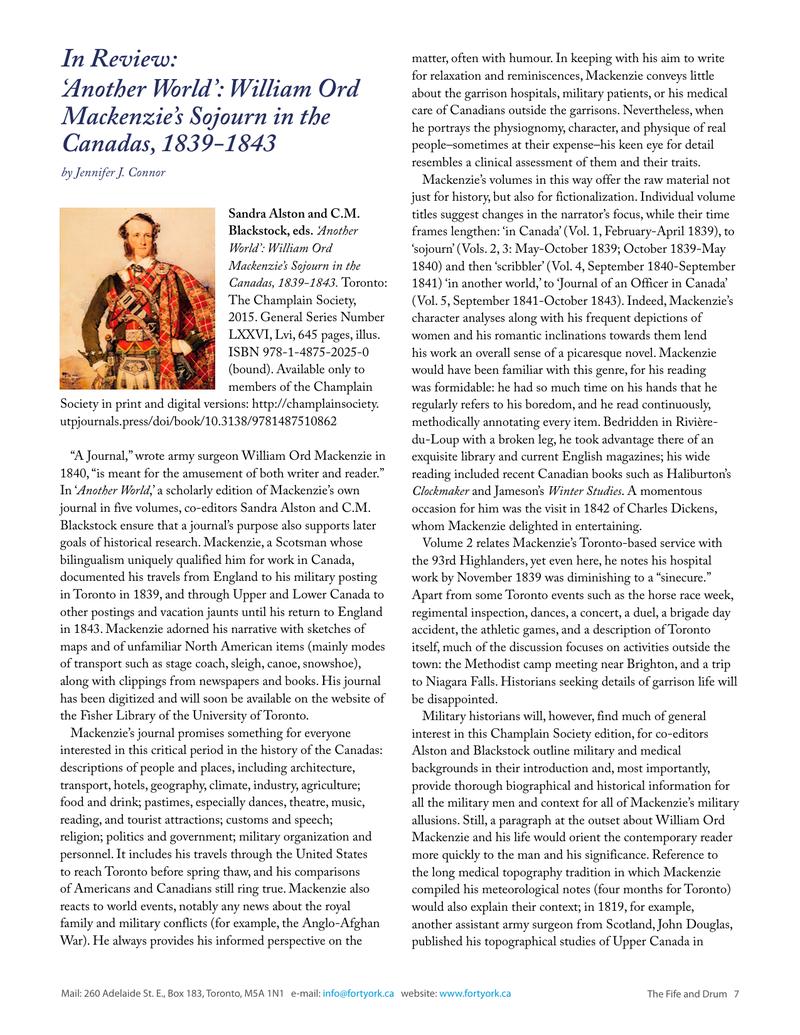
“A Journal,” wrote army surgeon William Ord Mackenzie in 1840, “is meant for the amusement of both writer and reader.” In ‘Another World’, a scholarly edition of Mackenzie’s own journal in five volumes, co-editors Sandra Alston and C.M. Blackstock ensure that a journal’s purpose also supports later goals of historical research. Mackenzie, a Scotsman whose bilingualism uniquely qualified him for work in Canada, documented his travels from England to his military posting in Toronto in 1839, and through Upper and Lower Canada to other postings and vacation jaunts until his return to England in 1843. Mackenzie adorned his narrative with sketches of maps and of unfamiliar North American items (mainly modes of transport such as stage coach, sleigh, canoe, snowshoe), along with clippings from newspapers and books. His journal has been digitized and will soon be available on the website of the Fisher Library of the University of Toronto.
Mackenzie’s journal promises something for everyone interested in this critical period in the history of the Canadas: descriptions of people and places, including architecture, transport, hotels, geography, climate, industry, agriculture; food and drink; pastimes, especially dances, theatre, music, reading, and tourist attractions; customs and speech; religion; politics and government; military organization and personnel. It includes his travels through the United States to reach Toronto before spring thaw, and his comparisons of Americans and Canadians still ring true. Mackenzie also reacts to world events, notably any news about the royal family and military conflicts (for example, the Anglo-Afghan War). He always provides his informed perspective on the matter, often with humour. In keeping with his aim to write for relaxation and reminiscences, Mackenzie conveys little about the garrison hospitals, military patients, or his medical care of Canadians outside the garrisons. Nevertheless, when he portrays the physiognomy, character, and physique of real people–sometimes at their expense–his keen eye for detail resembles a clinical assessment of them and their traits.
Mackenzie’s volumes in this way offer the raw material not just for history, but also for fictionalization. Individual volume titles suggest changes in the narrator’s focus, while their time frames lengthen: ‘in Canada’ (Vol. 1, February-April 1839), to ‘sojourn’ (Vols. 2, 3: May-October 1839; October 1839-May 1840) and then ‘scribbler’ (Vol. 4, September 1840-September 1841) ‘in another world,’ to ‘Journal of an Officer in Canada’ (Vol. 5, September 1841-October 1843). Indeed, Mackenzie’s character analyses along with his frequent depictions of women and his romantic inclinations towards them lend his work an overall sense of a picaresque novel. Mackenzie would have been familiar with this genre, for his reading was formidable: he had so much time on his hands that he regularly refers to his boredom, and he read continuously, methodically annotating every item. Bedridden in Rivière-du-Loup with a broken leg, he took advantage there of an exquisite library and current English magazines; his wide reading included recent Canadian books such as Haliburton’s Clockmaker and Jameson’s Winter Studies. A momentous occasion for him was the visit in 1842 of Charles Dickens, whom Mackenzie delighted in entertaining.
Volume 2 relates Mackenzie’s Toronto-based service with the 93rd Highlanders, yet even here, he notes his hospital work by November 1839 was diminishing to a “sinecure.” Apart from some Toronto events such as the horse race week, regimental inspection, dances, a concert, a duel, a brigade day accident, the athletic games, and a description of Toronto itself, much of the discussion focuses on activities outside the town: the Methodist camp meeting near Brighton, and a trip to Niagara Falls. Historians seeking details of garrison life will be disappointed.
Military historians will, however, find much of general interest in this Champlain Society edition, for co-editors Alston and Blackstock outline military and medical backgrounds in their introduction and, most importantly, provide thorough biographical and historical information for all the military men and context for all of Mackenzie’s military allusions. Still, a paragraph at the outset about William Ord Mackenzie and his life would orient the contemporary reader more quickly to the man and his significance. Reference to the long medical topography tradition in which Mackenzie compiled his meteorological notes (four months for Toronto) would also explain their context; in 1819, for example, another assistant army surgeon from Scotland, John Douglas, published his topographical studies of Upper Canada in the War of 1812 (including services and medical ailments of troops and provincial militia). Similarly, Mackenzie’s collection of specimens for the army’s medical museum could be explained within another longstanding medical–and army–tradition.
The value of this Champlain Society edition is delineated in the co-editors’ textual note on the bibliographical arrangement of the manuscript volumes and the editorial practice used to transcribe them; in photo facsimile pages of volume titles to show Mackenzie’s calligraphic representation of a printed title page; and in the index and an appendix listing every work that Mackenzie read. It therefore forms an essential companion to the original journal volumes themselves.
Original printed pages