Henry Evatt was born into a military family in the republic of Ireland in 1774. Having served in the regular army, his father accepted the appointment of Lieut. & Adjutant to the County Monaghan Militia in 1793, quickly rising to the rank of captain. Both Henry and his elder brother Francis served in the unit, which saw action during the troubles in Northern Ireland. Both were present at the Battle of Ballynahinch, June 1798, when their father was shot down by a rebel sniper. Henry later succeeded his father as captain and adjutant, while Francis joined the regular army as cornet in the 21st (Light) Dragoons in 1802. Henry followed, joining his brother’s regiment at the Cape of Good Hope in 1806. After a few years Henry and his wife Maria (King) returned to Ireland with their first son. Francis remained, eventually becoming the Commandant of Fort Elizabeth. He died at Port Elizabeth, South Africa, in 1850, and is today considered the founder of that town.
In 1813 Henry Evatt resigned his lieutenancy in the 21st Dragoons. How he occupied himself as a civilian for the following four years is unknown, but the deep recession into which Europe was plunged following the peace of 1815 must have hit him and his growing family hard. Sometime in 1817 he struck out for Canada in hope of obtaining employment in a military department, and securing a lieutenant’s land grant. In February 1818 he was granted 100 acres at Yonge Township, Upper Canada, (Bath). Maria and their three sons joined him that summer. He received approval for another 100 acres in August. His fortunes improved the following autumn when he was appointed Asst. Barrack Master at Coteau-du-Lac in Lower Canada. He served at that post for the following fifteen years, being promoted Barrack Master by 1832. By 1835 he also held the situation of Lock Keeper and Issuer, as well as Post Master. The extra income must have been welcome, for by that date his family had grown to three sons and two daughters.
Upon the retirement of Major Andrew Patton at Toronto in 1835, Evatt was appointed Barrack Master in his stead (the fourth), and he and his family were once again obliged to pull up stakes. Evatt served the troops in this city for the next six years, most notably through the Rebellion Crisis of 1837-38. In 1841, he became Barrack Master at Hamilton, where he moved with Maria and their two daughters who were still at home. He died at his final address, on Hannah Street (now Charlton), on 22 December 1857, aged 83, and was interred at Hamilton Cemetery.
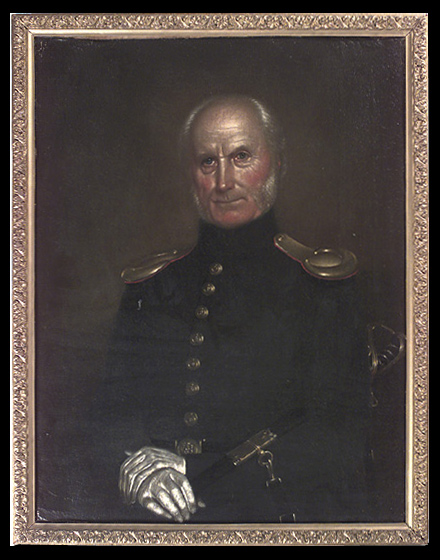
Presumably Henry Evatt sat for his portrait sometime in the 1840s, probably at Toronto or Hamilton. He wears the blue uniform of an officer of the Ordnance Department, to which all Barrack Branch personnel at home and abroad had been attached since 1822. The epaulettes denote the equivalency of a Barrack Master to the rank of major.
Original printed pages