

Originally Wellington Street between Spadina and Portland was called Wellington Place. Today the name describes the neighbourhood bounded by Bathurst, King, Spadina and Front streets that is part of the city’s King-Spadina planning district. Notwithstanding it’s history overlaps that of other neighbourhoods on all sides, it can be told separately.
For some time after the Town of York was founded in 1793 the Wellington Place Neighbourhood (WPN) was part of the Military Reserve. As such, it was simply an open piece of land swept by the guns of Fort York, the only significant landmark being a picket-fenced military cemetery where garrison soldiers and some townsfolk were buried. No private buildings were allowed to be erected there before November, 1833, when Lieutenant-Governor Sir John Colborne, authorized the auctioning of 18 lots to raise money for a new fortification west of Fort York. Eight large lots along Front Street went for £500 and £600 each to prominent buyers including Attorney General Robert Jameson, William H. Draper, an up-and-coming lawyer, and Judge Levius P. Sherwood. Other auctions followed in 1834 and 1836 when most of the WPN except for six acres around the military cemetery passed into private ownership. Colborne’s successor, Sir Francis Bond Head, approved a benchmark plan for the area in 1837 in which two squares, Victoria Square named for Princess Victoria the heir apparent and Clarence Square that recalled King William IV’s days as the Duke of Clarence, were joined by Wellington Place, an axial street of exceptional width.
Still, James Cane’s map of Toronto shows little building had occurred in the WPN by 1842 apart from Robert Jameson’s handsome little villa on the present-day site of The Globe and Mail and a few small dwellings here and there. Jameson erected his house in 1836-37 in a vain attempt to persuade his difficult wife, Anna, a noted author, to settle at his side in Canada. Probably the villa was designed by Robert Wetherell of Hamilton, the architect for Sir Allan MacNab’s “Dundurn.” It survived for another 125 years–from 1868 to 1930 within Loretto Abbey, a girl’s school, and then as part of a Jesuit seminary–until 1961 when it was replaced by Peter Dickinson’s modern printing house commissioned originally for The Telegram.
A few of Jameson’s contemporaries followed his lead and put up large brick houses on good-sized lots in the WPN, including Judge John G. Spragge whose home was on the northwest corner of Front and Portland (1844; John G. Howard, archt.); Alfred Coulson whose Tudoresque house of 1850 preceded the buildings at 450-52 Front St. today; and Lewis Moffatt’s ‘Clarence Lodge’ at the northwest corner of Spadina and Wellington Place. More high-end development might have taken place had the Northern Railway not erected its Toronto passenger depot and shops on landfill south of Front Street in the mid-1850s, thereby altering the character of the area.
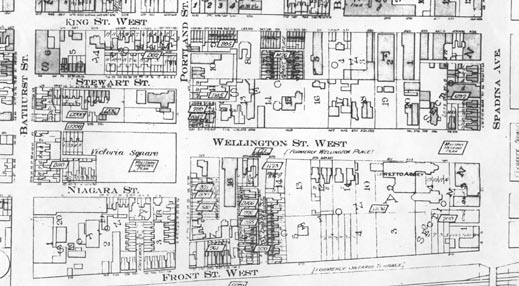
Alfred Brunel, the railway’s superintendent, lived on a big property fronting on Wellington Place, Spadina and Front. Foreseeing the need for workmen’s housing in the area, he subdivided most of his land in 1857 to create nineteen smaller lots, following the example set by George Draper the preceding year when he laid out Draper Street on land his father had bought in 1833. Sad to say, these initiatives were poorly timed. In the Fall, 1857, Canada and the U.S. were plunged into a commercial depression whose effects were felt for a decade. Housing starts in Toronto dropped abruptly and few buildings of a public character were erected. Two exceptions were the 1858 Church of St. John the Evangelist at Portland and Stewart streets, a Gothic board-and-batten structure from William Hay’s drawing board, and the Northern Railway offices at the corner of Front and Spadina on land bought from Brunel (W.G. Storm, architect, 1862).
Confederation year, 1867, marked the end of hard times. When domestic building resumed in the WPN in earnest, however, it was mostly in the form of modest houses north and west of Victoria Square. Development in the south part of the neighbourhood took longer. Draper Street was not built out before 1881-82. The Spragge estate at Front and Portland, now the site of Portland Park Village, had to wait until 1887-88, when Reuben J. Parker, a builder, put up thirty-three small homes there. Contemporary with them were twenty-nine houses erected by J. C. Musson on King Street and Brant Place, a cul-de-sac entered between 529 and 535 King Street West. In time the area’s increasing residential density was reflected in the need for a larger church. Accordingly, in 1892 St. John’s was replaced by a suave essay in brick designed by Eden Smith. While this church came down in 1963, the parish hall and Sunday School (W. R. Strickland, archt.,1872) survived on Stewart Street until 2002 when it was demolished for the apartment tower at 50 Portland.
For most of the latter 19th century the biggest industry within the WPN was Patrick Burns’ coal and wood yard at Front and Bathurst. About 1890 the site was redeveloped for the John Doty Engine Company; today Doty’s buildings are occupied by Sherwin-Williams. After 1900 other manufacturing businesses began to move into the area, and its character changed from residential to predominantly industrial. Some of the newcomers had been forced from the downtown by the Great Fire of 1904, while others wanted only to erect their factories in pleasant surroundings near a good supply of labour. Of all the streets in the WPN, Wellington Place was the best-suited for redevelopment since it was lined by big, old houses on good-sized lots. Renamed Wellington Street West in 1908, it came to resemble its present appearance largely between 1905 and 1920. In a later wave, several small houses along Bathurst Street were replaced by structures like the International Harvester building (Norman Armstrong, archt.,1939). Today the neighbourhood is experiencing change again as factories and parking lots give way to apartment buildings.
Original printed pages


