The first time around, York and Fort York were hit hard by the War of 1812. Happily they have done much better by the Bicentennial. With the Treaty of Ghent now fully two hundred years in the past, it is time to examine what the commemoration has done for the fort and the city and what lessons might be carried forward. Recently I talked with some of the people most directly engaged with what has happened to Fort York in the Bicentennial years.
The Bicentennial as Urban Renewal
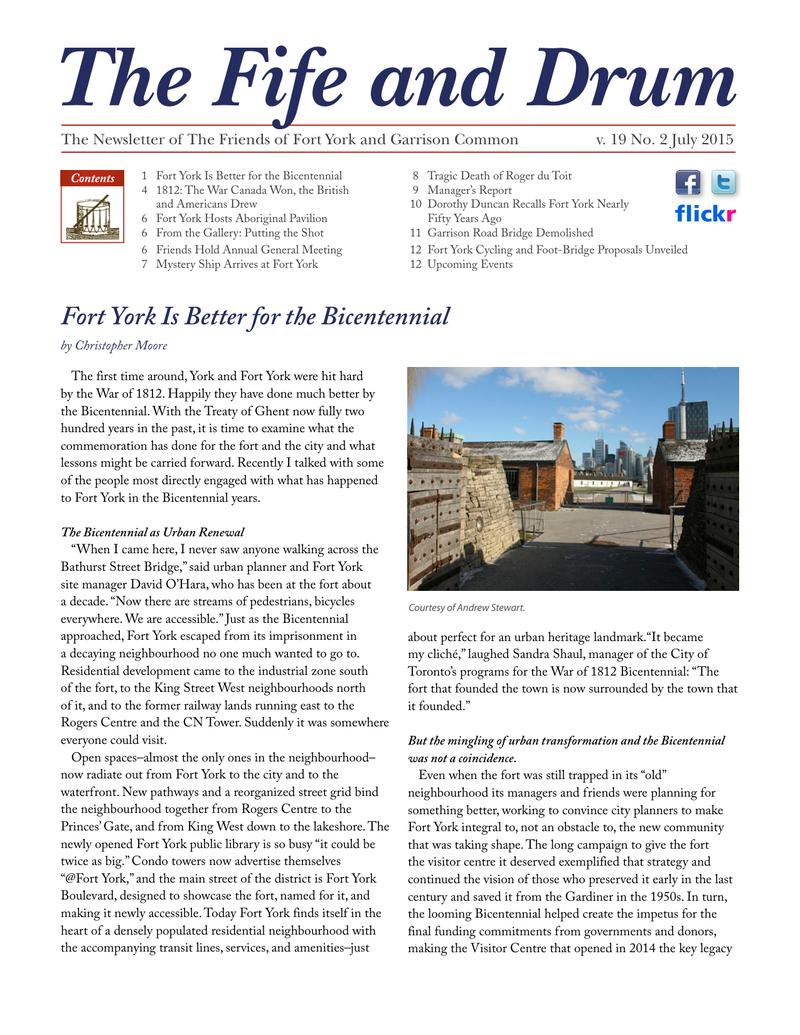
“When I came here, I never saw anyone walking across the Bathurst Street Bridge,” said urban planner and Fort York site manager David O’Hara, who has been at the fort about a decade. “Now there are streams of pedestrians, bicycles everywhere. We are accessible.” Just as the Bicentennial approached, Fort York escaped from its imprisonment in a decaying neighbourhood no one much wanted to go to. Residential development came to the industrial zone south of the fort, to the King Street West neighbourhoods north of it, and to the former railway lands running east to the Rogers Centre and the CN Tower. Suddenly it was somewhere everyone could visit.

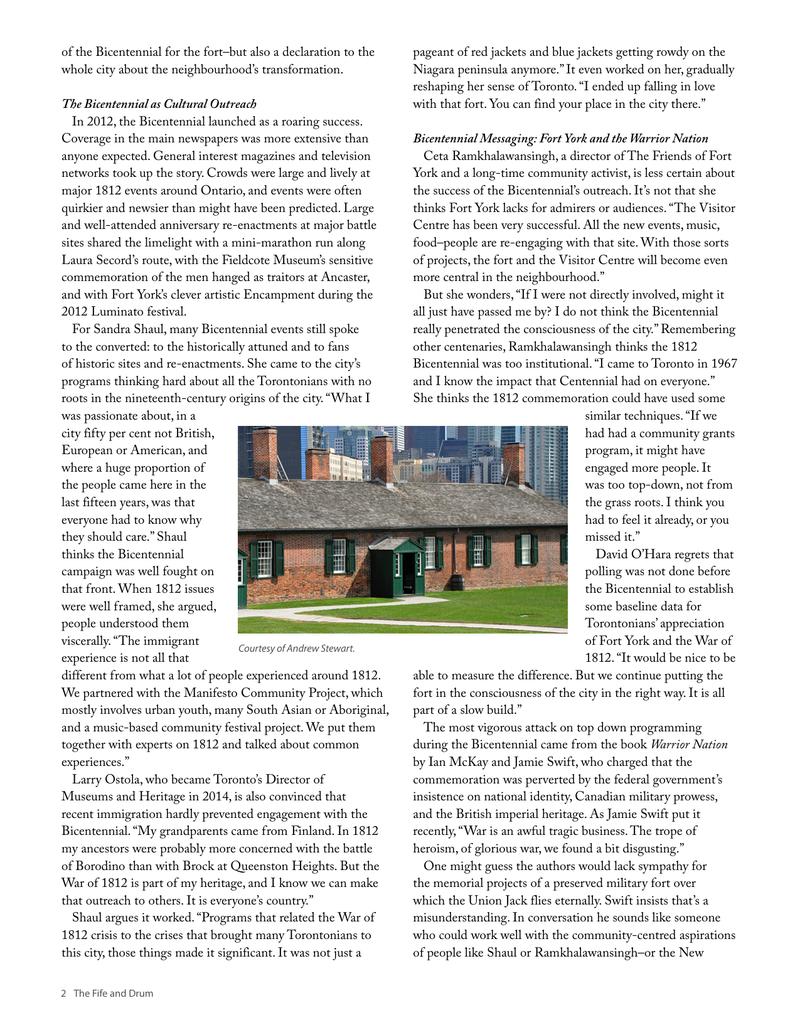
Open spaces–almost the only ones in the neighbourhood–now radiate out from Fort York to the city and to the waterfront. New pathways and a reorganized street grid bind the neighbourhood together from Rogers Centre to the Princes’ Gate, and from King West down to the lakeshore. The newly opened Fort York public library is so busy “it could be twice as big.” Condo towers now advertise themselves “@Fort York,” and the main street of the district is Fort York Boulevard, designed to showcase the fort, named for it, and making it newly accessible. Today Fort York finds itself in the heart of a densely populated residential neighbourhood with the accompanying transit lines, services, and amenities–just about perfect for an urban heritage landmark. “It became my cliché,” laughed Sandra Shaul, manager of the City of Toronto’s programs for the War of 1812 Bicentennial: “The fort that founded the town is now surrounded by the town that it founded.”
But the mingling of urban transformation and the Bicentennial was not a coincidence.
Even when the fort was still trapped in its “old” neighbourhood its managers and friends were planning for something better, working to convince city planners to make Fort York integral to, not an obstacle to, the new community that was taking shape. The long campaign to give the fort the visitor centre it deserved exemplified that strategy and continued the vision of those who preserved it early in the last century and saved it from the Gardiner in the 1950s. In turn, the looming Bicentennial helped create the impetus for the final funding commitments from governments and donors, making the Visitor Centre that opened in 2014 the key legacy of the Bicentennial for the fort–but also a declaration to the whole city about the neighbourhood’s transformation.
The Bicentennial as Cultural Outreach
In 2012, the Bicentennial launched as a roaring success. Coverage in the main newspapers was more extensive than anyone expected. General interest magazines and television networks took up the story. Crowds were large and lively at major 1812 events around Ontario, and events were often quirkier and newsier than might have been predicted. Large and well-attended anniversary re-enactments at major battle sites shared the limelight with a mini-marathon run along Laura Secord’s route, with the Fieldcote Museum’s sensitive commemoration of the men hanged as traitors at Ancaster, and with Fort York’s clever artistic Encampment during the 2012 Luminato festival.
For Sandra Shaul, many Bicentennial events still spoke to the converted: to the historically attuned and to fans of historic sites and re-enactments. She came to the city’s programs thinking hard about all the Torontonians with no roots in the nineteenth-century origins of the city. “What I was passionate about, in a city fifty per cent not British, European or American, and where a huge proportion of the people came here in the last fifteen years, was that everyone had to know why they should care.” Shaul thinks the Bicentennial campaign was well fought on that front. When 1812 issues were well framed, she argued, people understood them viscerally. “The immigrant experience is not all that different from what a lot of people experienced around 1812. We partnered with the Manifesto Community Project, which mostly involves urban youth, many South Asian or Aboriginal, and a music-based community festival project. We put them together with experts on 1812 and talked about common experiences.”

Larry Ostola, who became Toronto’s Director of Museums and Heritage in 2014, is also convinced that recent immigration hardly prevented engagement with the Bicentennial. “My grandparents came from Finland. In 1812 my ancestors were probably more concerned with the battle of Borodino than with Brock at Queenston Heights. But the War of 1812 is part of my heritage, and I know we can make that outreach to others. It is everyone’s country.”
Shaul argues it worked. “Programs that related the War of 1812 crisis to the crises that brought many Torontonians to this city, those things made it significant. It was not just a pageant of red jackets and blue jackets getting rowdy on the Niagara peninsula anymore.” It even worked on her, gradually reshaping her sense of Toronto. “I ended up falling in love with that fort. You can find your place in the city there.”
Bicentennial Messaging: Fort York and the Warrior Nation
Ceta Ramkhalawansingh, a director of The Friends of Fort York and a long-time community activist, is less certain about the success of the Bicentennial’s outreach. It’s not that she thinks Fort York lacks for admirers or audiences. “The Visitor Centre has been very successful. All the new events, music, food–people are re-engaging with that site. With those sorts of projects, the fort and the Visitor Centre will become even more central in the neighbourhood.”
But she wonders, “If I were not directly involved, might it all just have passed me by? I do not think the Bicentennial really penetrated the consciousness of the city.” Remembering other centenaries, Ramkhalawansingh thinks the 1812 Bicentennial was too institutional. “I came to Toronto in 1967 and I know the impact that Centennial had on everyone.” She thinks the 1812 commemoration could have used some similar techniques. “If we had had a community grants program, it might have engaged more people. It was too top-down, not from the grass roots. I think you had to feel it already, or you missed it.”
David O’Hara regrets that polling was not done before the Bicentennial to establish some baseline data for Torontonians’ appreciation of Fort York and the War of 1812. “It would be nice to be able to measure the difference. But we continue putting the fort in the consciousness of the city in the right way. It is all part of a slow build.”
The most vigorous attack on top down programming during the Bicentennial came from the book Warrior Nation by Ian McKay and Jamie Swift, who charged that the commemoration was perverted by the federal government’s insistence on national identity, Canadian military prowess, and the British imperial heritage. As Jamie Swift put it recently, “War is an awful tragic business. The trope of heroism, of glorious war, we found a bit disgusting.”
One might guess the authors would lack sympathy for the memorial projects of a preserved military fort over which the Union Jack flies eternally. Swift insists that’s a misunderstanding. In conversation he sounds like someone who could work well with the community-centred aspirations of people like Shaul or Ramkhalawansingh–or the New Credit First Nation, another active participant in Fort York events. He’s not so far, indeed, from the themes of the best book written around the Bicentennial. Alan Taylor’s The Civil War of 1812 emphasizes mixed loyalties and ambiguous outcomes.
Going Forward
After a long career in City of Toronto heritage, Carl Benn now teaches history at Ryerson University. He needs no convincing about the significance of the War of 1812, not least its purely military aspects. Nobody “won” the war outright–but he emphasizes that the consequences for Toronto were huge. And worth commemoration.
Benn is not convinced, however, that either Fort York’s new visibility or the blossoming of population around it will by themselves suffice to carry the fort into the post-Bicentennial years. The fort needs far more than its scenic community than green spaces for dog-walking and outdoor concerts. But, he observes, the budget for Toronto heritage remains small, and stretched across many sites and projects. Despite the Visitor Centre and the transformation of Garrison Common, Fort York’s ability to renew itself–new exhibits, new research, and new outreach programs–remains painfully restricted by its financial realities.
Larry Ostola came to the city from thirty years at Parks Canada, a federal agency also struggling with a budget barely keeping up with its mandate. He argues that the Bicentennial showcased Fort York brilliantly and that, going forward, “the whole series of centenaries and bicentenaries is a perfect opportunity for anyone who loves history and heritage. All the anniversaries are a great opportunity to make history accessible and engaging.” But he acknowledges that there remains a tension that he calls “interesting.”
The city’s heritage sites, he observes, “are doing all kinds of creative things, and they are very popular. But we always try to recall that when the people of Toronto and of Canada set aside Fort York for preservation, they did not do it just to create a concert venue. We need to do outreach, we want to serve our communities, but we still intend to respect the meaning of why Fort York was preserved, and the same goes for all our heritage properties. It’s always a challenge.”
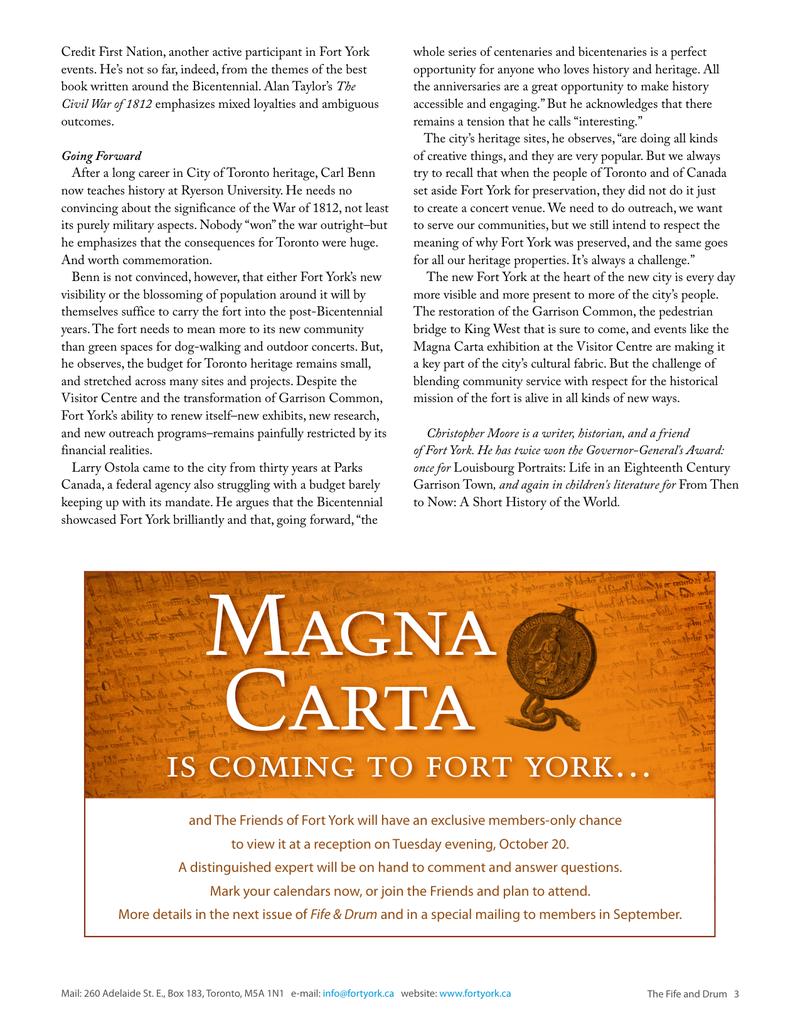
The new Fort York at the heart of the new city is every day more visible and more present to more of the city’s people. The restoration of the Garrison Common, the pedestrian bridge to King West that is sure to come, and events like the Magna Carta exhibition at the Visitor Centre are making it a key part of the city’s cultural fabric. But the challenge of blending community service with respect for the historical mission of the fort is alive in all kinds of new ways.
Original printed pages