On November 24, just one week after announcing the Under Gardiner project, made possible by an astonishing $25 million gift from Judy and Wil Matthews, Mayor Tory returned to the neighbourhood to report the signing of a $19.7 million contract between Build Toronto on behalf of the City and a team led by Dufferin Construction Company to construct the long-awaited Fort York Pedestrian-Cycling Bridge. Work on it will get under way immediately, and is expected to be completed by Spring 2017.
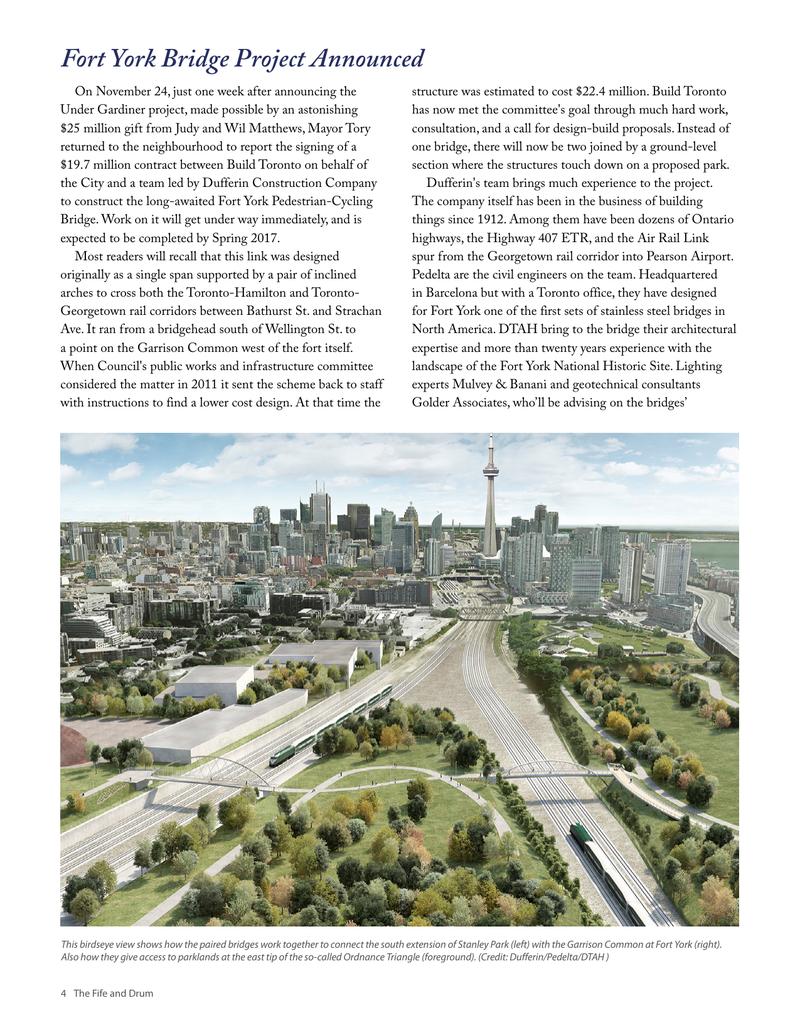
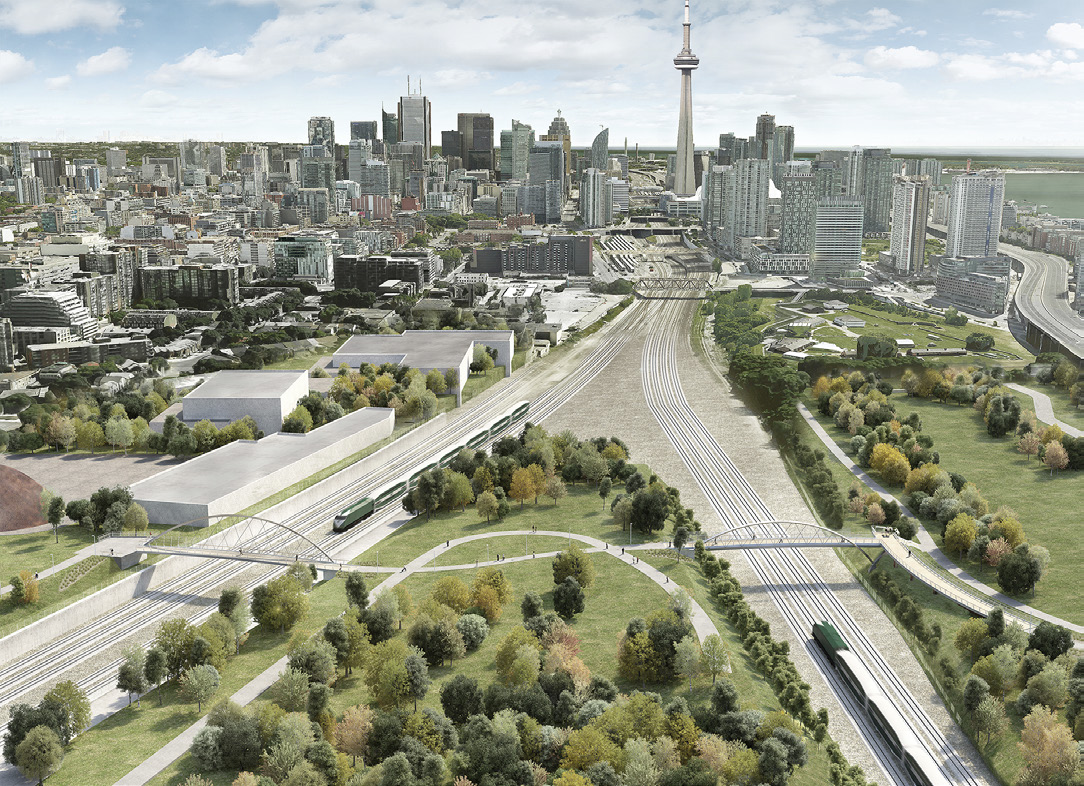
Most readers will recall that this link was designed originally as a single span supported by a pair of inclined arches to cross both the Toronto-Hamilton and Toronto-Georgetown rail corridors between Bathurst St. and Strachan Ave. It ran from a bridgehead south of Wellington St. to a point on the Garrison Common west of the fort itself. When Council’s public works and infrastructure committee considered the matter in 2011 it sent the scheme back to staff with instructions to find a lower cost design. At that time the structure was estimated to cost $22.4 million. Build Toronto has now met the committee’s goal through much hard work, consultation, and a call for design-build proposals. Instead of one bridge, there will now be two joined by a ground-level section where the structures touch down on a proposed park.
Dufferin’s team brings much experience to the project. The company itself has been in the business of building things since 1912. Among them have been dozens of Ontario highways, the Highway 407 ETR, and the Air Rail Link spur from the Georgetown rail corridor into Pearson Airport. Pedelta are the civil engineers on the team. Headquartered in Barcelona but with a Toronto office, they have designed for Fort York one of the first sets of stainless steel bridges in North America. DTAH bring to the bridge their architectural expertise and more than twenty years experience with the landscape of the Fort York National Historic Site. Lighting experts Mulvey & Banani and geotechnical consultants Golder Associates, who’ll be advising on the bridges’ foundations, make up the rest of the team. MMM Group was the project’s manager.

Dufferin Team’s proposal includes an unprecedented technical innovation in North America: the use of Duplex Stainless Steel throughout. Called Duplex because it has a different metallurgical makeup that makes it twice as strong as other stainless steels, this subtle difference contributes to the engineers’ ability to design more slender, lighter and transparent bridges. At Fort York both structures span the rail corridors almost perpendicularly rather than at an angle, to minimize the crossing length, which contributes to their strength as well.

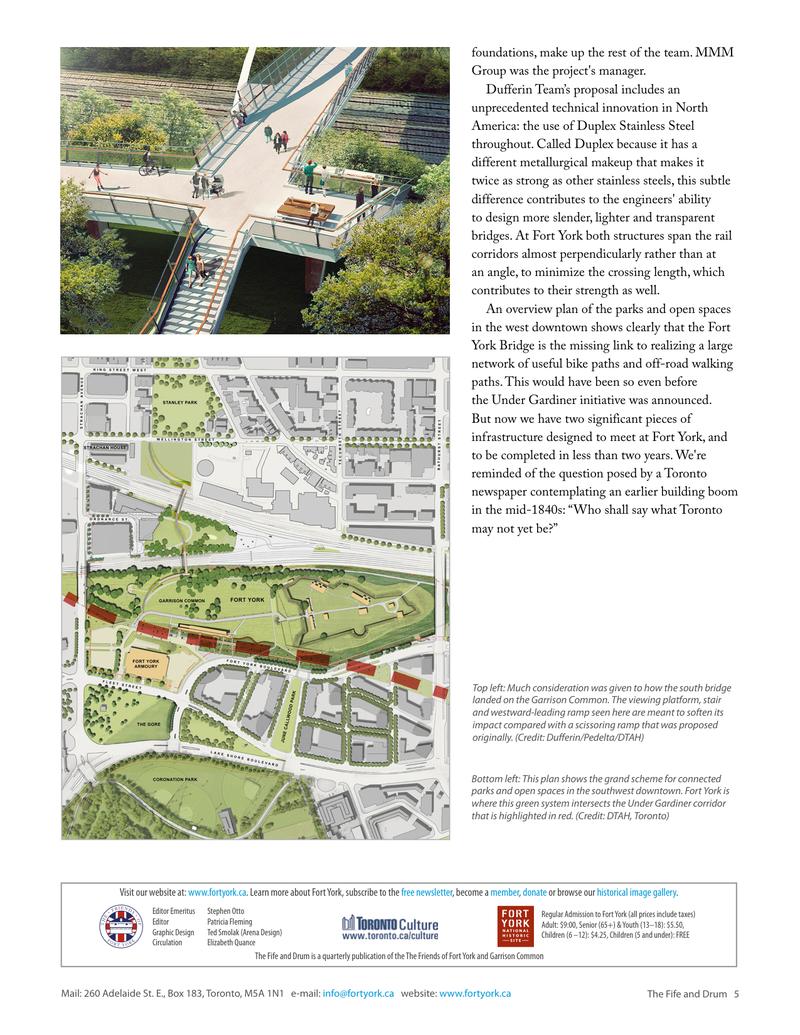
An overview plan of the parks and open spaces in the west downtown shows clearly that the Fort York Bridge is the missing link to realizing a large network of useful bike paths and off-road walking paths. This would have been so even before the Under Gardiner initiative was announced. But now we have two significant pieces of infrastructure designed to meet at Fort York, and to be completed in less than two years. We’re reminded of the question posed by a Toronto newspaper contemplating an earlier building boom in the mid-1840s: “Who shall say what Toronto may not yet be?”
Original printed pages