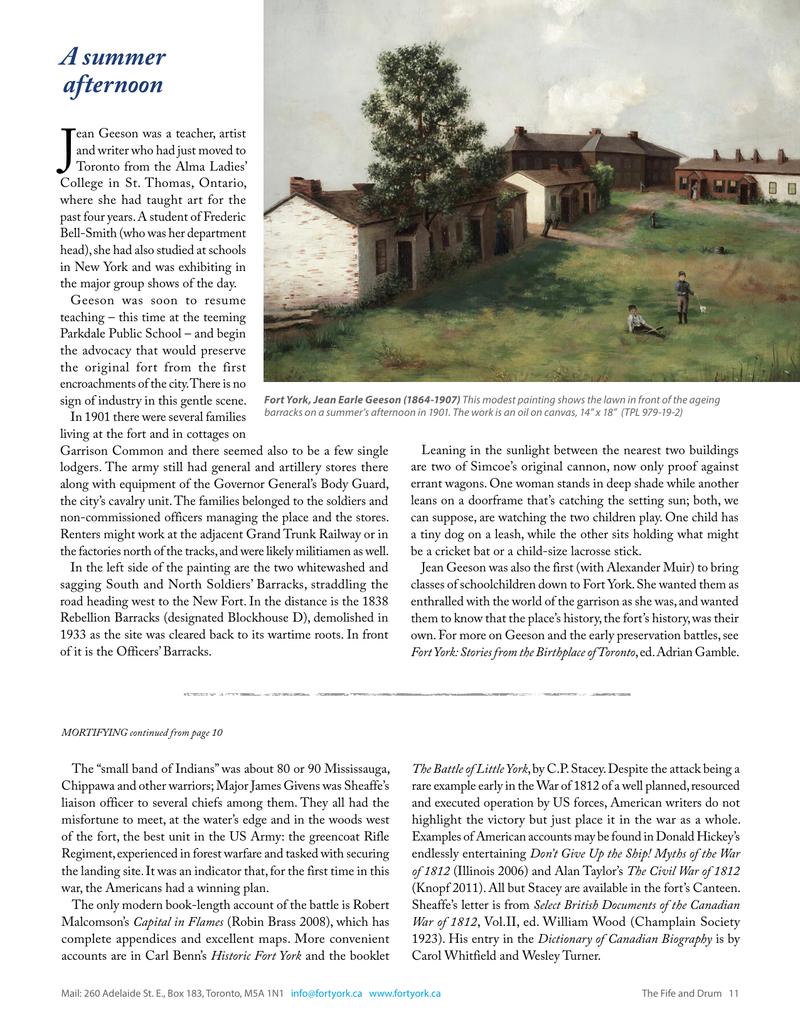
Jean Geeson was a teacher, artist and writer who had just moved to Toronto from the Alma Ladies’ College in St. Thomas, Ontario, where she had taught art for the past four years. A student of Frederic Bell-Smith (who was her department head), she had also studied at schools in New York and was exhibiting in the major group shows of the day. Geeson was soon to resume teaching – this time at the teeming Parkdale Public School – and begin the advocacy that would preserve the original fort from the first encroachments of the city. There is no sign of industry in this gentle scene.
In 1901 there were several families living at the fort and in cottages on Garrison Common and there seemed also to be a few single lodgers. The army still had general and artillery stores there along with equipment of the Governor General’s Body Guard, the city’s cavalry unit. The families belonged to the soldiers and non-commissioned officers managing the place and the stores. Renters might work at the adjacent Grand Trunk Railway or in the factories north of the tracks, and were likely militiamen as well.
In the left side of the painting are the two whitewashed and sagging South and North Soldiers’ Barracks, straddling the road heading west to the New Fort. In the distance is the 1838 Rebellion Barracks (designated Blockhouse D), demolished in 1933 as the site was cleared back to its wartime roots. In front of it is the Officers’ Barracks.
Leaning in the sunlight between the nearest two buildings are two of Simcoe’s original cannon, now only proof against errant wagons. One woman stands in deep shade while another leans on a doorframe that’s catching the setting sun; both, we can suppose, are watching the two children play. One child has a tiny dog on a leash, while the other sits holding what might be a cricket bat or a child-size lacrosse stick.
Jean Geeson was also the first (with Alexander Muir) to bring classes of schoolchildren down to Fort York. She wanted them as enthralled with the world of the garrison as she was, and wanted them to know that the place’s history, the fort’s history, was their own. For more on Geeson and the early preservation battles, see Fort York: Stories from the Birthplace of Toronto, ed. Adrian Gamble.
Original printed pages