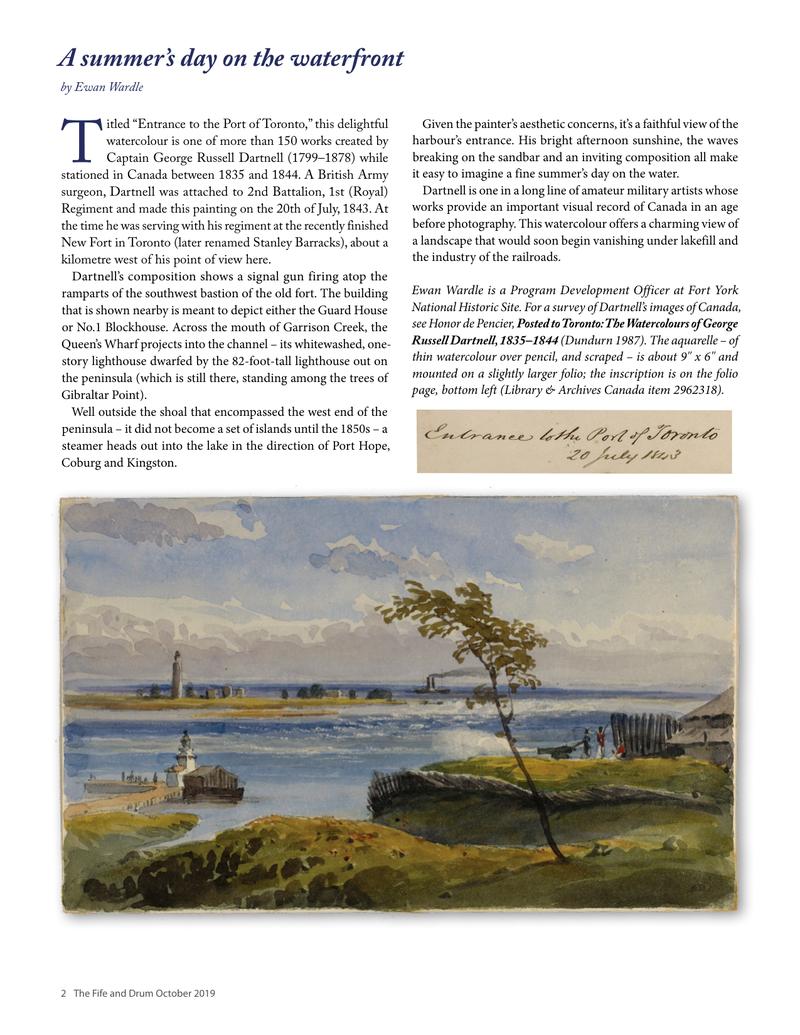
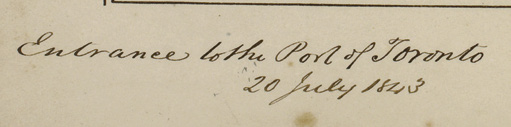
Titled “Entrance to the Port of Toronto,” this delightful watercolour is one of more than 150 works created by Captain George Russell Dartnell (1799–1878) while stationed in Canada between 1835 and 1844. A British Army surgeon, Dartnell was attached to 2nd Battalion, 1st (Royal) Regiment and made this painting on the 20th of July, 1843. At the time he was serving with his regiment at the recently finished New Fort in Toronto (later renamed Stanley Barracks), about a kilometre west of his point of view here.
Dartnell’s composition shows a signal gun firing atop the ramparts of the southwest bastion of the old fort. The building that is shown nearby is meant to depict either the Guard House or No.1 Blockhouse. Across the mouth of Garrison Creek, the Queen’s Wharf projects into the channel – its whitewashed, one-story lighthouse dwarfed by the 82-foot-tall lighthouse out on the peninsula (which is still there, standing among the trees of Gibraltar Point).
Well outside the shoal that encompassed the west end of the peninsula – it did not become a set of islands until the 1850s – a steamer heads out into the lake in the direction of Port Hope, Coburg and Kingston.
Given the painter’s aesthetic concerns, it’s a faithful view of the harbour’s entrance. His bright afternoon sunshine, the waves breaking on the sandbar and an inviting composition all make it easy to imagine a fine summer’s day on the water.
Dartnell is one in a long line of amateur military artists whose works provide an important visual record of Canada in an age before photography. This watercolour offers a charming view of a landscape that would soon begin vanishing under lakefill and the industry of the railroads.

Original printed pages