The preparation of this article and appearance of Crimea in the headlines the last few weeks was an unplanned coincidence, but reminds us that it has been a place in contention for a long time.
On 22 June 1897 tens of thousands of people poured into the streets of Toronto to mark Queen Victoria’s diamond jubilee. The big attraction was a parade, 15,000 strong, including the militia, fire brigades, and religious and fraternal societies. However, it didn’t include the Army and Navy Veterans Association. When they weren’t invited to head the procession, they held their own march from St. John’s Church in Victoria Square to Moss Park. Downplaying the slight, the Daily Mail and Empire dutifully listed the names, ranks, regiments, decorations, and years of service for every veteran in the parade, seventy in all. Some two dozen of them had fought in Crimea.
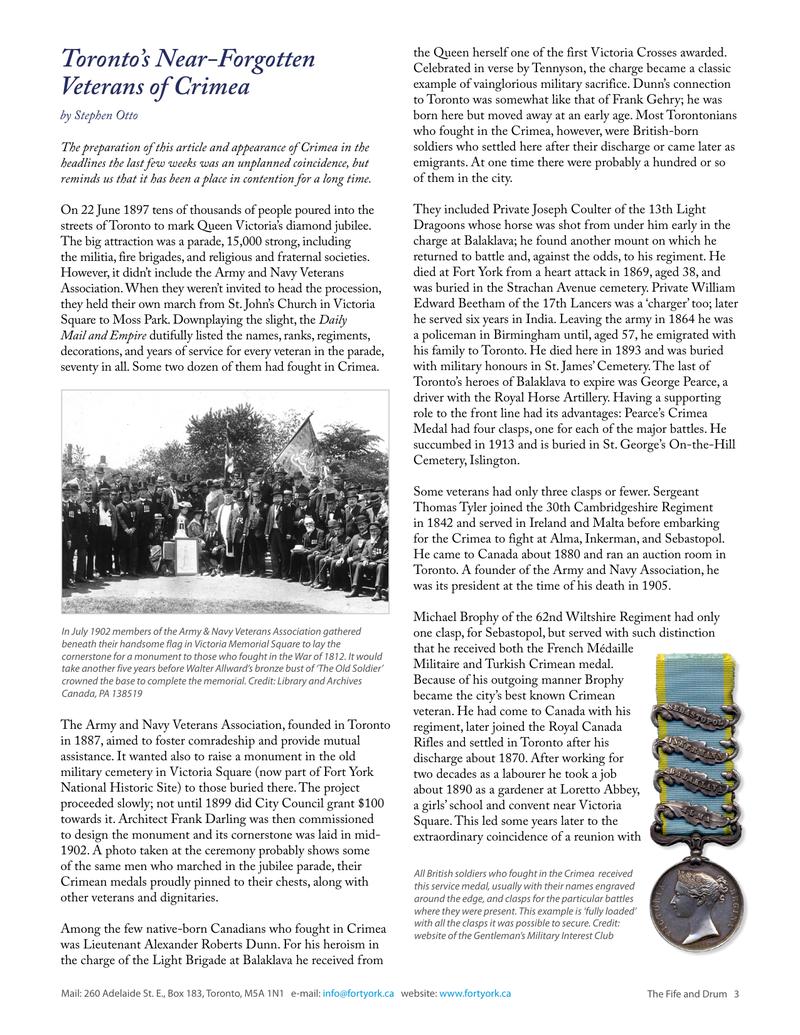
The Army and Navy Veterans Association, founded in Toronto in 1887, aimed to foster comradeship and provide mutual assistance. It wanted also to raise a monument in the old military cemetery in Victoria Square (now part of Fort York National Historic Site) to those buried there. The project proceeded slowly; not until 1899 did City Council grant $100 towards it. Architect Frank Darling was then commissioned to design the monument and its cornerstone was laid in mid-1902. A photo taken at the ceremony probably shows some of the same men who marched in the jubilee parade, their Crimean medals proudly pinned to their chests, along with other veterans and dignitaries.
Among the few native-born Canadians who fought in Crimea was Lieutenant Alexander Roberts Dunn. For his heroism in the charge of the Light Brigade at Balaklava he received from the Queen herself one of the first Victoria Crosses awarded. Celebrated in verse by Tennyson, the charge became a classic example of vainglorious military sacrifice. Dunn’s connection to Toronto was somewhat like that of Frank Gehry; he was born here but moved away at an early age. Most Torontonians who fought in the Crimea, however, were British-born soldiers who settled here after their discharge or came later as emigrants. At one time there were probably a hundred or so of them in the city.

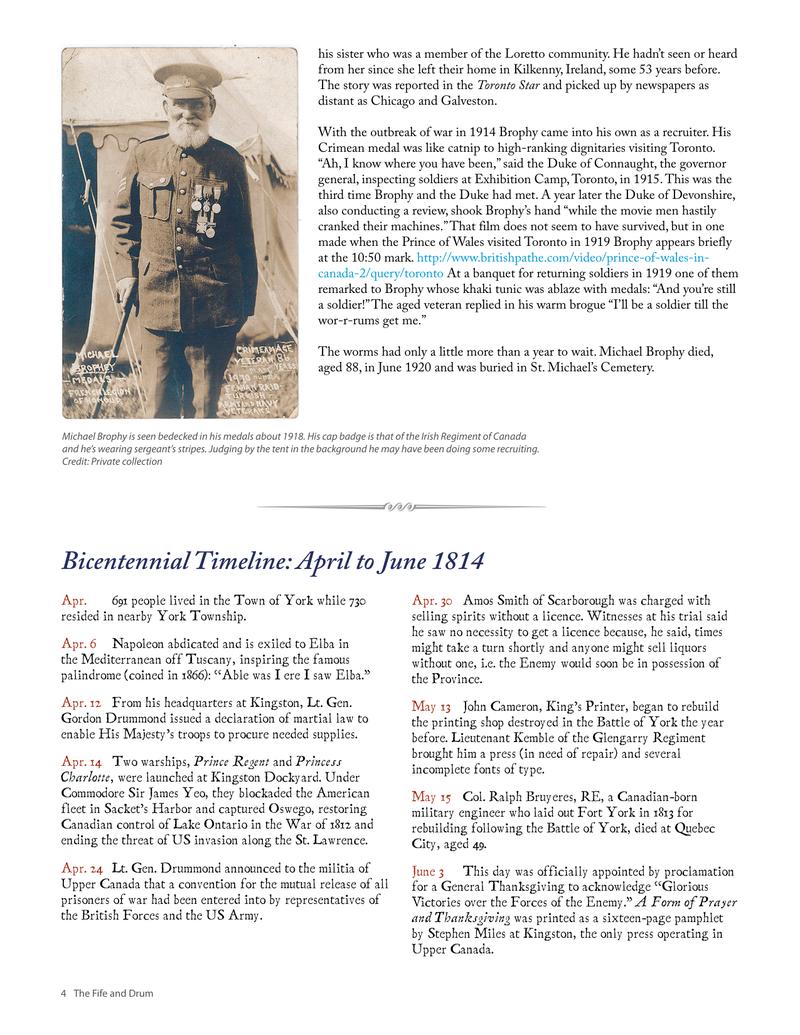
They included Private Joseph Coulter of the 13th Light Dragoons whose horse was shot from under him early in the charge at Balaklava; he found another mount on which he returned to battle and, against the odds, to his regiment. He died at Fort York from a heart attack in 1869, aged 38, and was buried in the Strachan Avenue cemetery. Private William Edward Beetham of the 17th Lancers was a ‘charger’ too; later he served six years in India. Leaving the army in 1864 he was a policeman in Birmingham until, aged 57, he emigrated with his family to Toronto. He died here in 1893 and was buried with military honours in St. James’ Cemetery. The last of Toronto’s heroes of Balaklava to expire was George Pearce, a driver with the Royal Horse Artillery. Having a supporting role to the front line had its advantages: Pearce’s Crimea Medal had four clasps, one for each of the major battles. He succumbed in 1913 and is buried in St. George’s On-the-Hill Cemetery, Islington.
Some veterans had only three clasps or fewer. Sergeant Thomas Tyler joined the 30th Cambridgeshire Regiment in 1842 and served in Ireland and Malta before embarking for the Crimea to fight at Alma, Inkerman, and Sebastopol. He came to Canada about 1880 and ran an auction room in Toronto. A founder of the Army and Navy Association, he was its president at the time of his death in 1905.
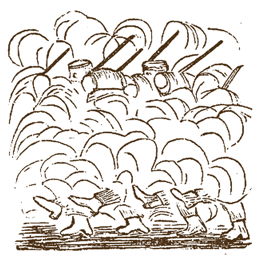
Michael Brophy of the 62nd Wiltshire Regiment had only one clasp, for Sebastopol, but served with such distinction that he received both the French Médaille Militaire and Turkish Crimean medal. Because of his outgoing manner Brophy became the city’s best known Crimean veteran. He had come to Canada with his regiment, later joined the Royal Canada Rifles and settled in Toronto after his discharge about 1870. After working for two decades as a labourer he took a job about 1890 as a gardener at Loretto Abbey, a girls’ school and convent near Victoria Square. This led some years later to the extraordinary coincidence of a reunion with his sister who was a member of the Loretto community. He hadn’t seen or heard from her since she left their home in Kilkenny, Ireland, some 53 years before. The story was reported in the Toronto Star and picked up by newspapers as distant as Chicago and Galveston.

With the outbreak of war in 1914 Brophy came into his own as a recruiter. His Crimean medal was like catnip to high-ranking dignitaries visiting Toronto. “Ah, I know where you have been,” said the Duke of Connaught, the governor general, inspecting soldiers at Exhibition Camp, Toronto, in 1915. This was the third time Brophy and the Duke had met. A year later the Duke of Devonshire, also conducting a review, shook Brophy’s hand “while the movie men hastily cranked their machines.” That film does not seem to have survived, but in one made when the Prince of Wales visited Toronto in 1919 Brophy appears briefly at the 10:50 mark. http://www.britishpathe.com/video/prince-of-wales-in-canada-2/query/toronto At a banquet for returning soldiers in 1919 one of them remarked to Brophy whose khaki tunic was ablaze with medals: “And you’re still a soldier!” The aged veteran replied in his warm brogue “I’ll be a soldier till the wor-r-rums get me.”
The worms had only a little more than a year to wait. Michael Brophy died, aged 88, in June 1920 and was buried in St. Michael’s Cemetery.
Original printed pages