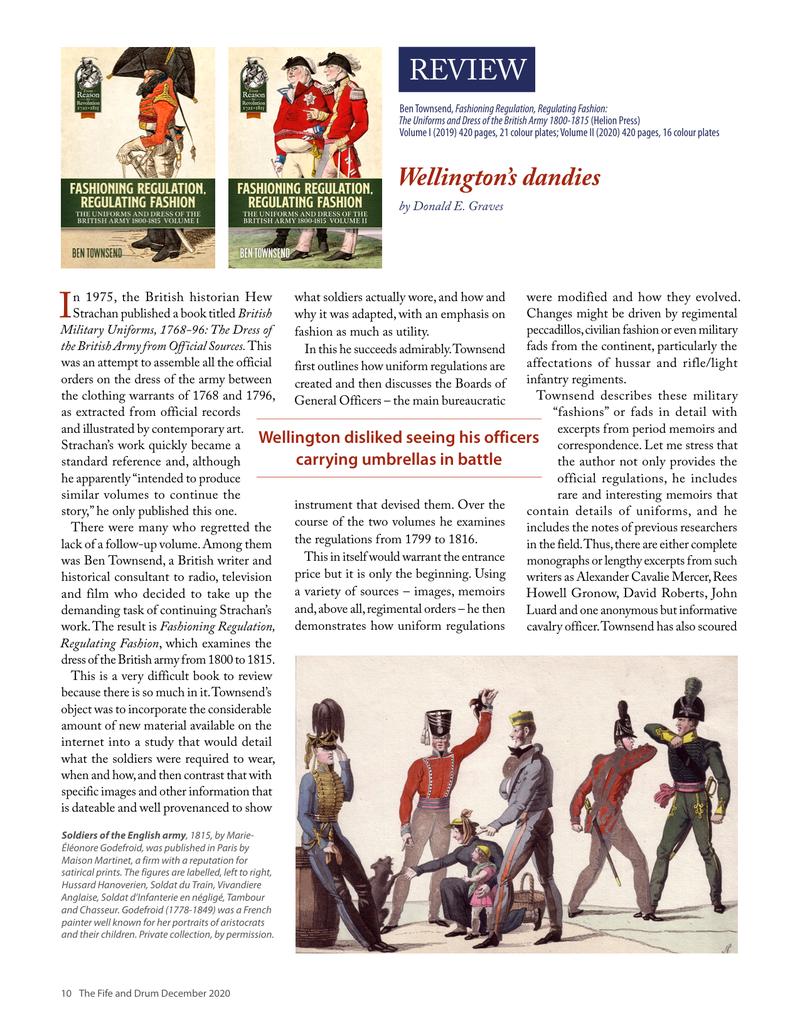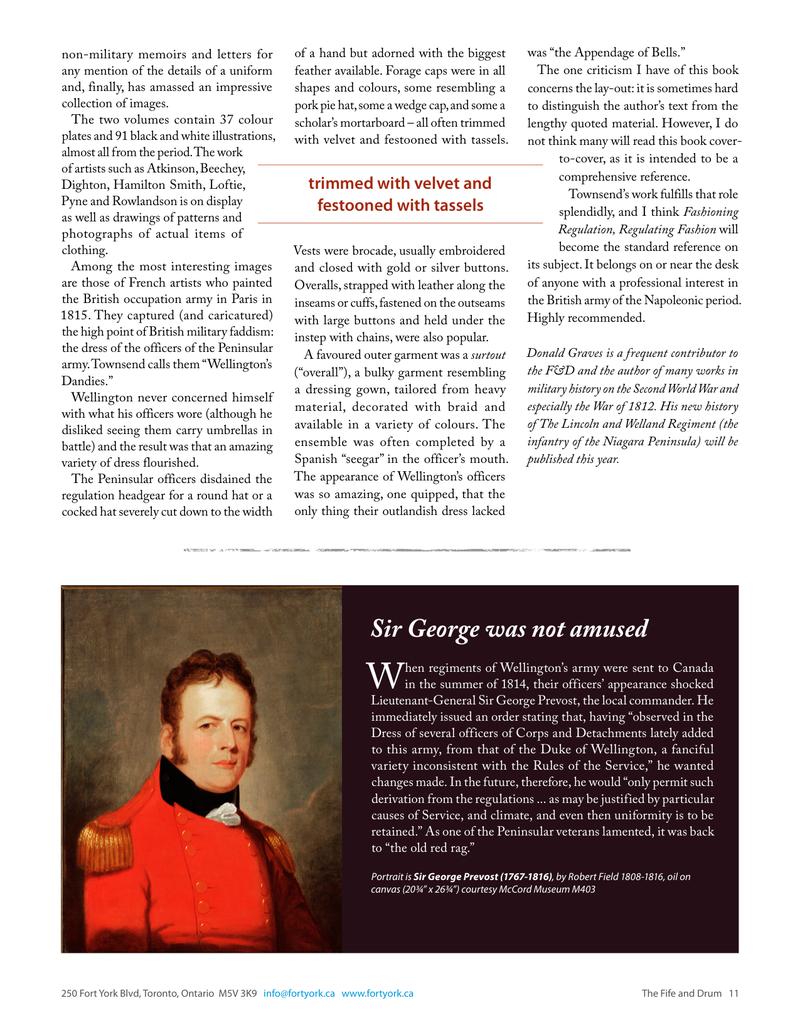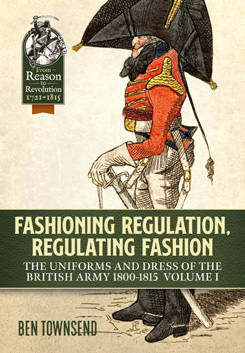
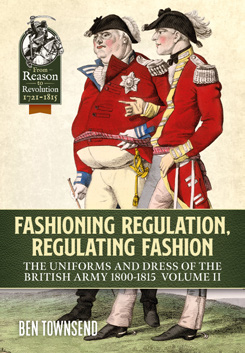
In 1975, the British historian Hew Strachan published a book titled British Military Uniforms, 1768-96: The Dress of the British Army from Official Sources. This was an attempt to assemble all the official orders on the dress of the army between the clothing warrants of 1768 and 1796, as extracted from official records and illustrated by contemporary art. Strachan’s work quickly became a standard reference and, although he apparently “intended to produce similar volumes to continue the story,” he only published this one.
There were many who regretted the lack of a follow-up volume. Among them was Ben Townsend, a British writer and historical consultant to radio, television and film who decided to take up the demanding task of continuing Strachan’s work. The result is Fashioning Regulation, Regulating Fashion, which examines the dress of the British army from 1800 to 1815.
This is a very difficult book to review because there is so much in it. Townsend’s object was to incorporate the considerable amount of new material available on the internet into a study that would detail what the soldiers were required to wear, when and how, and then contrast that with specific images and other information that is dateable and well provenanced to show what soldiers actually wore, and how and why it was adapted, with an emphasis on fashion as much as utility.
In this he succeeds admirably. Townsend first outlines how uniform regulations are created and then discusses the Boards of General Officers – the main bureaucratic instrument that devised them. Over the course of the two volumes he examines the regulations from 1799 to 1816.
Wellington disliked seeing his officers carrying umbrellas in battle
This in itself would warrant the entrance price but it is only the beginning. Using a variety of sources – images, memoirs and, above all, regimental orders – he then demonstrates how uniform regulations were modified and how they evolved. Changes might be driven by regimental peccadillos, civilian fashion or even military fads from the continent, particularly the affectations of hussar and rifle/light infantry regiments.
Townsend describes these military “fashions” or fads in detail with excerpts from period memoirs and correspondence. Let me stress that the author not only provides the official regulations, he includes rare and interesting memoirs that contain details of uniforms, and he includes the notes of previous researchers in the field. Thus, there are either complete monographs or lengthy excerpts from such writers as Alexander Cavalie Mercer, Rees Howell Gronow, David Roberts, John Luard and one anonymous but informative cavalry officer. Townsend has also scoured non-military memoirs and letters for any mention of the details of a uniform and, finally, has amassed an impressive collection of images.
The two volumes contain 37 colour plates and 91 black and white illustrations, almost all from the period. The work of artists such as Atkinson, Beechey, Dighton, Hamilton Smith, Loftie, Pyne and Rowlandson is on display as well as drawings of patterns and photographs of actual items of clothing.
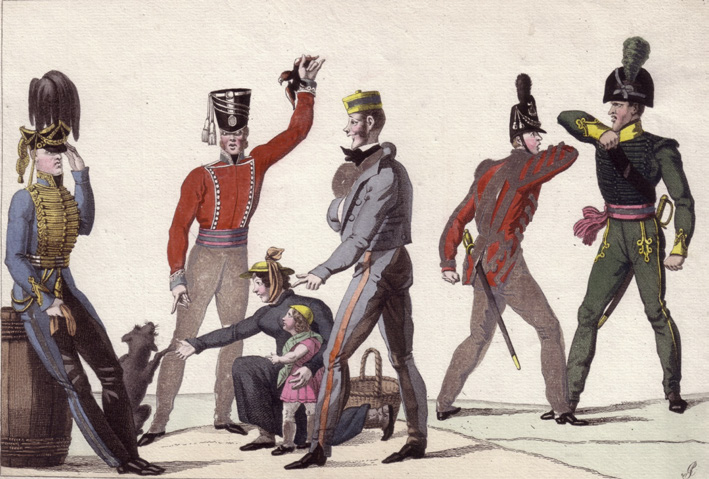
Among the most interesting images are those of French artists who painted the British occupation army in Paris in 1815. They captured (and caricatured) the high point of British military faddism: the dress of the officers of the Peninsular army. Townsend calls them “Wellington’s Dandies.”
Wellington never concerned himself with what his officers wore (although he disliked seeing them carry umbrellas in battle) and the result was that an amazing variety of dress flourished.
The Peninsular officers disdained the regulation headgear for a round hat or a cocked hat severely cut down to the width of a hand but adorned with the biggest feather available. Forage caps were in all shapes and colours, some resembling a pork pie hat, some a wedge cap, and some a scholar’s mortarboard – all often trimmed with velvet and festooned with tassels.
trimmed with velvet and festooned with tassels
Vests were brocade, usually embroidered and closed with gold or silver buttons. Overalls, strapped with leather along the inseams or cuffs, fastened on the outseams with large buttons and held under the instep with chains, were also popular.
A favoured outer garment was a surtout (“overall”), a bulky garment resembling a dressing gown, tailored from heavy material, decorated with braid and available in a variety of colours. The ensemble was often completed by a Spanish “seegar” in the officer’s mouth.
The appearance of Wellington’s officers was so amazing, one quipped, that the only thing their outlandish dress lacked was “the Appendage of Bells.”
The one criticism I have of this book concerns the lay-out: it is sometimes hard to distinguish the author’s text from the lengthy quoted material. However, I do not think many will read this book cover-to-cover, as it is intended to be a comprehensive reference.
Townsend’s work fulfills that role splendidly, and I think Fashioning Regulation, Regulating Fashion will become the standard reference on its subject. It belongs on or near the desk of anyone with a professional interest in the British army of the Napoleonic period. Highly recommended.

When regiments of Wellington’s army were sent to Canada in the summer of 1814, their officers’ appearance shocked Lieutenant-General Sir George Prevost, the local commander. He immediately issued an order stating that, having “observed in the Dress of several officers of Corps and Detachments lately added to this army, from that of the Duke of Wellington, a fanciful variety inconsistent with the Rules of the Service,” he wanted changes made. In the future, therefore, he would “only permit such derivation from the regulations … as may be justified by particular causes of Service, and climate, and even then uniformity is to be retained.” As one of the Peninsular veterans lamented, it was back to “the old red rag.”
Portrait is Sir George Prevost (1767-1816), by Robert Field 1808-1816, oil on canvas (90½” x 66½”) courtesy McCord Museum M403
Original printed pages